


From left, Prof Godwell Nhamo, team leader and Acting Head of the Institute for Sustainability and Corporate Citizenship at Unisa; Dr Thelma Louw, Director: Sustainability, Monitoring and Evaluation at Unisa; Ruben Saul, Director of Community Services at Matzikama Local Municipality; Mayor Johan van der Hoven, Matzikama Local Municipality; Motale Nkgoang: Unisa Western Cape Regional Director; Deoné Wessels, Manager of Strategic Services at Matzikama Local Municipality; and Councillor Cecil le Fleur
Unisa, in partnership with Matzikama Local Municipality in the Western Cape, hosted a successful two-day workshop in Vredendal, Matzikama, on 8 and 9 April 2026.
The workshop deliberated on strengthening collaboration and advancing a co-designed and co-delivered research and engaged scholarship agenda focused on building a smart and resilient Matzikama. The workshop also marked the launch of the Matzikama Local Municipality as one of the All-Atlantic Ocean Research and Innovation Alliance (AAORIA) Beacon Network Sites.
The workshop, which attracted over 100 participants, was opened by Ruben Saul, Director of Community Development Services at Matzikama Local Municipality. Motale Nkgoang, Unisa Western Cape Regional Director, gave a presentation highlighting Unisa’s mandates, including student support services. He emphasised that Unisa was an active partner working with municipalities and communities to address local needs. He further noted Unisa’s focus on the ten catalytic niche areas, including marine studies, the 4IR and digitalisation, and student support and co-curriculum. He concluded by encouraging stronger collaboration between the university, local government and communities to drive meaningful development.
Prof Godwell Nhamo, team leader and Acting Head of the Institute for Sustainability and Corporate Citizenship at Unisa, presented the background and objectives of the workshop. He highlighted the importance of community-led research and collaboration. He further outlined Unisa’s research strengths and long-term commitment to the Matzikama Municipality.
Nhamo explained that Unisa has strong expertise across multiple fields, including maritime studies, coastal development, energy, food security, technology and municipal management, all of which can be aligned with local needs. Nhamo highlighted the importance of "citizen science", a model where local communities actively contribute to research by sharing real-time data and observations, as well as other information at their disposal. This, he noted, ensures that research remains grounded in lived realities rather than distant academic analysis.
The workshop brought together stakeholders from government, local municipalities and various sectors, creating a platform for inclusive dialogue. As part of information sharing, various presentations were made by Deoné Wessels, Manager: Strategic Services, Matzikama Local Municipality, Kobus Steenkamp, Chief Executive Officer: Lower Olifants River Water Users Association (LORWUA), Councillor Cecil le Fleur, Griekwa Community representative, Philile Mvula from the Sustainable Ocean Modelling Initiative (SOMISANA), Lutendo Musetsho of the Department of Forestry, Fisheries and the Environment (DFFE), Fabian Mohammed, small-scale fishing communities representative, Hahn Goliath from Abalobi, and Katrien Visser of the Kliprand Farmers Association.
During the engagements, participants identified key areas of concern that Unisa could engage in through research and engaged scholarship. The Unisa team played a passive role, facilitating and listening to understand local challenges, and presenting a collaborative, solutions-oriented approach to improve livelihoods.

Unisa-Matzikama Local Municipality MoU Launch attendees
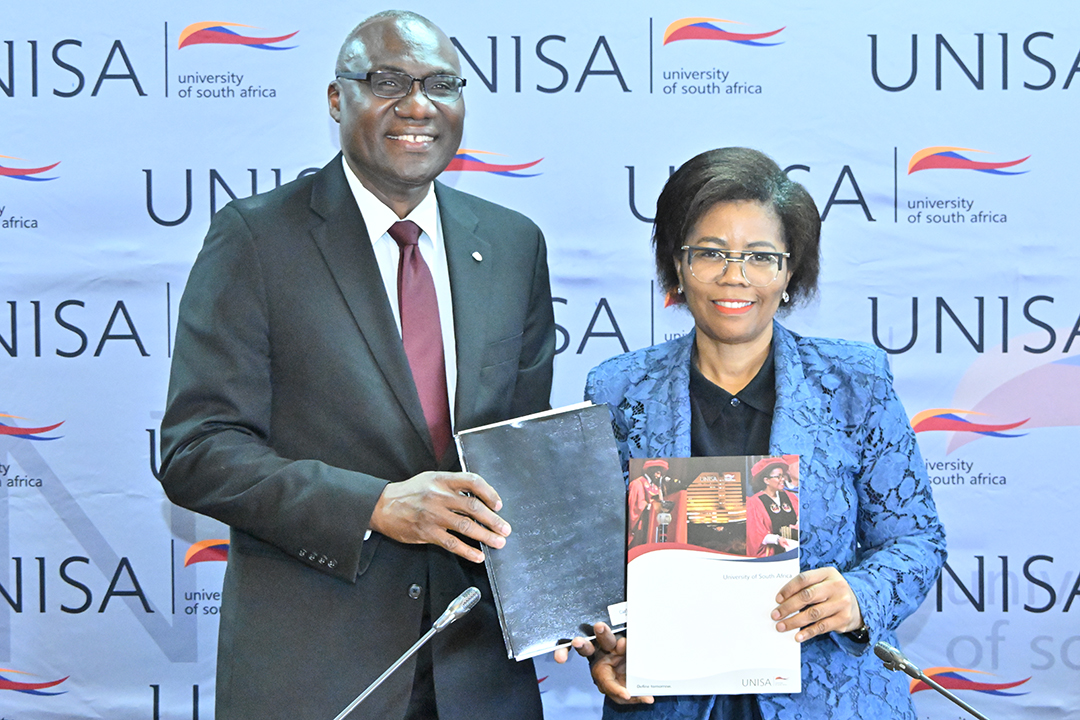
A significant milestone was reached on the second day, with the official launch of the Unisa-Matzikama Local Municipality Collaboration Partnership memorandum of understanding (MoU). Activities included an overview of the MoU by Prof Kevin Mearns from Unisa. Several messages of support were also conveyed. These included presentations by Lionel Phillips, the Acting Municipal Manager of Matzikama Local Municipality. Phillips expressed gratitude and strong support for the partnership. Other messages were received from Councillor Andreas Sindyamba, the Matzikama Council Chief Whip, Dr Gilbert Siko from the Department of Science, Technology and Innovation (DSTI), the South African Environmental Observation Network (SAEON), represented by Thomas Mtontsi, and ICLEI representative Dylan Beukes.
The Unisa team highlighted future initiatives for collaborative implementation with Matzikama. These included a presentation by Prof Noluntu Mpekoa on the growing importance of cybersecurity in local government, and another by Olubunmi Afinowi, introducing the concept of the South African Coastal Resilience Policy Living Lab (SA-CORLAB). Busisiwe Mabuse gave a brief overview of engaged scholarship, in which universities partner with communities to ensure research has practical impacts and real development outcomes. Lastly, Dr Nompe Ntombela gave a presentation on how Matzikama Local Municipality could draw lessons from Unisa’s United Nations Global Compact (UNGC) reporting to enrich its voluntary local review.
Delegates also participated in guided visits to identified research sites across Matzikama, namely Papendorp, Strandfontein and Doringbaai. These site visits provided practical insights into local challenges and opportunities, reinforcing the importance of place-based research and community engagement.
All parties walked away enriched with information and a clear way forward to making smart, resilient municipal practices a reality.
* Submitted by Thandeka Mtyali, Intern: Communication and Marketing, Western Cape Region
Publish date: 2026-05-08 00:00:00.0

 Prof LenkaBula calls for action on public service ills as 25th SAAPAM Conference opens
 Reimagining justice through Unisa's engaged scholarship
 Unisa geographer elected Fellow of the Society of South African Geographers
 Unisa raises over R10 million at gala dinner to tackle student debt
 Unisa and Carleton University formalise partnership to expand academic collaboration