
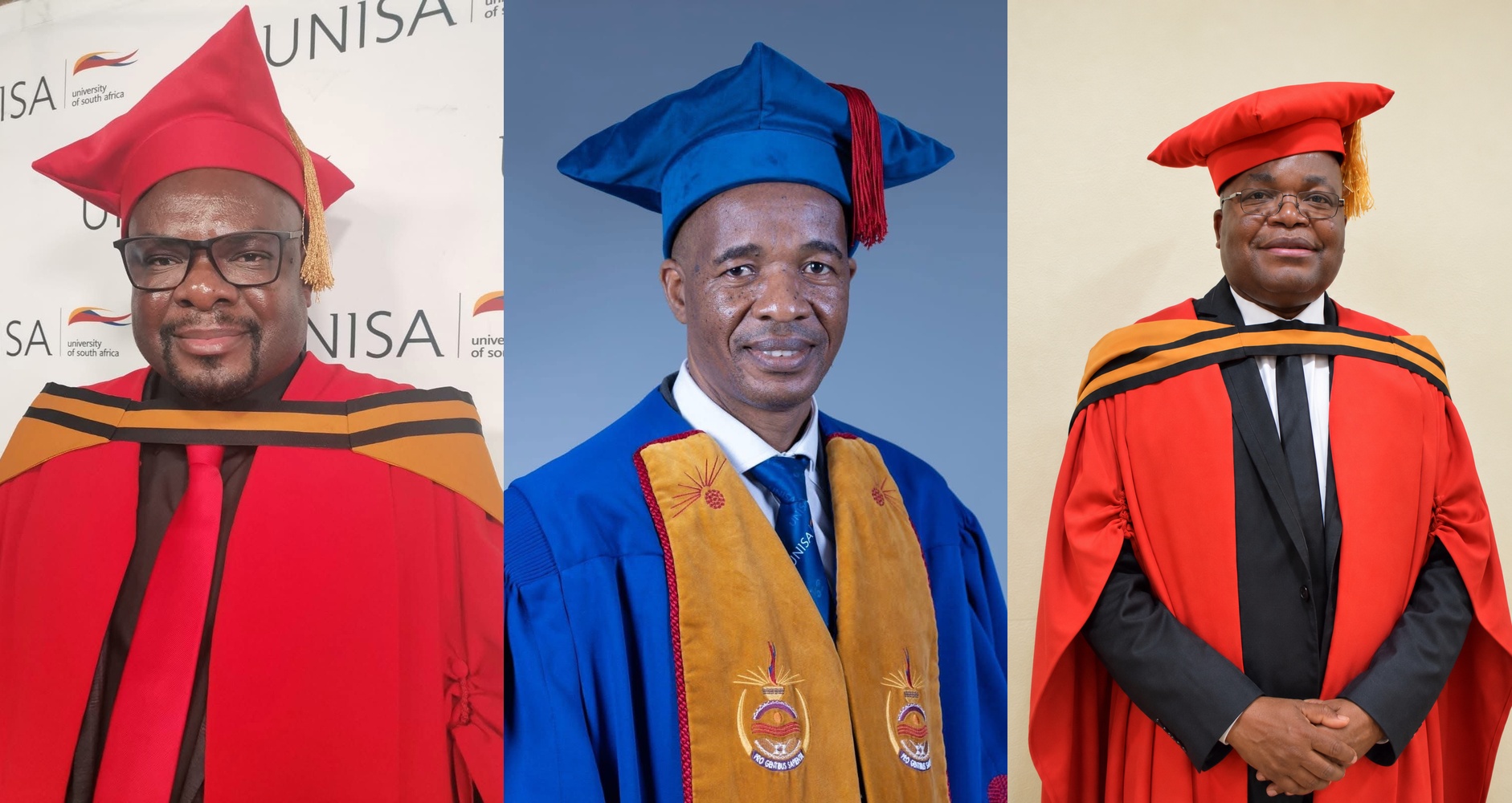
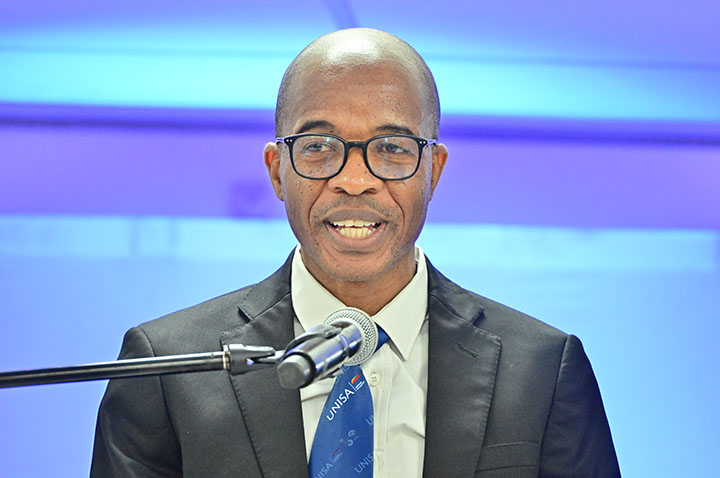
From left: Prof Ngoako Marutha, Prof Mpho Ngoepe and Prof Patrick Ngulube.
The University of South Africa (Unisa) has recorded the highest institutional research output in a global study of records management scholarship, highlighting the university’s growing contribution to a field that is becoming increasingly important in the digital age.
The finding comes from the study, "The Global Trends of Research on Records Management: A Bibliometric Analysis", published in the Record and Library Journal. Researchers analysed 1 100 Scopus-indexed publications on records management published between 1949 and 2024.
Among institutions with at least five publications, Unisa ranked first with 36 publications. Of these, 33 had received citations, generating a total of 232 citations. The university recorded an h-index of 8 and a g-index of 13.
The results place Unisa at the forefront of international scholarship in a discipline that underpins effective information governance, accountability and the preservation of institutional knowledge.
Read the full study: Global Trends of Research on Records Management: A Bibliometric Analysis
Unisa's institutional performance is reinforced by the contribution of several scholars who feature prominently among the study’s most prolific authors.
Prof Mpho Ngoepe, Vice-Principal: Teaching and Learning at Unisa, recorded 10 publications and 95 citations. All 10 publications had been cited, resulting in an h-index of 7 and a g-index of 9. The study identifies him as one of the leading contributors to records management scholarship from an African perspective.
Prof Patrick Ngulube, a professor at Unisa Interdisciplinary Research, recorded eight publications and 97 citations, with an h-index of 6 and a g-index of 8.
Prof Ngoako Marutha, from the Department of Information Science, contributed seven publications and received 30 citations, recording an h-index of 4 and a g-index of 5.
The presence of three Unisa academics among the study's leading contributors underscores the depth and continuity of the university's research in records management.
The achievement also aligns with Unisa’s Fourth Industrial Revolution and Digitalisation catalytic niche area, where research is focused on understanding and responding to the opportunities and challenges created by rapid technological change.
Records management has evolved significantly beyond the traditional storage and retrieval of paper documents. Organisations increasingly have to manage electronic records and address issues including artificial intelligence, blockchain, cybersecurity, privacy, information governance and the long-term preservation of digital information.
As governments, universities, businesses and other institutions move more of their operations online, the ability to create, manage, preserve and retrieve trustworthy records has become essential.
Digital records must remain authentic, accessible, secure and usable over time. Effective records management therefore plays an important role in supporting transparency and accountability, protecting information and ensuring that organisations retain an accurate institutional memory.
For Unisa, the global recognition of its research output reflects more than the number of publications produced. It points to the university’s contribution to addressing one of the defining challenges of the digital era: how to preserve reliable evidence and institutional knowledge in an increasingly complex information environment.
The findings further position Unisa scholars to contribute to international debates on how records management should evolve as emerging technologies reshape the way information is created, stored, accessed and preserved.
* By Itumeleng Mpete, Marketing Coordinator, Library and Information Services
Publish date: 2026-09-09 00:00:00.0

 Unisa symposium puts aviation at the centre of Africa’s economic growth
 Unisa leads global records management research output
 Unisa strengthens ties with Border Kei business community
 Prof Ngoepe brings decades of knowledge and leadership to new Unisa role
 Unisa women leaders challenge the meaning of power, equity and legacy