
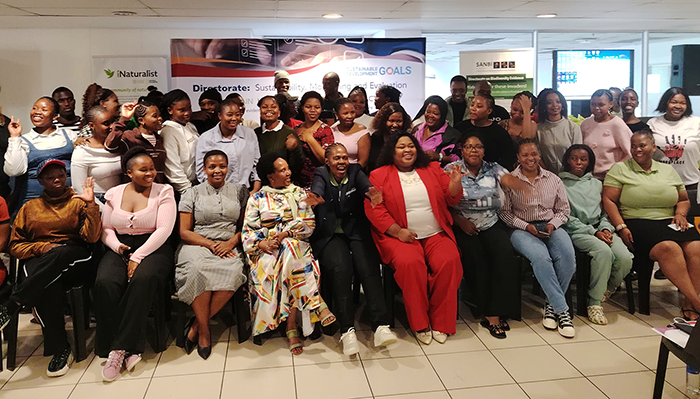
Attendees and presenters at the event
On 25 June, the University of South Africa (Unisa), through its Sustainability Office, joined forces with the South African National Biodiversity Institute (SANBI) KwaZulu-Natal (KZN) Region to host a hybrid Youth Month commemoration at the new Unisa building in Durban. Under the theme, "Youth, Biodiversity and Sustainable Futures: From Awareness to Action", students, scientists, municipal officials and conservation practitioners came together to mark the conclusion of Youth Month.
The event positioned Unisa students as active participants in conversations about sustainability, reflecting the institution's commitment to the Council on Higher Education's Good Practice Guide, which calls on universities to involve students meaningfully in institutional processes and decision-making. The proceedings addressed the alignment of the Sustainability Operational Plan with five Sustainable Development Goals: Goal 4 (Quality Education), Goal 5 (Gender Equality), Goal 6 (Clean Water and Sanitation), Goal 13 (Climate Action), and Goal 17 (Partnerships for the Goals).
Dr Joyce Myeza, Director of the Unisa KZN Region, opened the day by emphasising the importance of partnerships between higher education and environmental organisations in developing future sustainability leaders. Prof Lumkile Lalendle, Executive Director of the Department of Quality Assurance and Enhancement, reinforced the university's commitment to integrating sustainability into teaching, learning and institutional practice.
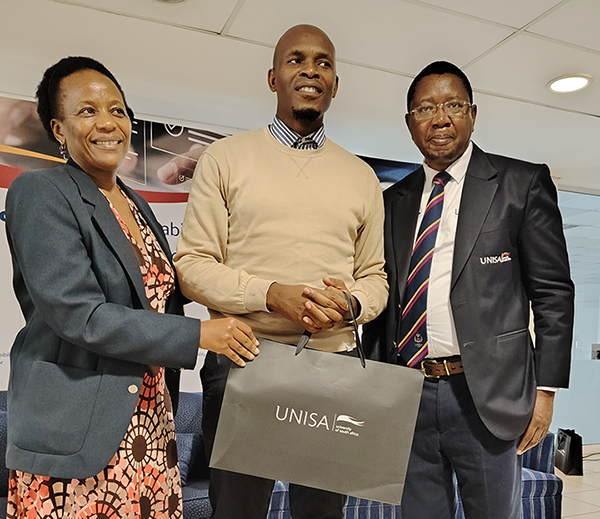
From left: Dr Joyce Myeza, Regional Director KwaZulu-Natal, Smiso Bhengu, Senior Climate Change Scientist at eThekwini Municipality, and Prof Lumkile Lalendle, Executive Director of the Department of Quality Assurance and Enhancement
The programme directors were Refiloe Tsephe, Quality Specialist and Project Leader in the Department of Quality Assurance and Enhancement (SEQASS), and Sanelisiwe Miya, Senior Technician for Science Collections at the SANBI KZN Herbarium.
The morning session showcased a range of voices working at the intersection of youth innovation and environmental stewardship. Joseph Nguthiru, founder of HyaPak and a UN Young Champion of the Earth, presented his work transforming invasive water hyacinth into biodegradable plastic alternatives, offering a tangible example of how environmental challenges can be converted into entrepreneurial solutions.
SANBI's Regional Coordinator for the KZN region, Futhi Shabalala, spoke on biodiversity and youth engagement, and Smiso Bhengu, Senior Climate Change Scientist at eThekwini Municipality, addressed the realities of climate change facing the region. He emphasised that the province has experienced a series of significant disasters over the past years, stating that "as KwaZulu-Natal, we have faced significant disasters over the past five to ten years. These challenges have extended beyond natural disasters to include the Covid-19 pandemic, civil unrest and devastating floods."
Collectively, these events have had a profound impact on the city, placing immense pressure on our finances and disrupting the implementation of critical development projects". Bhengu's remarks underscored the urgent need to strengthen climate resilience, improve disaster risk management and sustainable planning to reduce the impact of future disasters on communities and municipal development.
Zamani Gwala of Zimbali Eco Estate shared insights into wetland, wildlife and biodiversity management, highlighting the importance of protecting natural ecosystems while creating sustainable growth opportunities. He encouraged attendees to take initiative in their careers, noting that success often comes to those who are proactive and willing to create their own chances. He said, "You need to learn how to be proactive, especially in your career line, and create your own choices and your own chances, expand your career beyond what you are doing".
Nomfundo Ngidi, WESSA's Schools and Youth Project Coordinator, led a discussion on youth agency in environmental action, encouraging young people to see themselves as active contributors to sustainable change. She highlighted the importance of using their skills and ideas to make a positive impact in their communities while continuing their studies. She said: "The whole presentation is to introduce you to the things you can do while still studying to make a better impact, not only environmentally but also in your communities when it comes to economic issues. WESSA tries to involve youth in environmental initiatives that will uplift them into becoming their own entrepreneurs and not rely on finding jobs in the public sector."
Ngidi highlighted WESSA's commitment to youth-led environmental initiatives that build leadership, innovation and entrepreneurial thinking while addressing social and economic challenges in communities. Each presentation was followed by a short question-and-answer exchange, allowing attendees to engage directly with the speakers.
A highlight was the presentation by Unisa student Ntokozo Zulu on "Sustainability through the eyes of the Unisa Student: Student Roadmap to Sustainability". She offered a student perspective on the institution's sustainability journey.
After the mid-morning tea break, Thabiso Cele, Senior Technician at SANBI's KZN Region, discussed early detection and rapid-response strategies for emerging weed invasions, reinforcing the practical, science-based thread running through the day.
The second half of the morning shifted from presentations to participation. In a Youth Realities Mapping group activity led by Sane Miya and Nomi Mnotoza, Unisa's Sustainability Coordinator, students worked through real-world themes including invasive species, climate change, wetland and biodiversity conservation, water security, youth agency and entrepreneurship.
This fed into a group feedback session facilitated by Tsephe and Thabiso Cele, followed by a solution co-creation session led by Miya and Tsephe, in which students worked collaboratively on practical responses to the identified challenges. A further group feedback session, led by Mnotoza and Cele, gave participants the chance to share their proposed solutions before the morning's group work culminated in a sustainability pledge wall and a group photograph.
During the afternoon session, para-ecologist Samkelo Moloi of SANBI's KZN Region led a career pathways discussion, exploring opportunities for young people in the fields of biodiversity and conservation. Fellow para-ecologist Zethembe Ntombela then hosted an interactive quiz, adding an element of friendly competition to reinforce the day's learning.
The programme ended with participant reflections facilitated by Tsephe, and closing remarks by Siyabonga Seme, Communications Manager at the Unisa KZN Region. A networking session gave students, staff and partner organisations a final opportunity to connect before departing.
Throughout the day, the partnership between Unisa and SANBI's KZN Region was evident not only in the shared programme leadership but in the breadth of voices brought together from government and municipal science to private conservation estates, to youth-led entrepreneurship and the students themselves. By closing Youth Month with a hybrid platform built around dialogue, group problem-solving and a public pledge wall, the event translated the month's broader theme of youth empowerment into a concrete, sustainability-focused programme for action.
The event reflects Unisa's ongoing efforts, through its Sustainability Office, to embed the Sustainable Development Goals and the CHE's Good Practice Guide into lived institutional practice, ensuring that students are not only educated about sustainability but are actively shaping the university's response to it.
* By Anneline Johns and Zama Khanyile, Communication Interns, KwaZulu-Natal Region
Publish date: 2026-07-06 00:00:00.0

 From preserving knowledge to shaping the future: Unisa Press and LIS mark 150 years of collective impact
 Supporting success: How Unisa's PRG helped Babalwa Ramncwana take the next step in her academic journey
 Wisdom that connects generations: Unisa celebrates its senior citizens
 From e-Tutor to Adjunct Academic: Lerato Letsoalo’s journey into academia at Unisa
 NASDEV Conference celebrates women's leadership and calls for ethical, equitable institutions