
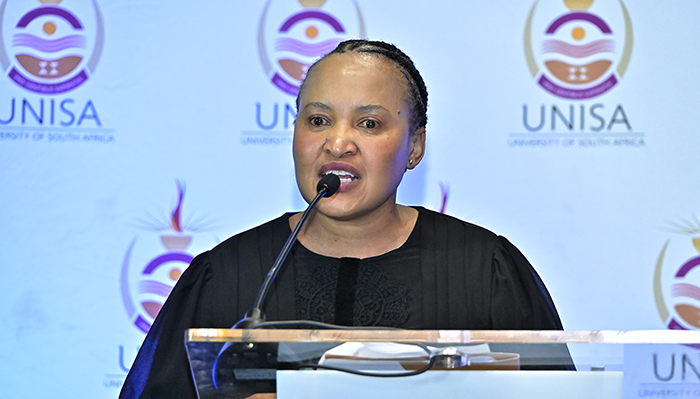
South Africa's Tax Ombud, Yanga Mputa, addressing delegates
Sound governance, effective regulation, ethical leadership and public trust are fundamental to building resilient institutions capable of serving society with integrity and accountability. This was the central message delivered by South Africa's Tax Ombud, Yanga Mputa, during the second day of the Principal and Vice-Chancellor's Summit on 3 July 2026.
Delivering her address, Mputa, South Africa’s first female Tax Ombud, drew from her extensive experience in public administration and challenged delegates to reflect on the principles that sustain credible public institutions. She argued that while governance frameworks and regulatory systems are essential, they are meaningful only when underpinned by ethical leadership, accountability and the confidence of the people institutions are established to serve.
Prof Puleng LenkaBula, Unisa Principal and Vice-Chancellor, introduced Mputa, describing her as a distinguished leader with more than two decades of experience in tax administration and public governance. Her career at the South African Revenue Service commenced in 1999, and she has since established herself as a respected authority in tax administration. She also serves as a board member of the African Tax Administration Forum and contributes to the organisation's Women in Tax Network, advancing collaboration and leadership across the African continent.
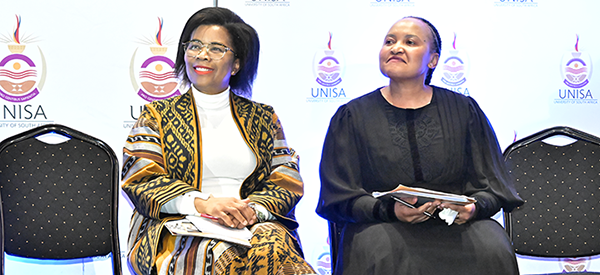
Prof Puleng LenkaBula, Unisa Principal and Vice-Chancellor, and Yanga Mputa, South Africa's Tax Ombud
At the heart of her presentation was the proposition that public trust is not claimed by institutions but earned through consistent ethical conduct, transparency and responsible decision-making. She urged leaders to evaluate whether their institutions inspire confidence by demonstrating integrity in every aspect of governance.
Mputa emphasised that effective governance begins with clearly defined responsibilities and accountability. Institutions, she said, should establish clear lines of authority and decision-making while ensuring that responsibility accompanies authority at every level. Although operational responsibilities may be delegated, accountability ultimately remains with those entrusted to lead.
She further highlighted the importance of independent oversight as a cornerstone of institutional credibility. Rather than viewing oversight mechanisms as obstacles to leadership, institutions should embrace them as valuable partners that identify risks, strengthen governance and reinforce public confidence. Independent oversight, she argued, contributes to transparency and ensures that institutions remain accountable to the communities they serve.
Reflecting on the higher education sector, Mputa observed that universities occupy a unique position as custodians of public trust. Although they operate within distinct legislative frameworks, they receive substantial public resources and therefore have an enduring responsibility to manage them ethically, transparently and in the public interest. Strong governance, she noted, is essential to preserving institutional legitimacy and ensuring long-term sustainability.
She cautioned against equating stronger governance with expanding bureaucracy. Creating additional committees, administrative layers or compliance processes does not, in itself, improve governance. Instead, institutions should focus on strengthening leadership, clarifying responsibilities and fostering a culture in which accountability is embraced throughout the organisation.
Mputa also underscored the importance of empowering leaders at every level of an institution. Effective middle managers, she said, are not merely administrators but leaders who make decisions, develop teams, address challenges proactively and accept responsibility for outcomes. Building such leadership capacity contributes to resilient institutions capable of adapting to an evolving higher education landscape.
Concluding her address, Mputa reminded delegates that institutions build enduring reputations through integrity, ethical leadership and accountability rather than through elaborate governance structures alone. Public trust, she said, remains an institution's most valuable asset and must be nurtured continuously through transparent leadership, responsible stewardship and an unwavering commitment to serving the public interest.
The Tax Ombud’s presentation reinforced the summit's broader focus on shaping future-ready institutions guided by sound governance, ethical leadership and a shared commitment to advancing excellence in higher education.
"Governance is important," said Dr Genevieve James, the Deputy Director of Engaged Scholarship at Unisa, who spoke next. She emphasised that universities must move beyond simply claiming to serve the public good and instead demonstrate measurable social impact through their teaching, research, innovation and partnerships.
James challenged higher education institutions to critically reflect on the gap between their aspirations and their societal impact. While universities often claim to develop critical citizens, stimulate economic growth, advance sustainability and contribute to the public good, these claims, she argued, must be continuously tested against the realities experienced by society.
"We must constantly reflect on the critical tension between what we claim and what is the actual reality," James said, urging institutions to interrogate whether the knowledge they produce genuinely reaches policymakers, communities, practitioners and those responsible for allocating public resources.
She questioned whether valuable research remains confined to academic journals and disciplinary silos, rather than informing public policy and addressing societal challenges. “If knowledge intended for the public good remains inaccessible to the people it is meant to serve,” she cautioned, “it risks becoming private benefit disguised as public good.”
James further argued that universities have a responsibility to ensure that the voices of communities, particularly those historically marginalised, are recognised as legitimate contributors to knowledge creation. Community members should not merely be recipients of university knowledge but active participants whose lived experiences and indigenous knowledge systems enrich teaching, learning and research.
Concluding her address, she thanked the university's leadership for embedding engaged scholarship into Unisa's mission, strategy and institutional culture. She described every member of the university community as an agent of change with a shared responsibility to ensure that knowledge is mobilised not for its own sake, but to improve lives, strengthen communities and advance the public good.
Read also:
Summit set to propel Unisa towards enhanced local and global performance
Unisa's leadership outline how resolutions are translated into measurable progress
* By Lesego Chiloane, Journalist, Department of Institutional Advancement
** Photography by Shooheima Champion, Multimedia Centre
Publish date: 2026-07-06 00:00:00.0

 From preserving knowledge to shaping the future: Unisa Press and LIS mark 150 years of collective impact
 Supporting success: How Unisa's PRG helped Babalwa Ramncwana take the next step in her academic journey
 Wisdom that connects generations: Unisa celebrates its senior citizens
 From e-Tutor to Adjunct Academic: Lerato Letsoalo’s journey into academia at Unisa
 NASDEV Conference celebrates women's leadership and calls for ethical, equitable institutions