

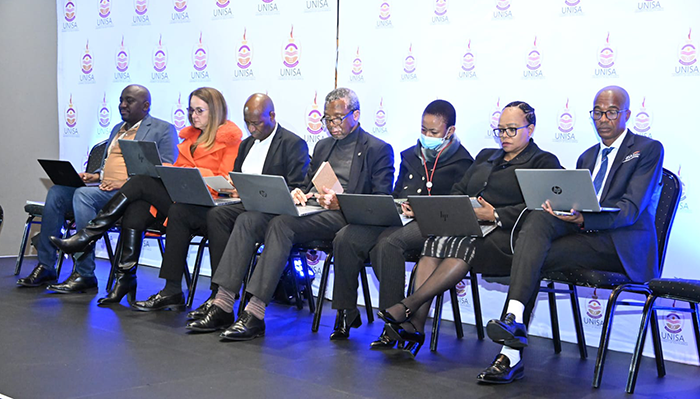
Portfolio heads during presentations
During the proceedings on the first day of the Principal and Vice-Chancellor's Summit, Unisa’s portfolio heads presented their implementation progress against February 2026 Lekgotla recommendations, reflecting on progress, institutional performance, strengthening accountability and accelerating the implementation of strategic priorities.
Through evidence-based presentations, portfolio heads demonstrated how collaborative leadership, digital transformation and strengthened governance are advancing the university's long-term strategic agenda.
A university governance expert, Morailane Morailane, who guided the proceedings, reminded delegates that the insights shared during the cybersecurity and artificial intelligence (AI) keynote should shape institutional thinking beyond the summit. Referring to the growing cyber threat landscape, he cautioned that digital risk is no longer a future concern but an immediate institutional responsibility. "Artificial intelligence is here to stay," he stated, urging delegates to embrace its opportunities while proactively managing its risks.
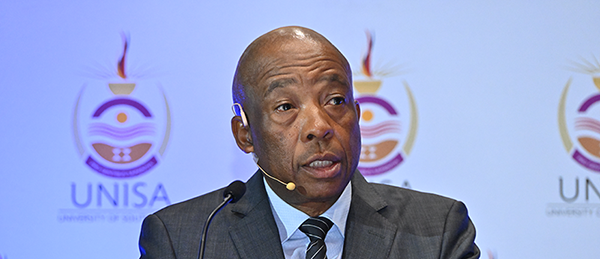
Morailane Morailane, a university governance expert, facilitated proceedings
Prof Moloko Sepota, Registrar, presented an overview of progress in strengthening student administration and institutional governance. Framing education as a transformative instrument for addressing inequality and social development, the presentation emphasised that widening access must be accompanied by student success, equity and comprehensive support services. Significant progress was reported in enrolment management, with the university moving steadily towards its registration targets while maintaining a total student population exceeding 414 000, including semester registrations.
Prof Solomon Magano, Vice-Principal of Institutional Development, highlighted the central role of people in achieving the university's strategic ambitions. He explained that the portfolio's mandate extends beyond human resource management to ensuring that institutional strategies are supported by capable, motivated and appropriately skilled employees.
In his reflections, Magano reported that leadership development initiatives are already underway, with targeted programmes designed to strengthen leadership capability across the institution. Particular attention is being given to supporting newly appointed academics through structured orientation and professional development initiatives to ensure they are effectively integrated into the university environment.
He further emphasised that staff development is increasingly informed by evidence-based needs analyses, ensuring that training interventions respond directly to institutional priorities rather than generic development programmes. Institutional Advancement also continues to strengthen the university's public profile, while Unisa Radio has recorded encouraging growth in listenership, further expanding the university's engagement with internal and external stakeholders.
Dr Matseliso Molapo, Acting Vice-Principal of Strategy, Risk and Advisory Services, reported considerable progress in strengthening integrated planning, governance and institutional performance management. She explained that the university has embedded strategic and operational risk management within its planning processes, ensuring that risks are systematically monitored through portfolio risk registers and institutional governance structures.
The portfolio has also reviewed several governance instruments, including institutional policies and the delegation of authority framework, to improve strategic alignment and organisational coherence. In addition, institutional dashboards continue to enhance evidence-based decision-making by providing real-time information on teaching and learning, research, planning and operational performance. These developments, Molapo noted, are reinforcing accountability while enabling the university to monitor progress against its strategic objectives more effectively.
Mathabo Nakene-Mginqi, Chief Information Officer and Vice-Principal of Information and Communication Technology, provided an update on the university's digital transformation agenda, reporting progress across several strategic priorities identified during the February Lekgotla. These include strengthening student information systems, improving cybersecurity, advancing AI governance, enhancing student query management and expanding digital skills development.
Nakene-Mginqi announced that preparations are well advanced for the launch of the Unisa Digital Academy, which will provide students and employees with internationally recognised digital skills training through partnerships with leading global technology companies. She further reported progress in strengthening cybersecurity controls, implementing smart campus initiatives and developing a new Student Information System designed to improve the overall student experience.
Recognising the increasing influence of AI in higher education, Nakene-Mginqi emphasised that the university is developing governance frameworks that promote responsible, ethical and secure adoption of emerging technologies while positioning Unisa to benefit from future advances in digital innovation, including quantum computing and intelligent automation.
Prof Mpho Ngoepe, Acting Vice-Principal: Research, Postgraduate Studies, Innovation and Commercialisation, presented progress on strengthening research governance, postgraduate support and innovation. He explained that the portfolio had focused on addressing the root causes of challenges identified during the February 2026 Management Lekgotla, particularly those affecting research ethics, postgraduate supervision and research administration.
A key achievement has been the significant improvement in ethics clearance turnaround times. Through targeted interventions and closer collaboration with colleges, the average processing period has been reduced from 97 days to 37 days, with further measures being implemented to achieve a one-month turnaround for applications involving human participants and seven days for non-human participant studies. Ngoepe noted that these improvements are intended to accelerate postgraduate research while maintaining the highest ethical standards. He further said, Unisa recently obtained a Good Financial Grant Practice Certificate, reinforcing confidence in the university's grant management systems and enhancing its competitiveness for external research funding.
Matsiababa Motebele, Vice-Principal of Operations and Facilities, demonstrated how the portfolio is using evidence-based management to improve institutional operations and resource utilisation. He reported that the university is expanding the implementation of integrated digital systems to strengthen infrastructure planning, facilities management and operational efficiency across its campuses.
Motebele highlighted the full utilisation of the Archibus facilities management system, which now supports space management, preventative and corrective maintenance, fleet management and the tracking of movable assets. The system enables the university to optimise the use of its infrastructure, identify opportunities to commercialise underutilised spaces, and strengthen accountability through reliable institutional data.
He further outlined progress on Smart Campus initiatives, including the installation of smart water meters to enhance water consumption monitoring and promote environmental sustainability.
Liana Joubert, Deputy Registrar of Student Admission and System Integration, delivered an insightful presentation on the encouraging growth in institutional income and investment returns, demonstrating the effectiveness of the university's long-term investment strategy. Emphasis was placed on aligning budgets with institutional priorities, strengthening asset management, improving return on investment and ensuring that financial resources are directed towards initiatives that deliver measurable value to the university and its stakeholders.
Collectively, the portfolio presentations illustrated the university's determination to translate the resolutions of the earlier Lekgotla into measurable institutional progress.
Read also:
Summit set to propel Unisa towards enhanced local and global performance
* By Lesego Chiloane, Journalist, Department of Institutional Advancement
** Photography by Shooheima Champion, Multimedia Centre
Publish date: 2026-07-03 00:00:00.0

 From preserving knowledge to shaping the future: Unisa Press and LIS mark 150 years of collective impact
 Supporting success: How Unisa's PRG helped Babalwa Ramncwana take the next step in her academic journey
 Wisdom that connects generations: Unisa celebrates its senior citizens
 From e-Tutor to Adjunct Academic: Lerato Letsoalo’s journey into academia at Unisa
 NASDEV Conference celebrates women's leadership and calls for ethical, equitable institutions