
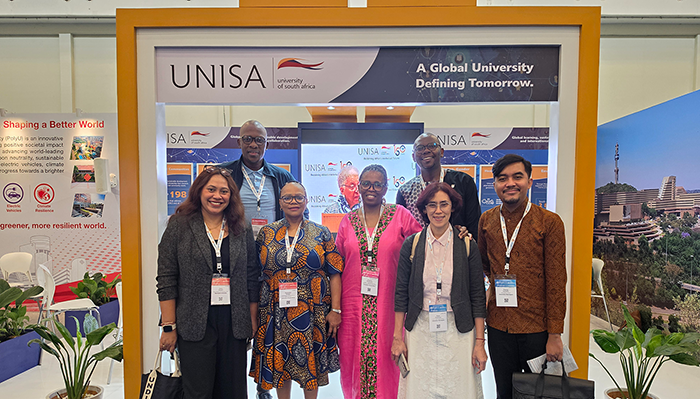
Unisa exhibition stand at the Times Higher Education Global Sustainable Development Congress in Jakarta
When thousands of higher education leaders, researchers, policymakers, industry experts and development partners gathered in Jakarta, Indonesia, for the 2026 Times Higher Education (THE) Global Sustainable Development Congress (GSDC) recently, the University of South Africa (Unisa) was not simply represented; it was among the institutions shaping the global conversation on the future of higher education and sustainable development.
Over four days, Unisa’s academics led university-hosted sessions and joined expert panels alongside colleagues from leading universities, development organisations and government institutions worldwide. Participating Unisa academics demonstrated how science is deployed to address humanity’s most pressing challenges. Their contributions reflected a university whose teaching, learning, research and development praxis extends well beyond academic publications to influence policy reform, deepen collaborative intelligence, preserve indigenous knowledge heritages and contribute meaningfully to the achievement of the United Nations’ Agenda 2030 - Sustainable Development Goals (SDGs).
Conversations extended far beyond the congress programme. Throughout the event, Unisa’s exhibition stand became one of the busiest engagement spaces, attracting more than 800 delegates interested in the university’s postgraduate programmes, research strengths, strategic partnerships and international collaboration opportunities. For many delegates, the discussions that began during the conference sessions continued at the stand, creating new opportunities to explore engaged and collaborative research, student mobility and institutional partnerships.
One of Unisa’s flagship sessions, Utilising engaged scholarship as collective action for a sustainable future, demonstrated how the higher education sector can create rich ecosystems to address the "wicked problems" of the world. In this session, three engaged scholarship projects were shared as examples of how academic departments can be hardwired for enhanced education and development outcomes.
Prof Liza van Jaarsveldt, from the Department of Public Administration and Management, presented Unisa’s engaged scholarship project on Gauteng’s West Rand. This project brought together researchers, municipalities, communities and industry to address the interconnected challenges facing mining communities, including water pollution, sinkholes, deteriorating infrastructure, declining municipal service delivery, unemployment and social vulnerability.
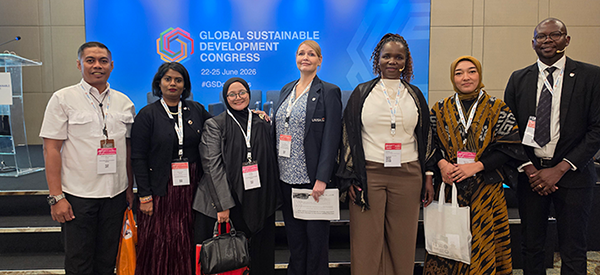
Unisa’s Dr Genevieve James, Prof Liza van Jaarsveldt, Prof Florence Malongane and Dr Napjadi Letsoale anchored by some of the session attendees from the Philippines
Using participatory action research, the project has generated postgraduate research, journal publications, policy support, municipal capacity-building and practical interventions that demonstrate how collaborative knowledge creation can produce measurable societal impact. "The project demonstrates that universities can serve as catalysts for sustainable, community-centred development through long-term partnerships and collaborative knowledge creation," Van Jaarsveldt explained.
Prof Florence Malongane, Senior Lecturer and Head of Academic Quality Assurance at the College of Agriculture and Environmental Sciences, presented engaged research showing that indigenous African foods offer affordable, climate-smart, culturally appropriate and nutritionally rich responses to the growing burden of malnutrition, micronutrient deficiencies and lifestyle diseases. Working collaboratively with communities, the Department of Life and Consumer Sciences and the Department of Computing adopt a dialogue-first approach that values existing community knowledge while creating opportunities for younger generations to reconnect with indigenous food systems. The initiative has already resulted in publications reaching thousands of readers through The Conversation, the filing of two intellectual property applications and the development of a model that can be scaled for broader impact.
Another important dimension of sustainable development focused on the preservation of indigenous languages and the knowledge they carry. Associate Professor Dr Napjadi Letsoalo, from the College of Human Sciences, demonstrated how language preservation contributes directly to sustainable development by strengthening education, cultural identity, social cohesion and community resilience. He argued that language loss represents far more than the disappearance of words. It also results in the loss of cultural memory, indigenous scientific understanding, oral traditions and community knowledge that have sustained generations.
Drawing on Unisa-led initiatives such as multilingual proverb dictionaries, terminology development, digital storytelling, the Multilingual Spelling Bee, and the TsošaMoya Kids Project, Letsoalo illustrated how engaged scholarship simultaneously advances literacy, inclusion and cultural sustainability. "The experience reaffirmed my conviction that languages are knowledge ecosystems," he reflected. "Protecting and developing indigenous languages is not simply a cultural responsibility; it is collective action toward a more inclusive, equitable and sustainable future for all."
Panel moderator Dr Genevieve James, Deputy Director: Community Engagement and Outreach, explained that Unisa’s strategic preference for an engaged orientation to curriculation, research and action has turned this mega-university into a sustainability dynamo. Addressing delegates, James challenged universities to move beyond lip service and mere claims of "public good". "Universities cannot credibly speak about advancing the public good without intentionally designing the institutional systems required to produce it," she said, explaining that Unisa’s engaged scholarship model deliberately breaks down disciplinary, sectoral and territorial silos to create the knowledge convergence required to solve increasingly complex development challenges. She explained that "an engaged orientation to teaching, learning, research and development is a game changer in higher education, supercharging universities for enhanced social significance and development impact".
In addition to participating in the university-hosted session, James joined international experts in discussions on Smart Cities for a Sustainable Tomorrow, contributing to conversations on how universities, municipalities, technology partners and communities can co-create local solutions to improve life in urban contexts. She addressed the disequilibria and intra-urban divides that will be deepened by the unequal access and implementation of smart city technology. She called for addressing the widening AI regulatory gaps.
While these presentations demonstrated impact within communities, another university-hosted session highlighted how sustainability is embedded throughout the institution.
Presenting The value of embedding SDGs in university strategy: A focus on the past, present and future, Prof Ophillia Ledimo, Academic Director at the Graduate School of Business Leadership, outlined how Unisa’s ten Catalytic Niche Areas (CNAs) integrate teaching, research and engaged scholarship around Africa’s most pressing development priorities. Aligned with the National Development Plan and the United Nations Sustainable Development Goals, she noted that the focus areas are already delivering impact through initiatives including renewable energy research, biotechnology applications, drone technology, marine and environmental simulation, and aviation research, positioning Unisa to contribute sustainable, innovative solutions that benefit South Africa, the continent and the global community.
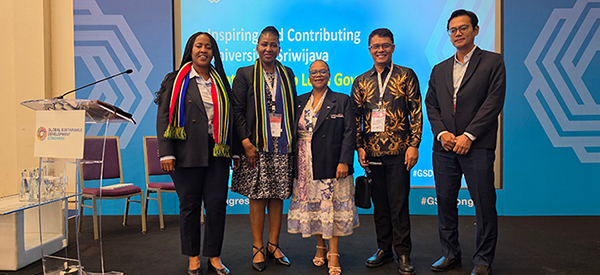
On the Global Sustainable Development Congress Country stage where Prof Edith Phaswana and Prof Ophillia Ledimo hosted their session. In support are Dr Matsheliso Molapo and session attendees
Building on this institutional perspective, Prof Edith Phaswana, Executive Dean of the Thabo Mbeki African School of Public and International Affairs, challenged delegates to rethink how African universities are evaluated globally.
Drawing on institutional performance data, she argued that Africa cannot achieve sustainable development while neglecting its own knowledge systems, skills and research capacity. She demonstrated how Unisa’s strategic focus on African development priorities naturally aligns with the SDGs, while highlighting the university’s growing international standing, including its recognition among the world’s leading universities, strong societal impact rankings, and leadership among open distance and e-learning institutions.
Most significantly, Phaswana challenged delegates to measure research not only by publication counts and citations, but also by the extent to which it transforms societies, informs policy and improves lives across the continent.
The future of higher education also featured prominently during the congress. Joining international panellists in the session Navigating the implementation of AI governance in academic institutions, Dr Nthabeleng Mmako, Senior Lecturer in Entrepreneurship, contributed practical perspectives on building inclusive and ethical AI governance frameworks for universities. She argued that institutions should avoid creating rigid governance structures that discourage innovation, instead recognising that universities are evolving from knowledge disseminators into facilitators of personalised learning.
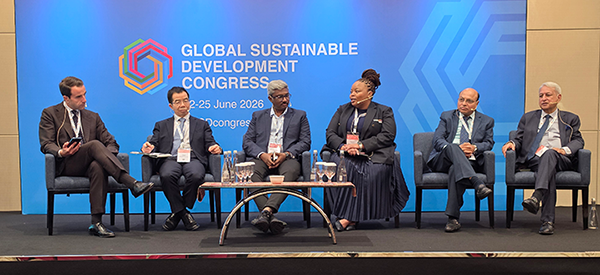
Unisa’s Prof Nthabeleng Mmako in the AI session with, from left, Alessandro Di Lullo, CEO: Digital Education Council (Moderator), Ronghuai Huang, Chair on AI in Education, UNESCO Beijing Normal University, Hemachandran Kannan, Director: AI Research Centre, Woxsen University, Prakash Sheelvanthmath, Pro Vice-Chancellor: Dayananada Sagar University, and Anoop Swarup, Secretary-General Association of Universities
"Universities are no longer delivering education; they are facilitating learning experiences," she said. "Our responsibility is to guide transparency, accountability, ethical use and lifelong learning."
Drawing on Unisa’s own experience, Mmako advocated for governance models built around local context, multidisciplinary participation, ongoing capacity development and continuous institutional learning. She also emphasised that responsible AI governance should not be viewed as a once-off policy exercise, but as an evolving institutional commitment that balances innovation with ethics, inclusion and accountability.
In Jakarta, Unisa did more than showcase research. It demonstrated the value of an African university whose scholarship is shaping policy, empowering communities, preserving knowledge systems and contributing evidence-based solutions to some of the world’s most urgent sustainability challenges. In doing so, the university strengthened its standing as a trusted global partner in building a more sustainable and equitable future.
Whether addressing food security, indigenous knowledge systems, community-engaged scholarship, institutional strategy, artificial intelligence or sustainable cities, Unisa scholars consistently demonstrated that African research is contributing practical solutions to global challenges while remaining firmly grounded in local realities.
* Submitted by Nolwazi Mwabi, Director: Communication, Marketing and Events, Department of Institutional Advancement
Publish date: 2026-07-06 00:00:00.0

 Astronomy lecture highlights Africa's role in advancing space science at Unisa
 Students take centre stage as Unisa hosts National Multilingual Student Debate
 Es'kia Mphahlele's legacy lives on as Unisa hosts 17th Annual Memorial Lecture
 From waste tyres to shoe polish: Unisa Professor turns waste into opportunity
 Beyond barriers: Dr Nozuko Langa's decade-long journey to a PhD