
Equipped with state-of-the-art laboratories that provide students with hands-on experiences to bridge theory and practice
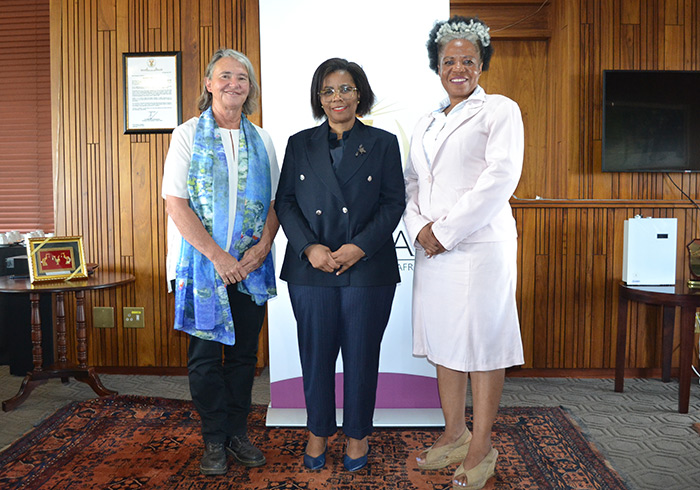
From left: Dr Anna Marais, Associate Dean at UNAM's School of Veterinary Medicine, Prof Puleng LenkaBula, Unisa Principal and Vice-Chancellor, and Dr Nomsa Msibi, President of the SAVC
Prof Puleng LenkaBula, Unisa Principal and Vice-Chancellor (VC), and the university’s executive and extended management team, recently hosted a meeting with delegates from the University of Namibia (UNAM) and the President of the South African Veterinary Council (SAVC).
The engagement, held on 25 March 2026 at Unisa’s Muckleneuk Campus, focused on enhancing Unisa’s agricultural and veterinary sciences through academic partnership with UNAM and strategic collaboration with SAVC.
The meeting explored the Unisa-UNAM partnership, through which South African Unisa students can receive training in veterinary science at UNAM. In addition, participants engaged in strategies to maximise Unisa’s use of its experimental farm for groundbreaking research and to foster Unisa’s future establishment of a dedicated School of Veterinary Science.
In 2024, Unisa and UNAM signed a memorandum of understanding at the Regional Universities Forum for Capacity Building in Agriculture Conference, outlining several key areas for collaboration between the two institutions. Unisa, through its College of Agriculture and Environmental Sciences, collaborates with UNAM’s School of Veterinary Medicine to strengthen one of Unisa’s catalytic niche areas, Biotechnological Studies.
With the SAVC, Unisa has a long-standing professional partnership that regulates the training and registration of para-veterinary professionals.
In her welcome address, the VC stressed the importance of the gathering, stating: "It is good for Southern Africa, and our partnership."
The VC noted Unisa’s progress in veterinary science. "Unisa has the largest number of animal geneticists in the country, and it is the first university in Africa to host a global animal genetics conference," she said.
LenkaBula further explained that Unisa owns an experimental farm, which allows the institution to combine veterinary science and veterinary hospital technologies to accelerate progress.
The VC reflected on the recent successful collaboration between Unisa and UNAM in advancing the Africa Millimetre Telescope Project.
Continuing, LenkaBula emphasised the importance of observing the principles outlined in the Africa Charter for Transformative Research Collaborations, ensuring reciprocity, equality and sustainability, and respecting Africa’s knowledge systems and innovations.
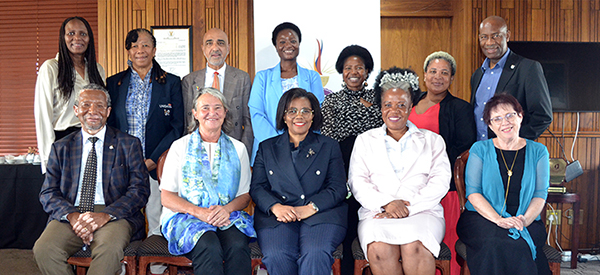
Seated, from left: Prof Solomon Magano, Vice-Principal: Institutional Development; Dr Anna Marais, Associate Dean at UNAM's School of Veterinary Medicine; Prof Puleng LenkaBula, Unisa Principal and Vice-Chancellor; Dr Nomsa Msibi, President of the SAVC; and Prof Erika Maas, UNAM Registrar.
Standing, from left: Yvonne Mathole, Directorate: Special Projects, Office of the Principal and Vice-Chancellor; Prof Madiopane Masenya, Executive Director in the Office of the Principal and Vice-Chancellor; Ambassador Prof Iqbal Jhazbhay of the VC’s Office; Prof Aluwani Maiwashe-Tagwi, Chair of the Department of Agriculture and Animal Science at Unisa; Prof Ntanganedzeni Mapholi, Acting Executive Director: College of Agriculture and Environmental Sciences; Tebogo Moemise, Deputy Director: Coordination and Liaison; and Prof Moloko Sepota, Unisa Registrar
The UNAM delegates, led by Dr Anna Marais, Associate Dean of UNAM’s School of Veterinary Medicine, applauded Unisa’s management for their active participation in ensuring a successful partnership, and for adhering to the relevant regulations, demonstrated by the SAVC’s approval and support.
Marais expressed that UNAM’s School of Veterinary Medicine offers a highly rated Bachelor of Veterinary Medicine programme, known for its hands-on training. It is accredited in South Africa and recognised by the SAVC, allowing South African graduates to practise in their country without needing to write board exams first.
UNAM has agreed to accept ten Unisa students for training in veterinary science. "This move will provide Unisa with young adult scholars when our implementation processes mature," the VC expressed.
Notably, there is only one institution of higher education in South Africa with a veterinary school, and Marais reaffirmed UNAM’s commitment to assisting Unisa in bridging the gap. "It is a real pleasure to be able to help Unisa to walk the path that UNAM has walked over the past ten years," she maintained.
Prof Ntanganedzeni Mapholi, Acting Executive Dean of the College of Agriculture and Environmental Sciences, asserted her college’s dedication to ensuring that Unisa has a significant impact in the agricultural sector, supporting the catalytic niche area Biotechnological Studies, and contributing to the National Development Plan.
Dr Nomsa Msibi, President of the SAVC, reiterated the council’s support for Unisa, noting that its letter of support to the university should help foster success in Unisa’s application to the Department of Higher Education and Training for relevant accreditations as the partnership with UNAM evolves.
* Article and photography by Victor Malatji, Journalist Intern, Department of Institutional Advancement
Publish date: 2026-03-26 00:00:00.0

 Three structures, one college: Unisa CHS takes a united approach to student leadership in KwaZulu-Natal
 A journey defined by research, resilience and impact
 Unisa's Political Sciences Department celebrates 80 years of shaping political thought
 Unisa symposium explores Africa's aviation future through innovation and collaboration
 Second Annual CNA Indaba signals a new phase of implementation at Unisa