


Dr AM Makola and Dr AC Tshivhase with ATNS Stakeholders
The University of South Africa (Unisa) is entering a new phase of its Catalytic Niche Areas (CNA) programme, with greater emphasis on turning strategic priorities into qualifications, research, partnerships and innovations that deliver measurable impact.
This was a central theme of the university’s Second Annual CNA Indaba, hosted by the Department of Academic Planning, on 15 July 2026. The event brought together executive leadership, academic colleges, support divisions and strategic partners to assess progress and shape the next phase of the CNA programme in support of Unisa Vision 2030.
Opening the Indaba, Dr Azwindini Christopher Tshivhase, Acting Vice-Principal: Teaching, Learning, Community Engagement and Student Support, said the university had established a strong strategic foundation for the CNA programme and must now focus on implementation.
"The next phase of the Catalytic Niche Areas programme is about delivery. Our success will ultimately be determined by our ability to translate strategy into qualifications, research, partnerships and innovation that create lasting value for our students and society."

Dr AC Tshivhase, Acting Vice-Principal: Teaching, Learning, Community Engagement and Student Support
He said the CNA programme is central to the university’s accountability to Council and the Department of Higher Education and Training (DHET), while also supporting Unisa Vision 2030 and the African Union’s Agenda 2063.
The Indaba provided an opportunity to assess the progress made since the launch of the CNA initiative.
New CNA-aligned qualifications are continuing to move through institutional governance and statutory approval processes, while interdisciplinary research, curriculum innovation, infrastructure planning and strategic partnerships are gaining momentum.
A significant milestone presented during the Indaba was that approximately 52% of Unisa’s recent research output is now aligned with the Catalytic Niche Areas. This demonstrates the growing integration of the CNA agenda across the university’s academic and research activities.
The Department of Academic Planning also showcased the continued development of institutional dashboards and monitoring tools aimed at strengthening governance, improving reporting and supporting evidence-based decision-making.
Prof Iqbal Jhazbhay, Executive Director: Office of the Principal and Vice-Chancellor, called for greater coordination of CNA-related initiatives across the university.
While acknowledging the significant work already under way, he said some initiatives remained fragmented and needed to be brought together as part of a coordinated institutional programme.
"Excellent work is taking place across the university, but much of it remains fragmented. Our challenge is to connect these initiatives into a single institutional programme that delivers collective impact."
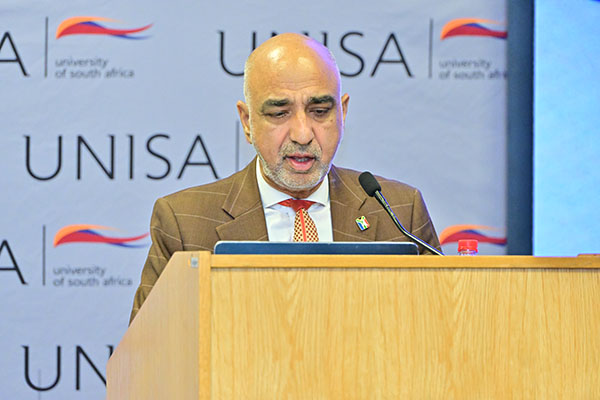
Prof Jhazbhay Office of the Vice Principal and Chancellor
Prof Jhazbhay highlighted stronger institutional coordination, clearer governance and accountability, integrated monitoring and reporting, and closer alignment between curriculum, research, infrastructure and innovation as key priorities.
He also emphasised the importance of stronger partnerships with industry and government.
The Executive Director further challenged the university to broaden how it measures the CNA programme's success.
"Our success cannot simply be measured by the number of qualifications we develop. It must be reflected in graduate employability, societal impact, innovation, partnerships and the contribution we make to Africa’s development."
The message places the focus firmly on the outcomes of the CNA programme and its ability to benefit students and graduates while contributing to broader social and economic development.
A key highlight of the Indaba was the first institutional presentation of a proposed operating model for implementing the CNA programme.
Developed by the Department of Academic Planning, the model was presented by Dr Madoda Makola, Acting Executive Director: Academic Planning.
The proposed model introduces a single institutional Programme of Work designed to coordinate qualifications, research, partnerships, infrastructure, innovation and student enablement across Unisa’s 10 Catalytic Niche Areas.
It proposes a portfolio-based implementation approach supported by integrated workstreams and strengthened governance structures, including an Institutional Programme Board, Portfolio Steering Committees and Delivery Task Teams.
The proposed structure is intended to improve institutional coordination, accountability and oversight while bringing together the work already taking place across different parts of the University.
"The proposed operating model is intended to provide a coordinated institutional framework that brings together the many excellent initiatives already taking place across the University, enabling them to be implemented as one integrated programme in support of Unisa’s strategic objectives," said Dr Makola.
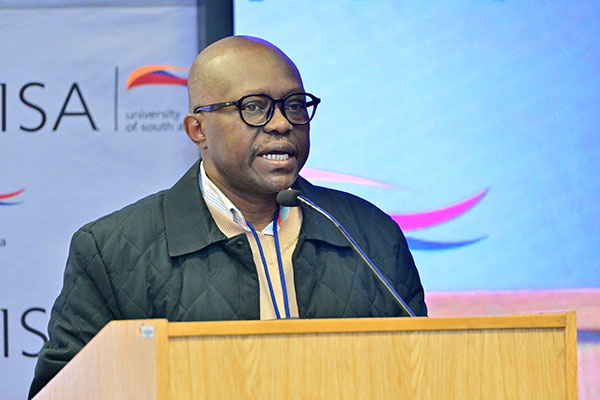
Dr AM Makola
The presentation provided delegates with an opportunity to consider the model and provide strategic input. Feedback from the Indaba will be incorporated into its refinement before it is shared more broadly across the University for further consultation.
The refined proposal will subsequently be submitted to the relevant Unisa statutory governance structures for consideration and approval before implementation.
Strategic partnerships featured prominently throughout the Indaba, with delegates highlighting the importance of collaboration between universities, industry, government and professional bodies in ensuring that qualifications remain relevant to changing skills needs.
The event also marked one year since the signing of the Memorandum of Understanding between Unisa and Air Traffic and Navigation Services (ATNS).
The anniversary provided an opportunity to reflect on the partnership’s contribution to teaching and learning, research, innovation and skills development within Unisa’s Aviation and Aeronautical Catalytic Niche Area.
The Unisa-ATNS partnership was highlighted as a practical example of the collaborative approach envisaged under the CNA programme. Such partnerships can strengthen curriculum relevance, support applied research and contribute to improved graduate employability.
Providing an update on qualification implementation, Bongani Ntuli, Project Coordinator in the Office of the Executive Director: Academic Planning, highlighted the role played by institutional Scrum sessions in accelerating qualification development.
The sessions have strengthened collaboration between academic colleges and support divisions, while improving accountability and coordination.
Several qualifications have progressed through institutional governance structures, with some submitted to DHET and others advancing towards CHE accreditation. Additional qualifications remain in the development pipeline as the University works towards its Vision 2030 targets.
At the time of the Indaba, approximately 10 CNA qualifications were awaiting Programme and Qualification Mix (PQM) clearance, 10 were awaiting accreditation outcomes and three were awaiting SAQA registration. About 10 CNA qualifications had also started being offered since 2024.
Ntuli, however, noted that capacity constraints within key support functions remained a challenge requiring continued institutional attention.
The Second Annual CNA Indaba concluded with broad support for stronger institutional coordination, portfolio-based governance, integrated monitoring, enhanced industry engagement and continued collaboration.
The discussions showed that the CNA programme is moving into a critical implementation phase, with the focus shifting towards connecting qualifications, research, innovation, infrastructure and partnerships to deliver measurable outcomes.
For Unisa, the next phase will be about more than the number of initiatives completed. It will be about the impact these initiatives have on students and graduates, the relevance of the University’s research, the strength of its partnerships and its contribution to South Africa and the wider African continent.
As Unisa advances towards Vision 2030, the Department of Academic Planning will continue to provide strategic leadership and institutional coordination to support the implementation of the Catalytic Niche Areas and strengthen their role as drivers of academic innovation, institutional transformation and sustainable societal impact.
* By Bongani Ntuli: Office of the Executive Director: Academic Planning
Publish date: 2026-09-10 00:00:00.0

 Reclaiming African heritage through geographical names
 From research to real-world impact: Unisa-linked project explores new ways to advance LGBTQIA+ rights
 Unisa hackathon winners develop AI solution to support students at risk of falling behind
 Beyond Black Wednesday: Unisa lecture calls for urgent action to protect media freedom and public broadcasting
 Unisa celebrates 25 new PhD graduates advancing research and innovation