
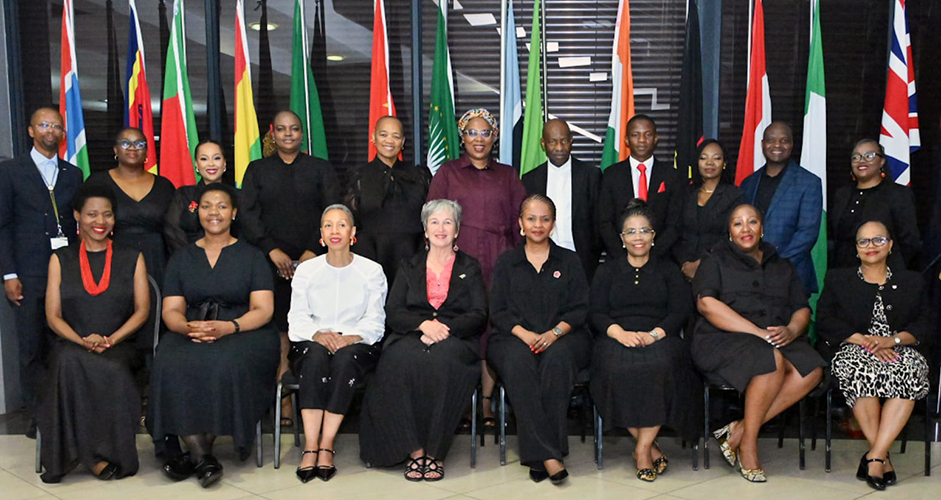
Speakers, members of the Qoboza family, Unisa leadership and media representatives at the 16th Percy Qoboza Memorial Lecture, held at Unisa's Muckleneuk Campus on 21 October 2026
Forty-nine years after the apartheid government attempted to silence Black journalists who exposed its injustices, the University of South Africa (Unisa) has brought media leaders, academics and policymakers together to confront the challenges threatening journalism and public broadcasting in democratic South Africa.
The discussions took centre stage at the 16th Percy Qoboza Memorial Lecture, hosted by Unisa in partnership with the National Press Club and the Qoboza family on 21 October 2026 at the university's Muckleneuk Campus in Pretoria. Held under the theme "Public interest or public broadcaster: Can the SABC survive democracy?", the lecture examined the financial sustainability of the South African Broadcasting Corporation (SABC), threats against journalists, the influence of artificial intelligence (AI) and the changing media landscape.
Beyond commemorating a painful chapter in South Africa's history, the gathering challenged participants to consider how media freedom can be protected and public broadcasting strengthened for future generations. The lecture commemorated Black Wednesday, 19 October 1977, when the apartheid government banned The World and Weekend World, outlawed Black Consciousness organisations and detained journalists and activists. Among those arrested was Percy Qoboza, then editor of The World, whose reporting exposed apartheid injustices and challenged the government's attempts to suppress Black voices.
His detention became a defining moment in South Africa's struggle for press freedom. Nearly five decades later, Qoboza's legacy remains a reminder that independent journalism is essential to democratic accountability and that freedom of expression must never be taken for granted. The lecture therefore provided an opportunity to honour his contribution while examining the contemporary pressures confronting journalists and media institutions.
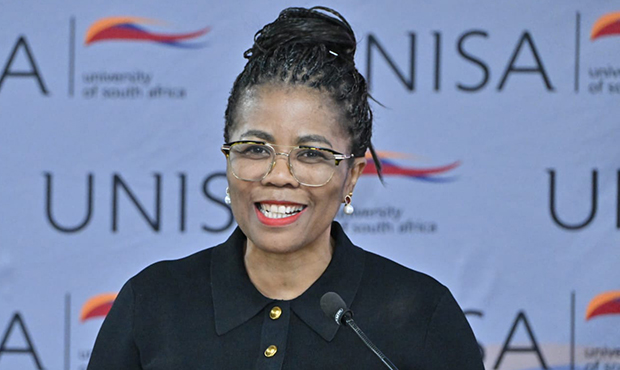
Unisa principal and vice-chancellor Prof Puleng LenkaBula addresses delegates at the 16th Percy Qoboza Memorial Lecture
Opening the proceedings, Unisa principal and vice-chancellor Prof Puleng LenkaBula welcomed delegates and acknowledged the partnership with the National Press Club and the Qoboza family. Her address highlighted the importance of preserving historical memory while creating opportunities for critical engagement with contemporary challenges. Through initiatives such as the Percy Qoboza Memorial Lecture, Unisa provides a platform where academics, journalists, policymakers and students can exchange ideas on issues affecting democracy and society. The gathering also reinforced the university's responsibility to promote informed public discourse and develop future generations capable of questioning established thinking and contributing to democratic accountability.
This commitment supports the objectives of the United Nations Sustainable Development Goal 16, particularly the promotion of accountable institutions and public access to information. It also reflects the African Union's Agenda 2063 vision of a continent characterised by good governance, democracy and respect for human rights. National Press Club chairperson Antoinette Slabbert warned that South Africa's hard-won media freedoms remain vulnerable to intimidation and other pressures. She highlighted the risks facing journalists, particularly community reporters who often investigate sensitive issues while working close to the individuals and institutions they cover.
"Media freedom means little if journalists cannot report without fear," she said. Slabbert also emphasised the SABC's importance in providing information to communities that commercial broadcasters may not adequately serve. Its multilingual radio services remain particularly significant in reaching South Africans across linguistic, geographic and socioeconomic divides. Her remarks underscored that media freedom depends not only on constitutional protections but also on conditions that allow journalists to work independently and safely.
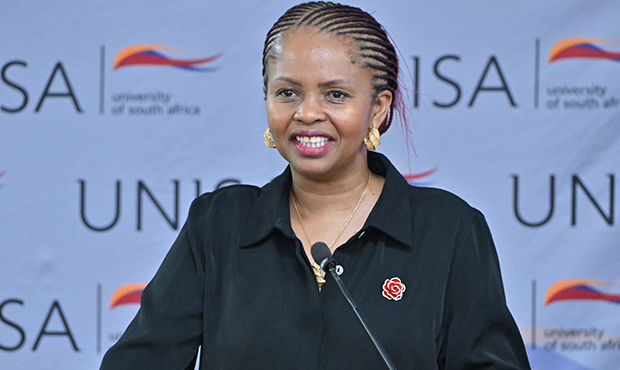
Khusela Sangoni Diko, chairperson of Parliament's Portfolio Committee on Communications and Digital Technologies, delivers the keynote address on the future of public broadcasting
Delivering the keynote address, Khusela Sangoni Diko, chairperson of Parliament's Portfolio Committee on Communications and Digital Technologies, called for urgent attention to the SABC's funding challenges. Diko argued that public broadcasting should not be measured solely against commercial performance because its responsibilities extend beyond generating revenue. The SABC has a constitutional and public-service role in informing, educating and entertaining citizens while reflecting South Africa's cultural and linguistic diversity.
These responsibilities distinguish it from commercial broadcasters, whose programming decisions are often influenced by profitability and advertising revenue. Diko maintained that public interest and public broadcasting should not be treated as competing priorities. Rather, the broadcaster's value lies in serving the public. However, she warned that fulfilling this mandate requires a sustainable and reliable funding framework. Without adequate resources, the broadcaster faces difficulties maintaining quality programming, serving diverse audiences and meeting its broader public-service obligations. At the same time, Diko emphasised that financial support must not compromise editorial independence or create opportunities for political interference.
Her address placed responsibility on government and Parliament to confront the broadcaster's structural funding challenges rather than rely on temporary interventions. She also raised concerns about harassment, intimidation and online abuse directed at journalists, particularly women. These pressures, she suggested, demonstrate that constitutional guarantees alone cannot ensure an environment in which journalists can investigate and report without fear. A panel discussion following the keynote explored the technological, institutional and economic pressures transforming the media industry.
William Bird, director of Media Monitoring Africa, examined the growing influence of artificial intelligence on broadcasting and journalism. His contribution highlighted the need for media organisations to embrace technological developments while safeguarding accuracy, credibility and public trust. Dr Phathiswa Magopeni, an SABC board member and executive director of the Press Council of South Africa, focused on governance and institutional accountability.
She cautioned that the existence of policies does not necessarily guarantee effective implementation, particularly when established procedures can be circumvented. Her remarks reinforced the importance of ensuring that governance frameworks translate into consistent institutional practice. Eyewitness news journalist Alpha Ramushwana raised concerns about the juniorisation of newsrooms, highlighting the loss of experienced journalists and the implications for mentorship and editorial quality. His contribution drew attention to the need to retain institutional knowledge and equip emerging journalists with the skills required for rigorous reporting.
Radio presenter and podcaster David Mashabela examined the growing influence of independent digital content creators. He contrasted the relatively informal production methods used by podcasters with the more resource-intensive operations of traditional broadcasters. The discussion highlighted how changing audience preferences and alternative business models are reshaping competition for attention. Together, the panellists demonstrated that the SABC's future depends on more than financial reform. Effective governance, technological adaptation, experienced journalists and audience engagement will also be essential.
The lecture also celebrated academic excellence through the announcement of two Percy Qoboza bursary recipients. Frankie Mojapelo, director of Unisa Foundation and Alumni Relations, announced that Ntando Dhlova and Mbali Nama had been selected following an assessment of 367 students registered for the BA Honours in Communication Science in 2026. Dhlova achieved the highest average of 92%, while Nama attained 88%. Their achievements highlighted Unisa's commitment to recognising academic excellence and supporting the development of future communication professionals. The bursaries connect Qoboza's legacy to the university's educational mission, contributing to Sustainable Development Goal 4, which promotes inclusive and equitable quality education. Members of the Qoboza family attended the lecture, while a video message further reinforced the significance of preserving his legacy.
Closing the programme, Mbali Thethani, news editor at Kaya 959 and programme director for the event, reflected on Qoboza's persecution for reporting the truth about apartheid-era injustices. She recalled that his supposed "crime" was exposing what happened in 1976, when the apartheid government sought to silence critical Black voices. Her message reinforced the importance of ensuring that such persecution remains part of South Africa's history rather than its future. Although journalism has changed considerably since Black Wednesday, its fundamental responsibility remains unchanged: informing the public, scrutinising power and giving a voice to those who might otherwise go unheard. For Unisa, the annual lecture demonstrates the importance of universities as spaces for historical reflection, critical dialogue and the advancement of democratic values.
* By Lesego Chiloane, Journalist, Department of Institutional Advancement
* Photography: Shooheima Champion, Multimedia Centre
Publish date: 2026-10-22 00:00:00.0

 Unisa hackathon winners develop AI solution to support students at risk of falling behind
 Beyond Black Wednesday: Unisa lecture calls for urgent action to protect media freedom and public broadcasting
 Unisa celebrates 25 new PhD graduates advancing research and innovation
 From Maramanzhi to master's: Unisa graduate champions Tshivenda through scholarship
 Unisa students help shape digital complaints system to improve accountability and service delivery