
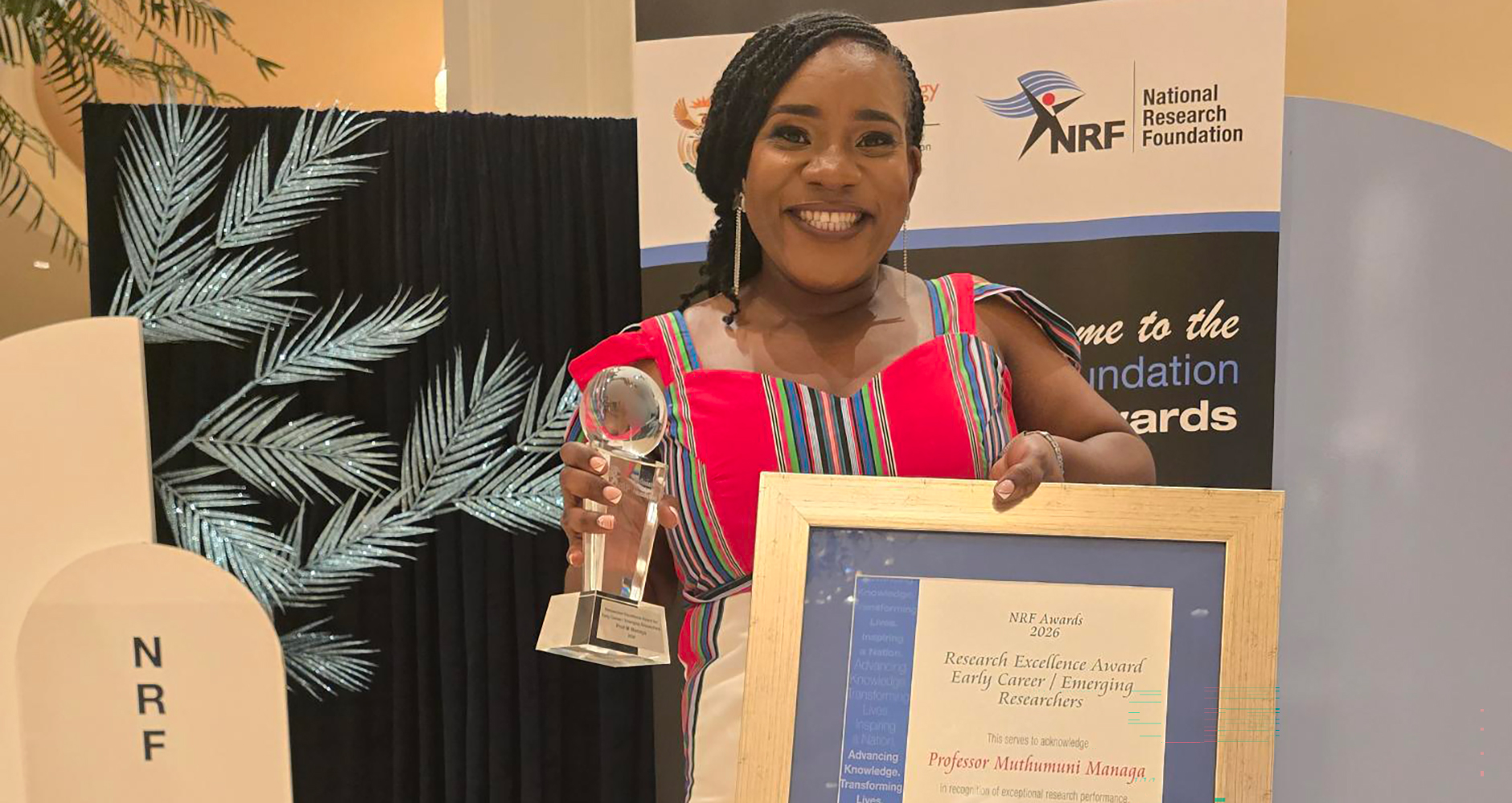
Prof Muthumuni Managa
Prof Muthumuni Managa's research journey has been marked by resilience, collaboration and a determination to turn scientific knowledge into solutions for real-world challenges.
The Associate Professor and Y2-rated researcher at Unisa's Nanostructured Materials Institute for Nanotechnology and Water Sustainability (iNanoWS) was recently named the recipient of the 2026 National Research Foundation (NRF) Research Excellence Award for Early Career/Emerging Researchers.
The award was presented at the 2026 NRF Awards, held on Thursday, 3 September at the Boardwalk Hotel and Casino in Gqeberha, Eastern Cape, under the theme, "Building an Inclusive, Impactful and Transformed Research Future."
The NRF Research Excellence Award recognises outstanding research performance by early career and emerging researchers across disciplines who hold NRF grants.
For Managa, the recognition reflects years of research focused on some of society’s most pressing environmental challenges, particularly water security and disinfection.
Her work explores the application of nanotechnology and photodynamic approaches to water disinfection, aiming to develop innovative solutions to real-world water and environmental challenges.
Her research achievements include a UK patent application currently under review, an intellectual property disclosure this year, more than 80 peer-reviewed publications and an h-index of 25 on Google Scholar.
"Research of this nature requires specialised equipment and interdisciplinary expertise, which are not always readily available," said Managa.
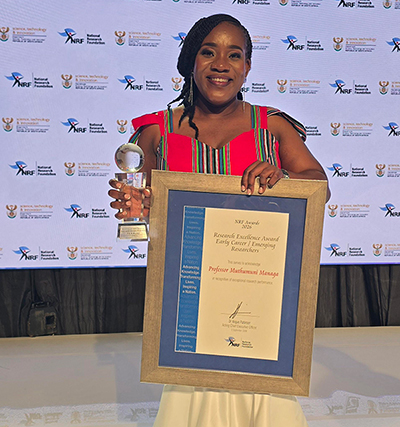
Prof Muthumuni Managa
Rather than letting resource constraints limit her research, she has built national and international collaborations, pursued competitive funding opportunities, and established partnerships that provide access to expertise and facilities beyond those immediately available at Unisa.
"I have actively developed national and international collaborations, sought competitive funding, and established partnerships that provide access to expertise and facilities that complement those available at my institution," she said.
For Managa, the significance of the NRF award extends beyond the accolade itself.
"Personally, I received the award with gratitude and humility, but also with a renewed sense of responsibility," she said.
The NRF recognition is the latest in a year of significant achievements for the researcher. Earlier this year, she was named second runner-up in the SAWiSA Distinguished Young Woman Researcher Award and received the 2026 South African Chemical Institute (SACi) Raikes Medal.
She views these achievements as an affirmation of the research path she has chosen, but not as an endpoint.
"I see the awards as a milestone rather than a destination," she said.
The recognition, she added, has encouraged her to become more ambitious in her research and to pursue work capable of delivering greater societal impact.
While awards provide important recognition, Managa believes they should ultimately inspire researchers to do more.
"It also reminded me that research is not an individual journey. Whatever recognition I receive is connected to the students I supervise, my collaborators, mentors, and the communities that have supported my work."
Managa's understanding of research excellence has also evolved throughout her career.
As an emerging researcher, she initially measured success through conventional milestones such as publishing research, completing projects and establishing herself as an independent researcher.
Over time, however, her perspective broadened.
"I came to understand that a strong research programme should go beyond generating knowledge," she said.
For Managa, this means asking more fundamental questions about why research is being conducted, who it benefits and how its findings can contribute to addressing challenges beyond academia.
Since joining Unisa, she has secured approximately R4.6 million in competitive research funding from national and international sources.
Her contribution extends beyond her own research output. Through postgraduate supervision and capacity development, she is also helping to develop the next generation of researchers and strengthen research capability within the university.
Her journey reflects the research culture that Unisa seeks to strengthen as it continues to position itself as a leading institution of research and innovation.
Through researchers such as Managa, whose work combines scientific excellence with a focus on practical challenges, the university is contributing to solutions that have relevance beyond the academy and the potential to make a difference in communities and society.
* By Moleboheng Mpafa, Communication Intern, Department of Institutional Advancement
Publish date: 2026-09-14 00:00:00.0

 From Maramanzhi to master's: Unisa graduate champions Tshivenda through scholarship
 Unisa students help shape digital complaints system to improve accountability and service delivery
 Age is no barrier to success: Former NAFCOC president earns Unisa master's degree at 71
 From academic setbacks to master's distinction: Unisa graduate's journey of resilience
 Ethiopian doctoral graduates highlight Unisa's growing impact across Africa