

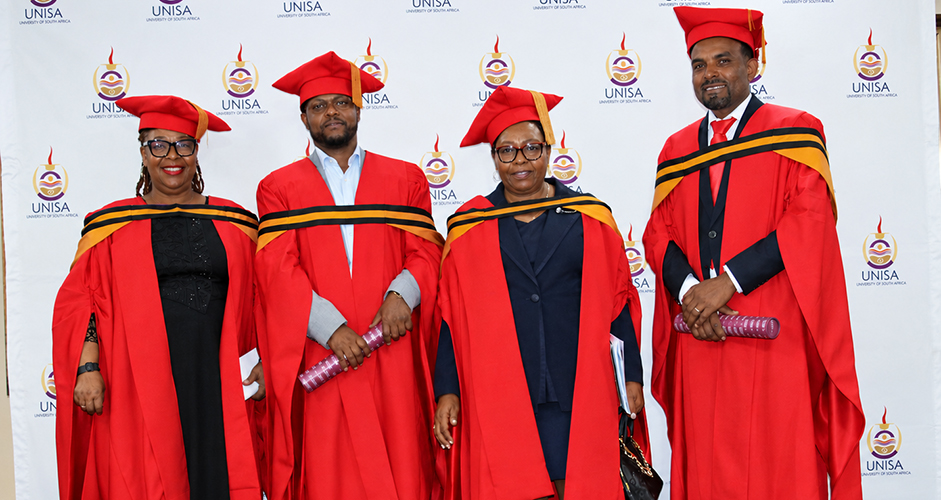
From left: Prof Sisinyana Hannah Khunou, supervisor; Dr Getachew Gebreselassie Nida; Prof Rose Mmusi-Phetoe, supervisor; and Dr Derese Teshome during Unisa's 2026 Spring Graduation ceremonies.
The University of South Africa (Unisa) continues to strengthen its position as a leading African institution for postgraduate education, with doctoral graduates from across the continent contributing research that addresses pressing social and developmental challenges.
Two Ethiopian scholars, Dr Derese Teshome and Dr Getachew Gebreselassie Nida, were among those celebrated during the university's 2026 Spring Graduation ceremonies, earning Doctor of Philosophy (PhD) degrees in Public Health. Their achievements reflect Unisa's expanding continental reach and its commitment to developing African researchers whose work contributes to improving lives beyond the university.
Through its comprehensive open distance e-learning (CODeL) model, regional learning centre in Ethiopia and longstanding academic initiatives such as the Eritrean Project, Unisa continues to provide opportunities for students across Africa to pursue advanced qualifications without necessarily relocating from their home countries. For Teshome and Nida, obtaining their doctorates represents years of perseverance, sacrifice and academic dedication. More importantly, their research addresses public health challenges affecting young people and vulnerable communities, particularly in Ethiopia.
Teshome obtained his PhD in Public Health after completing research focused on improving access to sexual and reproductive healthcare services among adolescents in south-eastern Ethiopia. His thesis, titled A strategy to enhance utilisation of adolescents' sexual and reproductive health services in South-East Ethiopia, investigated barriers preventing young people from accessing essential healthcare services and explored strategies for improving their availability and use. According to Teshome, financial constraints, limited awareness, cultural taboos and systemic barriers are among the challenges affecting adolescents’ access to sexual and reproductive health services.
These obstacles can prevent young people from seeking timely healthcare, obtaining reliable information and making informed decisions about their health. "I wanted to shine a light on these challenges and find ways to make these services accessible, acceptable and user-friendly," he said. Teshome hopes his findings will contribute to the development of healthcare approaches that respond more effectively to adolescents’ needs.
"I hope that my work will shape user-friendly services and empower young people to make informed health decisions," he explained. His research is particularly relevant to efforts to strengthen adolescent healthcare services and reduce barriers affecting underserved populations. It also contributes to the objectives of Sustainable Development Goal (SDG) 3, which promotes good health and well-being, including improved access to sexual and reproductive healthcare services.
By examining challenges within the Ethiopian healthcare system, Teshome's study offers insights that may inform service improvements and discussions about adolescent health in other African settings facing similar barriers. Like many doctoral candidates, Teshome faced the demanding task of balancing academic research with professional and family responsibilities. Completing a PhD required sustained discipline, effective time management and the ability to navigate setbacks while maintaining progress towards his research objectives.
Despite these challenges, he remained committed to completing his qualification. "Doing a PhD is tough, but do not lose sight of why you started the journey," he advised. He encouraged current and prospective doctoral students to anticipate difficulties and draw on support from supervisors, mentors, family and friends. His experience highlights the importance of academic guidance and supportive learning environments in enabling postgraduate students to complete demanding research programmes.
It also demonstrates the value of flexible higher education pathways for working professionals seeking to advance their qualifications while remaining active in their communities. Fellow Ethiopian graduate Nida also obtained his PhD in Public Health, with research titled Development of guidelines to improve young sexual and reproductive health. His work focuses on improving sexual and reproductive healthcare for young people, contributing to the broader effort to strengthen health services and improve outcomes for vulnerable populations. Reflecting on his graduation, Nida described the achievement as a defining moment in his academic and personal journey.
"Today, I proudly celebrate a major milestone in my life: earning my Doctor of Philosophy (PhD) in Public Health from the University of South Africa," he said. For Nida, the qualification represents far more than academic recognition. It is the culmination of years of hard work, sacrifice and determination. He acknowledged that his doctoral journey had been marked by challenges and moments that tested his resolve, but said perseverance had ultimately carried him through.
"Today, I feel incredibly excited, grateful, and proud of how far I have come," he reflected. The experience, he said, reinforced his belief that setbacks should not determine a person's future and that sustained commitment can turn difficult ambitions into achievable goals. Nida intends to use the knowledge and research expertise gained through his doctoral studies to contribute to stronger healthcare systems, evidence-informed policymaking and improved public health outcomes.
"Earning my PhD in Public Health is not simply a personal academic achievement; it is a renewed commitment to serving communities, strengthening health systems, and contributing to better health outcomes at national, regional, and global levels," he said. His ambition is to translate academic research into practical interventions that address health inequalities and improve services for underserved communities. In Ethiopia, he hopes to contribute to healthcare policy development, programme design and implementation, and the integration of research findings into public health practice.
He also aims to support the development of sustainable, equitable and people-centred health services, particularly in communities where access to quality healthcare remains limited. His aspirations demonstrate the importance of postgraduate research that extends beyond academic publication to influence public policy, professional practice and community well-being. Together, the work of Teshome and Nida illustrates how doctoral education can equip African scholars with the research and leadership capabilities needed to respond to pressing public health challenges.
The research undertaken by the two graduates aligns with broader continental and international development priorities. Their focus on adolescent sexual and reproductive healthcare supports SDG 3, particularly efforts to improve access to essential health services and promote healthier communities. Their achievements also demonstrate the contribution to SDG 4 (Quality Education), which recognises the importance of inclusive educational opportunities and the development of advanced knowledge and skills.
At a continental level, their work speaks to the African Union's Agenda 2063, particularly Aspiration 1, which envisages a prosperous Africa based on inclusive growth and sustainable development, including healthier and better-educated citizens. For South Africa, the National Development Plan 2030 similarly recognises the importance of higher education, research capacity and improved health outcomes in advancing social and economic development. Although the graduates' research focuses on Ethiopia, their achievements demonstrate how South African universities can contribute to continental development by supporting research that addresses challenges extending beyond national borders.
Their work also reflects the importance of building African research capacity and generating contextually relevant knowledge that can inform healthcare improvements. The achievements of Teshome and Nida reinforce Unisa's role in expanding access to postgraduate education across Africa. Through its CODeL model and regional academic initiatives, the university provides opportunities for students to pursue advanced qualifications while maintaining professional, family and community responsibilities.
This approach is particularly significant for postgraduate students whose research is closely connected to challenges within their own countries. By enabling scholars to investigate local problems while participating in an established research environment, Unisa contributes to developing African expertise and strengthening the continent’s knowledge base. The university's contribution extends beyond awarding qualifications. Through doctoral supervision, research training and academic mentorship, it supports the development of researchers who can contribute to public institutions, healthcare systems and policy development.
For Teshome and Nida, graduation marks both the completion of an important academic journey and the beginning of a new chapter in applying their research to improve lives. Their achievements illustrate the wider value of postgraduate education: producing knowledge that can strengthen communities, inform decisions and contribute to a healthier, more sustainable Africa.
* By William Thubakgale and Victor Malatji, Department of Institutional Advancement
Publish date: 2026-10-19 00:00:00.0

 From academic setbacks to master's distinction: Unisa graduate's journey of resilience
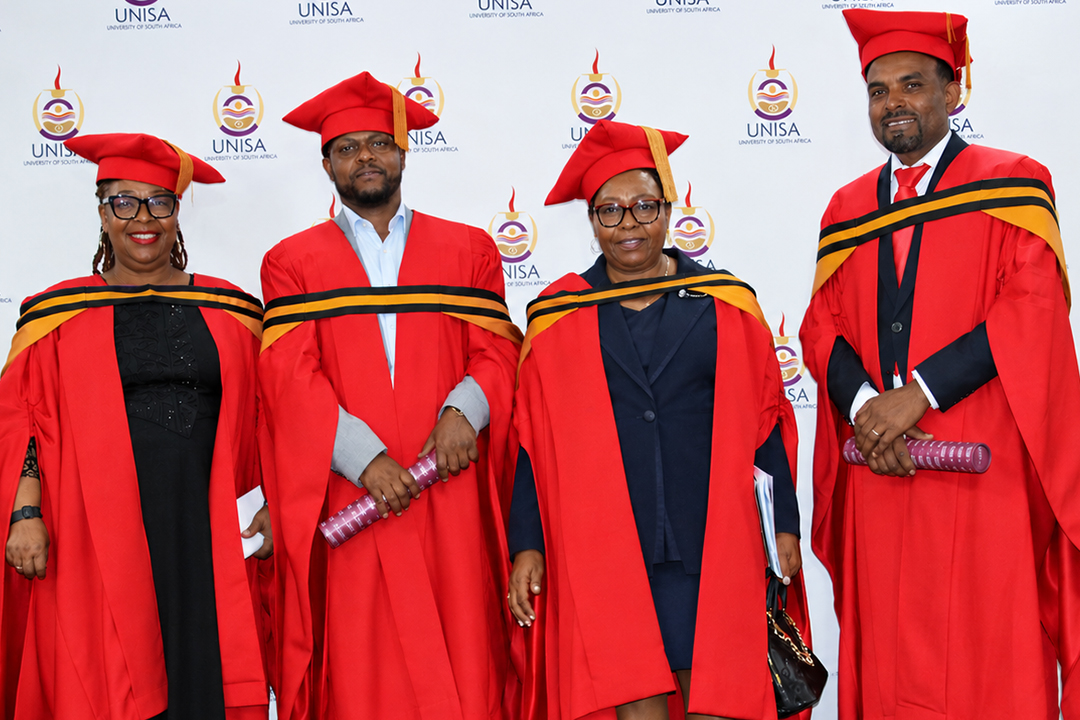 Ethiopian doctoral graduates highlight Unisa's growing impact across Africa
 Unisa SBL calls for shift from building houses to creating sustainable communities
 From law graduate to student leader: Tshegofatso Mmope's commitment to justice and empowerment
 Unisa Western Cape honours retirees and celebrates their enduring legacy