

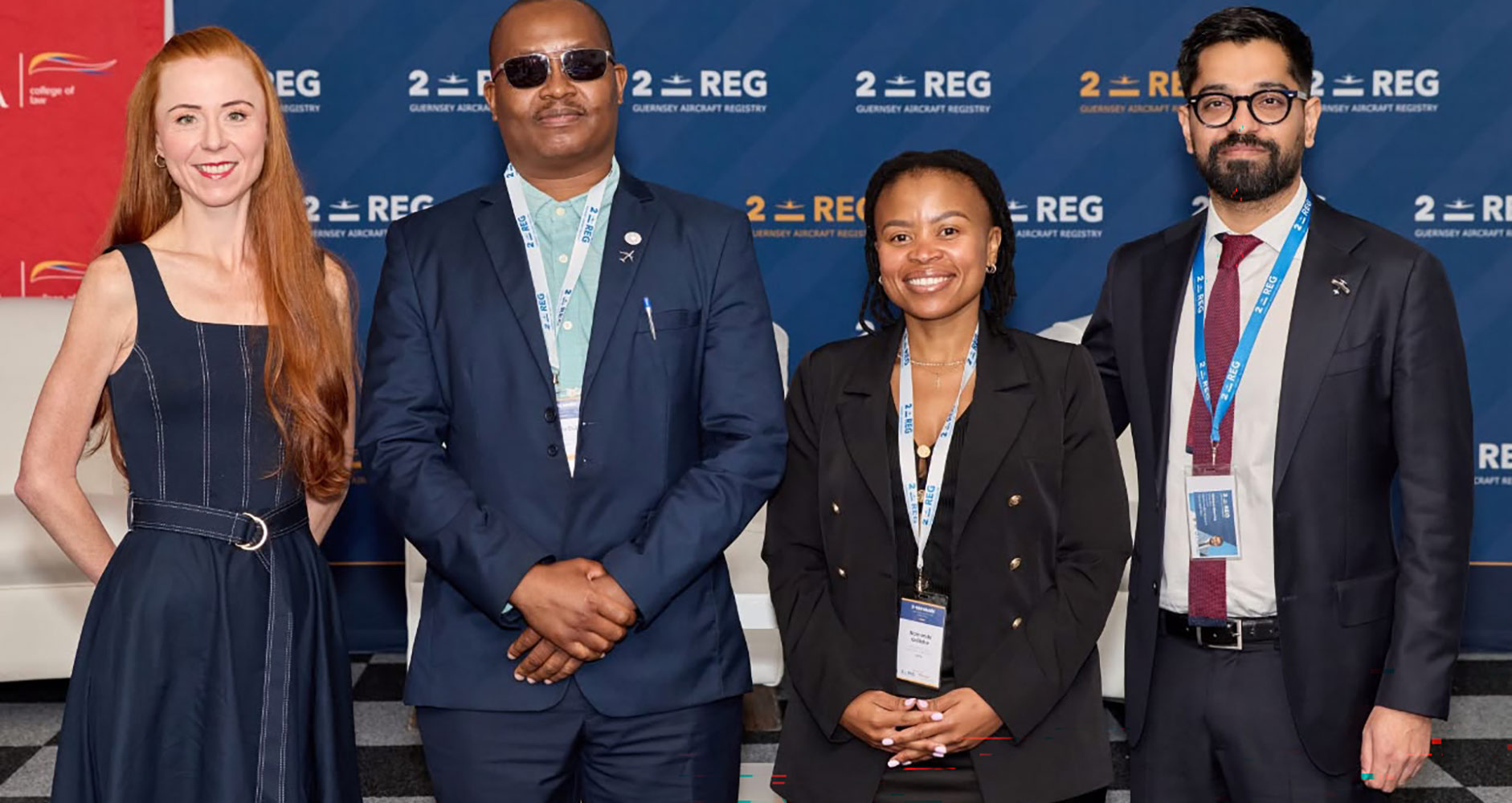
From left: Joloudi Badenhorst (2-REG), Prof Angelo Dube (Unisa), Nomonde Gxilishe (Unisa) and Sid Sharma, Director at 2-REG, during the 2-REG McGill Cape Town Convention Conference hosted by Unisa in Cape Town.
The University of South Africa (Unisa) brought together more than 100 international aviation leaders, regulators, legal academics and asset finance specialists for a conference examining the impact of the Cape Town Convention and the challenges likely to shape the future of global aircraft financing.
The 2-REG McGill Cape Town Convention Conference, hosted from 15 to 17 November 2026 at Unisa's Parow Campus, marked 25 years since the adoption of the international treaty framework governing interests in high-value mobile assets, particularly aircraft.
On 16 November 2001, states adopted the Convention on International Interests in Mobile Equipment and its Protocol on Matters Specific to Aircraft Equipment at a diplomatic conference in Cape Town. Collectively known as the Cape Town Convention, the instruments were developed to address a longstanding challenge in aircraft financing: providing lenders, lessors and other creditors with predictable and enforceable rights over assets that move across national borders.
The Convention and Aircraft Protocol entered into force on 1 March 2006, establishing an international framework for aircraft financing and leasing.
The conference was organised through a collaboration involving Unisa, 2-REG Guernsey, McGill University and Tuli & Co. It brought together academic and industry expertise to reflect on the Convention’s first 25 years and consider how the framework could respond to changing technologies, financing requirements and the growth of emerging aviation markets, particularly in Africa.
The opening keynote address was delivered by Hilary Pullum KC, His Majesty's Comptroller (Solicitor General) for the Bailiwick of Guernsey. She provided insights into Guernsey's regulatory environment, the work of 2-REG and the jurisdiction's contribution to international aviation.
The first day's programme examined developments in aircraft financing and leasing, creditor remedies, the Cape Town discount, regulatory changes and the practical application of the Convention across different jurisdictions.
A central discussion focused on the institutional role in the Convention's continued success, highlighting the contribution of regulators, academic institutions and other stakeholders in ensuring that the treaty's objectives are realised.
The second day broadened the discussion to sustainable aviation, the next 25 years of the Convention and aircraft financing in the prevailing global economic environment. Participants considered whether the existing framework, including the Aircraft Protocol’s definition of aircraft objects, adequately responds to emerging technologies and the financing requirements of next-generation aircraft.
These questions are becoming increasingly important as technological advances challenge established legal and regulatory frameworks and create new demands for the financing and regulation of aviation assets.
Some of the most practical insights came from practitioners who shared experiences of disputes, litigation, arbitration and aircraft recovery operations.
For African aviation, one concern was the difficulty of recovering aircraft stranded in territories affected by armed conflict and political instability.
Although the Convention provides a framework for protecting international interests, its effectiveness depends on domestic implementation and the willingness and capacity of states to honour their international obligations.
Participants highlighted the gap that can emerge between treaty provisions and the realities of enforcement on the ground. In some circumstances, recovering an aircraft requires more than invoking legal remedies. It may also involve engagement with the political and institutional structures of the jurisdiction concerned.
The discussions underscored the importance of effective regulation, institutional capacity and cooperation between countries in making international aviation agreements work in practice.
For Unisa, hosting the international gathering reinforced its commitment to Aviation and Aeronautical Studies, one of the University's ten Catalytic Niche Areas (CNAs).
The University's contribution extended beyond providing the venue. Distinguished Professor Angelo Dube, who leads Unisa's Aviation Law Working Group, participated as a panellist in a session on the Institutional Role in the Convention's Success.
Dube outlined the University's progress in mainstreaming aviation across its academic programmes, including current developments and prospective qualifications. He also called on industry stakeholders to work more closely with Unisa to develop programmes that respond to the sector's changing requirements.
The discussion highlighted the need for universities and industry to work together when developing aviation qualifications. Closer collaboration can help ensure that graduates acquire the knowledge, competencies and professional attributes required in an increasingly complex aviation environment.
The conference also provided an opportunity for Unisa's doctoral students in aviation studies to engage directly with international practitioners. Such exchanges allow emerging researchers to test their research questions against professional experience and identify research challenges grounded in the realities of the industry.
The gathering therefore provided more than an opportunity to discuss international aviation law. It also created a platform for strengthening research networks, sharing industry knowledge and exploring how academic institutions can contribute to the development of the sector.
The conference's focus on research, knowledge exchange and industry collaboration also connects with broader development priorities.
Its academic engagement and opportunities for doctoral students relate to Sustainable Development Goal (SDG) 4, which promotes quality education. Discussions on aviation growth, financing and skills development speak to SDG 8 on decent work and economic growth, while the examination of aircraft financing, infrastructure and emerging technologies relates to SDG 9 on industry, innovation and infrastructure.
The partnerships between Unisa, 2-REG, McGill University and other industry stakeholders also reflect the objectives of SDG 17, which emphasises international cooperation and partnerships.
These connections are particularly relevant to Africa, where the development of aviation markets requires investment, appropriate regulatory frameworks, skilled professionals and stronger institutional capacity. The conference provided a forum to consider how international expertise and local academic capacity can contribute to these priorities.
The successful hosting of the conference was made possible through the work of the Aviation Law Working Group, with support from the Western Cape Region's Regional Director, Motale Nkgoang, and Nomonde Gxilishe. The Parow Campus support team also contributed to the running of the programme.
As the conference concluded, a central message emerged: the future of aviation cannot be shaped by industry or government alone. Academic institutions also have an important responsibility to generate knowledge, advance research and develop the human capital on which the sector depends.
For Unisa, the gathering affirmed its place in the global aviation conversation and offered an opportunity to strengthen relationships that could develop into lasting academic and industry partnerships. The challenge now is to translate those connections into practical cooperation, relevant academic programmes and research that respond to the needs of the aviation sector in Africa and beyond.
The discussions also reinforced the importance of building an aviation industry that is not only commercially viable, but supported by effective institutions, sound regulation, innovation and sustainable development.
*By Prof Angelo Dube, Distinguished Professor (Aviation and Aeronautical Studies), with editorial contributions by Lesego Chiloane, Journalist, Unisa Communication Directorate.
Publish date: 2026-11-26 00:00:00.0

 Unisa brings global aviation experts together to explore the future of aircraft financing
 Affirming the lives of South African women and girls in efforts to end GBVF
 Five young entrepreneurs turn a passion for books into a growing business
 From rural beginnings to award-winning researcher: Dr Nokulunga Ngcongo's journey
 Unisa wins three MACE Awards of Excellence for its digital and recruitment work