

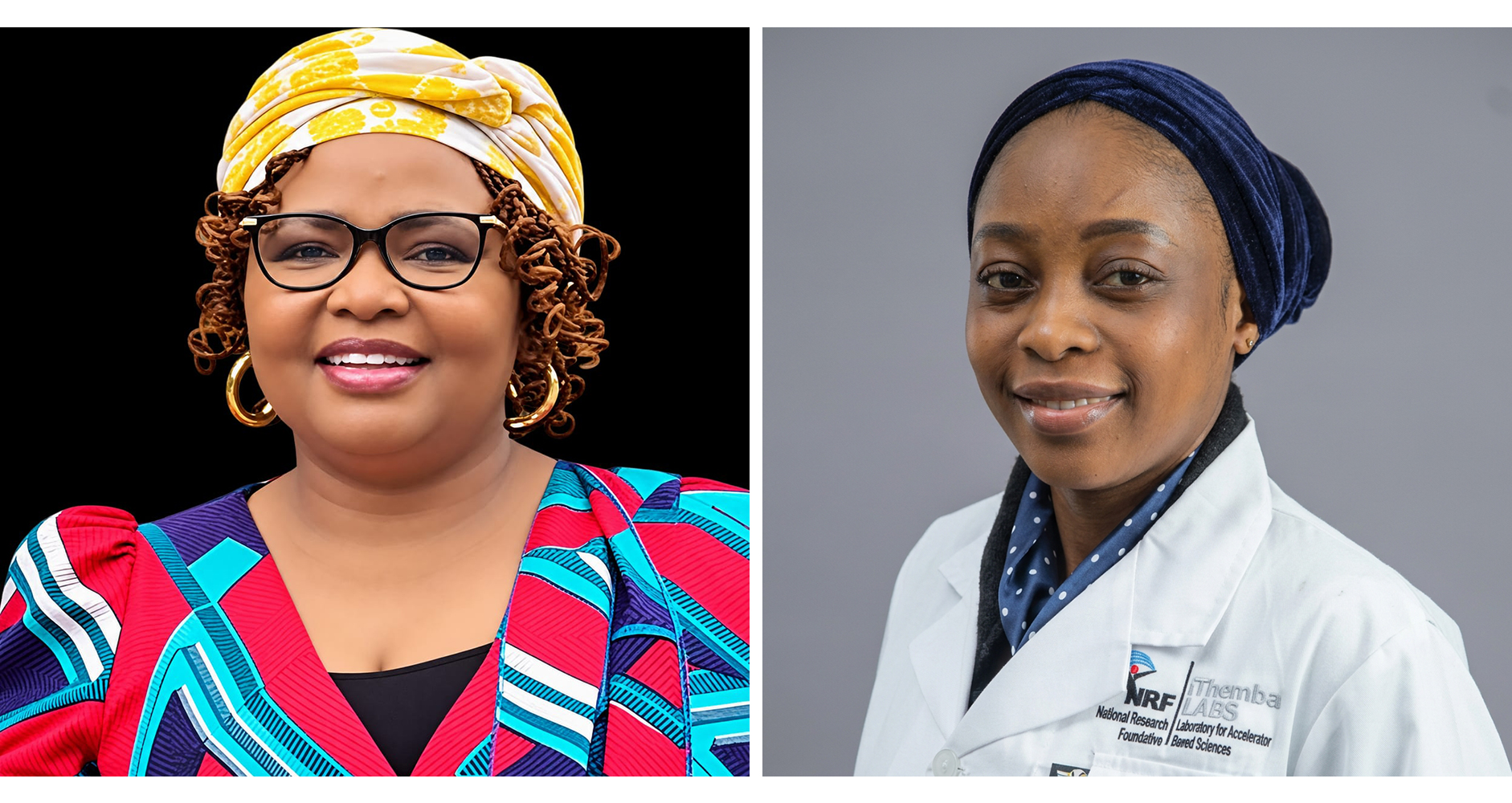
Left to right: Linkie Mohlala and Erna Ngounou
A doctoral thesis can run to 204 pages and contain between 80 000 and 100 000 words. The challenge of the Three-Minute Thesis (3MT) competition is to distil that research into a compelling three-minute presentation, supported by a single static PowerPoint slide.
Participants faced this task at the annual 3MT competition, held at the University of the Free State at the end of October. Unisa was represented by two doctoral candidates, Linkie Mohlala and Erna Ngounou. After emerging from a highly competitive institutional round involving 12 entrants, the pair received intensive coaching and mentorship from a dedicated support team ahead of the national event.
Mohlala presented her doctoral study, titled The Translator's Invisibility in Translation: With Specific Reference to isiZulu Translation of Long Walk to Freedom. Her research examines the often-overlooked role translators play in shaping meaning across languages and cultures, while highlighting the important contribution of African-language translators. She described the competition as an exciting and rewarding experience. It deepened her appreciation of her research and reinforced the importance of communicating scholarly work clearly and confidently to audiences beyond academia.
Ngounou presented her research, titled Linear and Nonlinear Optical Properties of Carotenoid Molecules Bioconjugated with Silver Nanoparticles for Biomedical Applications. Her study investigates innovative approaches to the early detection of cancer, exploring how naturally occurring carotenoid molecules can be combined with silver nanoparticles to improve biomedical imaging and diagnostic techniques. Both candidates acknowledged the dedication and extensive academic support provided by the Unisa 3MT Competition Committee in preparing them for the national event.
Although neither advanced to the final round, both described the competition as a valuable learning experience that strengthened their ability to communicate complex research with clarity, confidence and impact.
The two projects illustrate the range of scholarship taking place at Unisa and its potential contribution to addressing challenges in society. Ngounou's research has a direct connection to Unisa's Health/Pharmaceutical Studies Catalytic Niche Area (CNA). This niche area supports research that advances healthcare delivery, disease prevention and pharmaceutical development. Its focus includes biomedical research, disease biomarker diagnostics, drug discovery and development, and the training of future health researchers.
Her investigation into the optical properties of carotenoid molecules bioconjugated with silver nanoparticles for biomedical applications contributes to this broader research focus. By exploring how these materials could improve biomedical imaging and diagnostic techniques, her work examines potential approaches that could support the early detection of cancer. It also reflects the importance of scientific research and pharmaceutical innovation in developing solutions to healthcare challenges. The research is relevant to Sustainable Development Goal 3: Good Health and Well-being, particularly efforts to improve health outcomes and strengthen disease prevention and diagnostic capacity. It also relates to SDG 9: Industry, Innovation and Infrastructure, through its focus on scientific research and technological innovation. While the research explores potential diagnostic applications, further evidence would be needed to establish its clinical effectiveness or practical use.
Mohlala's work, meanwhile, highlights the importance of translation in preserving meaning and making knowledge accessible across languages and cultures. Its focus on isiZulu translation raises broader questions about the visibility and recognition of African-language translators and the role of African languages in academic and public discourse. This has relevance to SDG 4: Quality Education, particularly inclusive access to knowledge and learning. It also speaks to the African Union's Agenda 2063, which recognises the importance of African cultural identity, heritage and languages in the continent's development. The research has broader relevance to South Africa's National Development Plan Vision 2030, particularly its objectives of building an inclusive society and strengthening education and knowledge production.
Together, the projects demonstrate how postgraduate research can contribute to different areas of development, from healthcare innovation to language, knowledge access and cultural inclusion. They also reinforce the importance of making academic findings understandable and relevant to people outside specialist research communities. Developed by the University of Queensland in Australia in 2008, the 3MT competition has grown into a global academic initiative involving more than 900 universities across more than 85 countries.
The competition challenges postgraduate students to explain their research to a non-specialist audience in just three minutes, using a single static slide. The aim is to make complex academic work accessible, engaging and relevant beyond the university environment. For Unisa, initiatives such as 3MT contribute to postgraduate development by allowing doctoral candidates to strengthen their communication and presentation skills. The ability to explain research clearly is important not only in academic settings, but also when engaging communities, policymakers, industry and other stakeholders who may benefit from research findings.
This supports the University’s broader contribution to SDG 4: Quality Education, by strengthening postgraduate development and the communication of knowledge. It also reflects the ambitions of the African Union's Agenda 2063 and South Africa's NDP Vision 2030 to develop knowledge, skills and innovation that contribute to inclusive development. The competition provides a platform for Unisa to showcase its postgraduate research and encourage candidates to communicate findings in ways that can inform society. Making research accessible beyond academic publications is an important part of ensuring that knowledge can contribute to sustainable development.
* By Hanli Wolhuter, Communication and Marketing Specialist, College of Graduate Studies.
Publish date: 2026-11-27 00:00:00.0

 3MT: The art of explaining complex research in three minutes
 Unisa Innovation Festival brings researchers together to tackle poverty and inequality
 Unisa and Eskom Foundation STEM partnership makes a difference in 2026
 Unisa brings global aviation experts together to explore the future of aircraft financing
 Advocate Vuyiswa Mathaba makes history as first woman to chair Unisa Bargaining Forum