

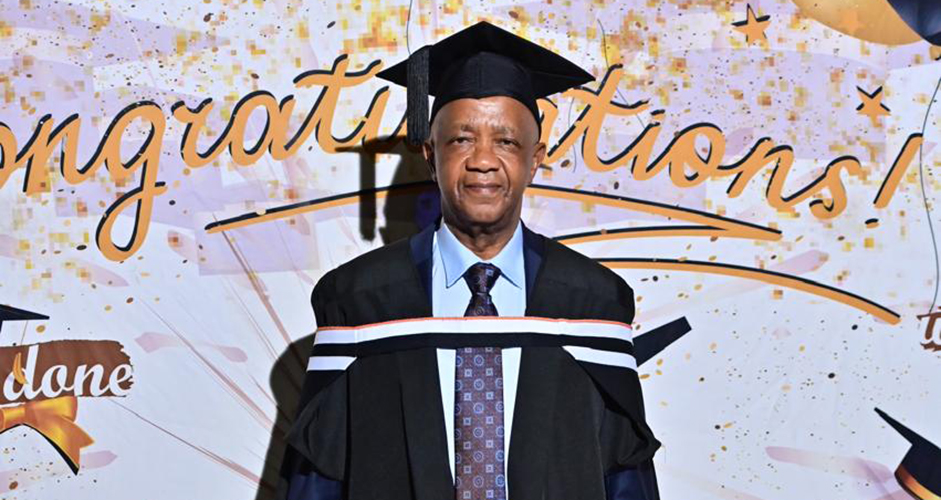
Sabelo Macingwane, 71, former Chief Executive Officer and National President of NAFCOC, celebrates obtaining his Master of Business Leadership degree from Unisa, demonstrating that lifelong learning has no age limit.
At an age when many people are considering retirement, 71-year-old Sabelo Macingwane has achieved a milestone that demonstrates the enduring value of education: graduating with a Master of Business Leadership (MBL) from the University of South Africa (Unisa).
The former Chief Executive Officer and National President of the National African Federated Chamber of Commerce and Industry (NAFCOC) has spent decades championing entrepreneurship, Black economic participation and business development. Yet, despite his extensive leadership experience, he remained determined to strengthen his knowledge through formal postgraduate education. For Macingwane, obtaining his master's degree is not simply about adding another qualification to his name. It represents a personal commitment fulfilled, a willingness to challenge established assumptions and a powerful reminder that learning has no age limit.
"It is the culmination of perseverance, personal sacrifice, intellectual discipline, unwavering faith, and a lifelong commitment to learning," he said. Macingwane's achievement reflects Unisa's commitment to widening access to quality higher education and creating opportunities for people to pursue their academic ambitions at different stages of their lives. Having occupied senior positions in business leadership, economic transformation and community development, Macingwane could have considered his extensive professional experience sufficient.
Instead, he chose to return to formal education, embrace new perspectives and subject his knowledge to academic scrutiny. The decision required him to move beyond familiar leadership environments and engage with contemporary business theories, research methodologies and strategic management approaches. For someone with decades of practical experience, the opportunity to connect academic knowledge with real-world leadership challenges proved particularly valuable.
Macingwane described the qualification as one of the most fulfilling achievements of his life. He explained that the MBL programme demanded sustained intellectual engagement, extensive reading, analytical thinking and the ability to critically examine complex business and leadership issues. One of his greatest challenges was balancing postgraduate studies with his continuing responsibilities in business, corporate governance, community development and family life.
"The research component was particularly demanding. It required sustained concentration, patience, intellectual independence, and the willingness to revisit and refine my work repeatedly," he said. Despite these demands, he persevered, demonstrating that professional experience and academic learning can complement and strengthen one another. Macingwane's academic achievement builds on a career dedicated to advancing entrepreneurship, economic inclusion and business development.
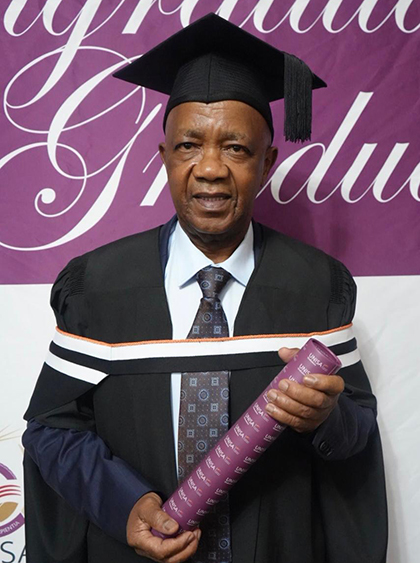
Sabelo Macingwane
"Throughout my career, I have been privileged to serve in various leadership capacities, including as Chief Executive Officer of NAFCOC and subsequently as its National President, succeeding Lawrence Mavundla," he said. Through these positions, he participated in efforts to promote Black economic participation and expand opportunities for entrepreneurs and businesses. He believes that while his leadership experience provided invaluable practical knowledge, postgraduate education has equipped him with additional theoretical, analytical and strategic tools to examine contemporary economic challenges.
The qualification has also strengthened his ability to approach leadership decisions through research, critical reflection and evidence-based analysis. For Macingwane, the MBL represents a renewed commitment to applying his knowledge and experience towards meaningful leadership, economic transformation and service to society. His journey illustrates the importance of developing leaders who can combine practical experience with academic expertise to address complex economic and organisational challenges.
Macingwane's achievement extends beyond personal success, highlighting the contribution that lifelong learning can make to economic participation, leadership development and social transformation. His experience reflects the importance of higher education in strengthening the skills and competencies required to build capable institutions, support entrepreneurship and advance inclusive economic growth. These priorities are closely aligned with South Africa's National Development Plan (NDP) 2030, which identifies education, skills development and improved institutional capacity as essential to reducing inequality, creating employment and strengthening the economy.
The achievement also resonates with Sustainable Development Goal (SDG) 4, particularly its emphasis on inclusive, equitable quality education and lifelong learning opportunities for all. By supporting mature students and working professionals, Unisa contributes to expanding educational opportunities beyond conventional age groups and career stages. Macingwane's background in business leadership also provides a practical connection to SDG 8, which promotes decent work, entrepreneurship and inclusive economic growth.
At a continental level, his commitment to business development and economic participation reflects the African Union's Agenda 2063 vision of a prosperous Africa driven by inclusive growth, education and skills development. For Unisa, his achievement demonstrates how postgraduate education can strengthen the leadership capabilities of individuals already contributing to economic and social development. Drawing on his experiences in business and academia, Macingwane encouraged young South Africans to recognise education as a powerful instrument of personal empowerment and national development.
He urged them not to wait for ideal circumstances before pursuing their ambitions. "Opportunities are not always presented under perfect conditions. Sometimes, progress begins with the courage to take the first step despite uncertainty," he said. His message emphasised the importance of discipline, curiosity, humility and determination in achieving academic and professional success.
He also cautioned that qualifications alone do not guarantee long-term success. For Macingwane, academic credentials may create opportunities, but character, competence, a strong work ethic and a commitment to continuous improvement are equally important. His advice reflects a lifetime of experience in leadership and entrepreneurship, where adaptability and the willingness to learn remain essential in changing economic environments. While Macingwane's achievement offers inspiration to younger generations, he hopes it will resonate particularly with older South Africans who may believe that their opportunity to pursue further education has passed.
"Age should be regarded as an asset rather than an obstacle. The knowledge and wisdom accumulated through years of practical experience can become powerful advantages when combined with formal academic learning," he said. He believes that returning to education later in life can provide opportunities for intellectual renewal, professional growth and continued contribution to society. His achievement challenges the perception that formal education belongs primarily to younger people or those beginning their careers.
Instead, it demonstrates that learning can remain meaningful throughout adulthood, whether the objective is professional advancement, personal fulfilment or contributing to society. This perspective is especially relevant in an era of rapid technological change, evolving business practices and increasing demand for adaptable leadership skills. For universities, it reinforces the importance of flexible learning pathways that accommodate students with diverse professional backgrounds, family responsibilities and life experiences.
Macingwane praised Unisa for providing opportunities for people from different backgrounds and age groups to pursue formal education. As a comprehensive open distance e-learning institution, Unisa offers learning pathways that can accommodate individuals who may be unable to participate in conventional full-time, campus-based education. Its approach contributes to broadening access to postgraduate qualifications for working professionals, mature students and individuals seeking to strengthen their expertise while maintaining other responsibilities.
Macingwane's achievement demonstrates the value of an education system that recognises learning as a continuous process rather than an activity confined to a particular stage of life. "My own journey illustrates that lifelong learning is not merely an attractive educational philosophy; it is a practical and achievable reality," he said. His experience also reinforces the importance of leadership development within higher education, particularly in preparing individuals to respond to changing economic and organisational demands.
For Unisa's Graduate School of Business Leadership, his achievement illustrates the potential of postgraduate business education to combine academic rigour with extensive professional experience. For Macingwane, earning his MBL does not signal the end of his academic or professional journey. Rather, it represents the beginning of a renewed commitment to leadership, economic transformation and service to society.
His story demonstrates that experience does not eliminate the need for learning and that academic development can strengthen the contribution individuals make throughout their lives. At 71, Macingwane has achieved more than a postgraduate qualification. He has challenged conventional expectations about ageing, demonstrated the value of perseverance and offered encouragement to anyone considering returning to education. His message is simple but significant: the pursuit of knowledge should never be limited by age.
As he reflected on his achievement, Macingwane offered a final reminder that the day people stop learning is the day they begin limiting their potential.
* By William Thubakgale and Victor Malatji, Department of Institutional Advancement
Publish date: 2026-10-20 00:00:00.0

 From Maramanzhi to master's: Unisa graduate champions Tshivenda through scholarship
 Unisa students help shape digital complaints system to improve accountability and service delivery
 Age is no barrier to success: Former NAFCOC president earns Unisa master's degree at 71
 From academic setbacks to master's distinction: Unisa graduate's journey of resilience
 Ethiopian doctoral graduates highlight Unisa's growing impact across Africa