
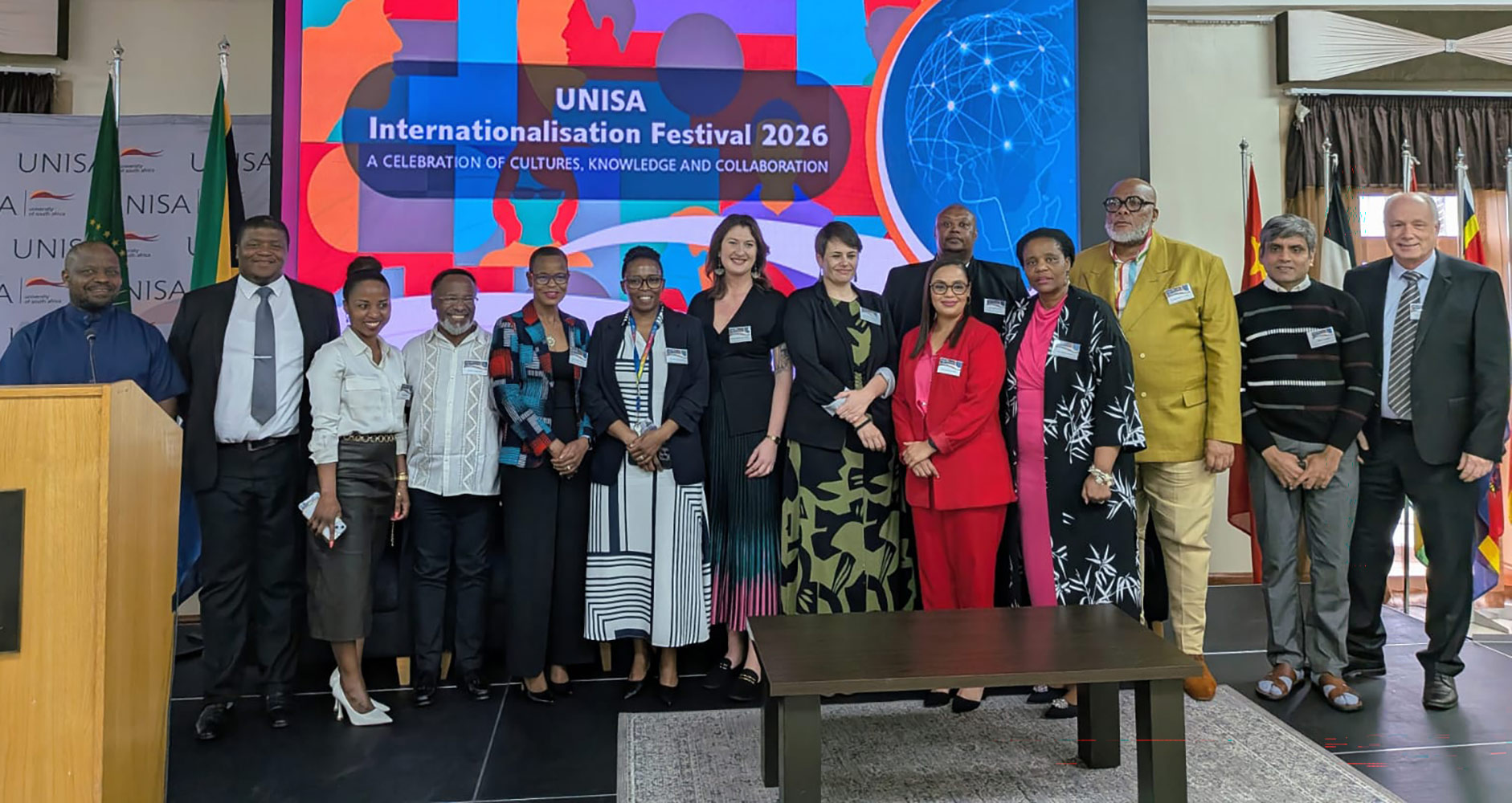
Speakers at Unisa's Internationalisation Festival, held at the Kgorong Building, Muckleneuk Campus, on 18 November 2026.
The University of South Africa (Unisa) opened its three-day 2026 Internationalisation Festival at the Kgorong Building, Muckleneuk Campus, on 18 November, bringing together university leaders, academics, international partners, diplomats and higher education stakeholders to examine the purpose and impact of international collaboration.
Organised by the Directorate of Internationalisation and Partnerships in the Department of Institutional Advancement (DIA), the festival was held under the theme Advancing Transformative Change in African Higher Education through International Partnerships and Collaborations. The opening day, themed Internationalisation for Knowledge Creation, Partnerships and Impact, focused on African universities' role in global knowledge production and how international partnerships can help address the continent’s development challenges.
The discussions moved beyond institutional visibility, international rankings, and student mobility to consider how universities can build reciprocal relationships, strengthen research, and ensure global engagement responds to their societies' needs. Delivering the opening and welcome address on behalf of Prof Solomon Magano, Vice-Principal of Institutional Development, Prof Boitumelo Senokoane, Acting Executive Director of DIA, called for a more purposeful approach to internationalisation. He cautioned against viewing international engagement primarily through university rankings and international student recruitment, arguing that partnerships should instead strengthen knowledge production and contribute to Africa’s development priorities.
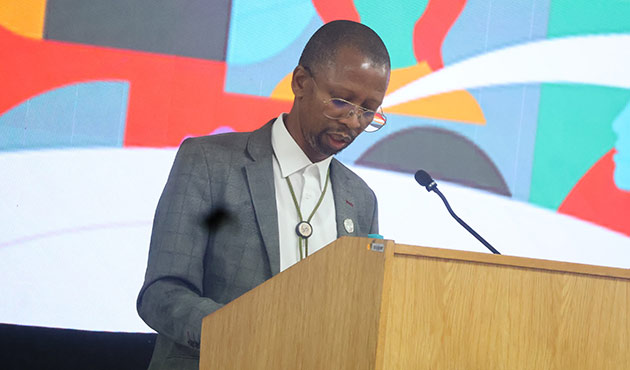
Prof Boitumelo Senokoane, Acting Executive Director of the Department of Institutional Advancement.
Senokoane situated the discussion within the challenges confronting African societies, including climate change, public health concerns and youth unemployment. These issues, he said, require universities to work across national borders, institutional boundaries and academic disciplines. International partnerships should therefore be assessed not by the number of agreements signed, but by the knowledge they generate, the research they support and their contribution to improving people’s lives. "No single university, however large, and no single country, however well-resourced, can resolve these problems alone. Our shared challenges demand shared solutions," he said.
He also linked the festival's objectives to the African Union's Agenda 2063 and the United Nations Sustainable Development Goals, highlighting the contribution of collaboration to education, knowledge creation and sustainable development. His message placed social relevance at the centre of international engagement, emphasising that partnerships must serve not only institutional interests but also the communities and societies universities exist to serve.
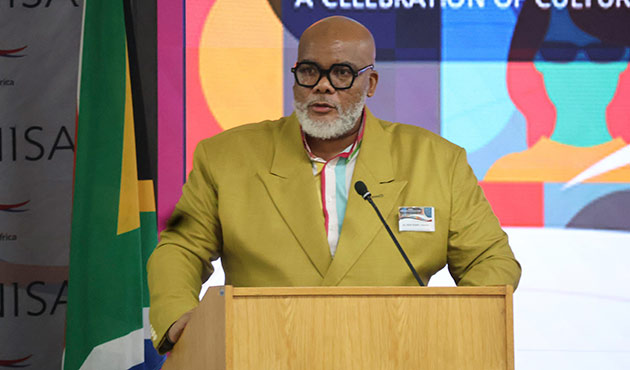
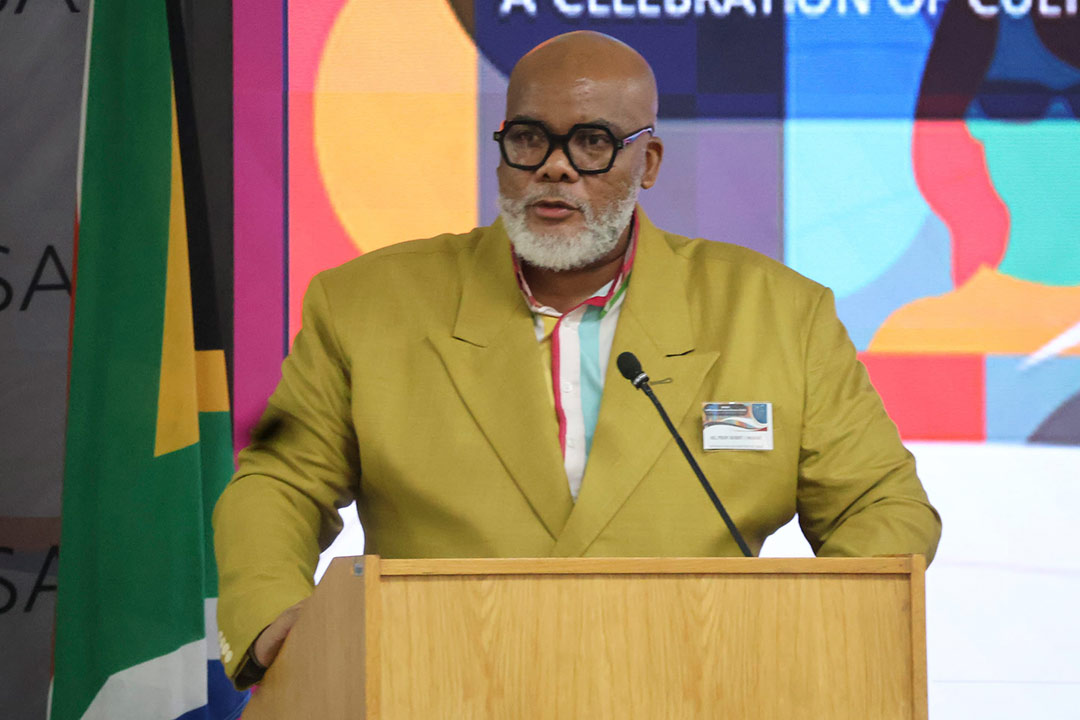
HE Prof Bobby Moroe, Consul-General of South Africa to Nigeria.
The keynote address by HE Prof Bobby Moroe, Consul-General of South Africa to Nigeria, challenged African universities to reconsider the terms on which they participate in global higher education. Moroe called for an approach to internationalisation that advances Africa’s intellectual and development ambitions without compromising its identities, indigenous knowledge systems or institutional purpose. He argued that the question was not whether African universities should engage internationally, but how they could do so while retaining ownership of their intellectual traditions and contributing meaningfully to global scholarship.
This, he said, required moving away from models that position African institutions mainly as recipients of knowledge produced elsewhere. Instead, they should become active contributors to international academic debates, generate knowledge and assert the value of African intellectual traditions. He captured the tension between global engagement and intellectual self-determination in a question that resonated with the festival’s theme: "How do we internationalise without recolonising ourselves? Students should not have to choose between being African and being global. They can be both."
His remarks challenged the assumption that global competitiveness requires African universities to distance themselves from their histories, cultures and knowledge traditions. Rather, African identity and international participation should be viewed as complementary. Universities can build global networks while remaining rooted in their local contexts, confident in their intellectual heritage and responsive to the needs of their communities. Moroe also highlighted indigenous knowledge systems as valuable resources for addressing contemporary challenges, including climate change, healthcare, agriculture and conflict resolution.
He called on universities to document, develop and share this knowledge through meaningful international partnerships, ensuring that African knowledge is recognised not merely as cultural heritage but as a living resource for research, innovation and development. He further encouraged stronger collaboration between universities, diplomatic missions, government and the private sector. Such relationships, he said, should produce practical outcomes through research partnerships, student mobility, investment and sustainable development. His central message was that internationalisation should expand the reach and influence of African knowledge rather than diminish its authority.
The festival also examined how internationalisation translates into institutional practice through a session showcasing the Unisa–Times Higher Education (THE) partnership. Facilitated by Dr Angie Magabane, Director of Internationalisation and Partnerships at Unisa, the session was titled The Unisa–Times Higher Education Partnership: Reflections on Lessons Learned, Challenges Encountered, and Future Opportunities. It brought together Dr Letlhogonolo Marumolwa, Unisa's Director of Business Intelligence, and Mose Petje of Times Higher Education.
The discussion provided an opportunity to reflect on the experiences, challenges and opportunities arising from the partnership. It also highlighted the importance of looking beyond the formal establishment of institutional agreements to consider what partners learn from one another, how they address challenges and how existing relationships can support future collaboration. The session reinforced the broader argument that internationalisation must have a clear purpose. Partnerships are most valuable when they contribute to institutional development, strengthen capacity and create opportunities for meaningful knowledge exchange.
The resources needed to sustain international partnerships were another focus of the opening day. A session titled Funding Collaborative Partnerships that Empower South African Universities explored regional and international funding opportunities to support lasting academic collaboration. Coordinated by Mpho Bopape of Unisa's CSET, the discussion brought together Dr Ndivhuwo Luruli, Chief Strategist in the Office of the Chief Executive Officer at the National Research Foundation (NRF); Huba Boshoff of Erasmus+ and The Knowledge Collab; and Helin Bäckman Kartal, SASUF+ Project Manager at Uppsala University.
The discussion highlighted the financial and institutional requirements of effective internationalisation. Research partnerships need more than shared interests and signed agreements. They require sustained investment, coordinated planning and opportunities for researchers and institutions to work together over time. By examining regional and international funding opportunities, the session drew attention to the importance of partnerships that are financially and institutionally sustainable.
It also placed funding within the wider conversation about equitable collaboration, research capacity and the ability of South African universities to participate meaningfully in international research networks. Chevon Slaambe, Chief Officer of International Partnerships and Relations at the University of the Free State and programme director for the first day, outlined the broader significance of internationalisation in a rapidly changing world. She said universities were increasingly required to respond to technological change, global interconnectedness, evolving workforce demands and complex societal challenges.
Internationalisation, she explained, creates opportunities for learning, stronger partnerships, expanded academic engagement and the production of knowledge that benefits institutions and the communities they serve. "Internationalisation has become more than a strategy. It has become a way of fostering learning, strengthening partnerships, expanding opportunities and creating new knowledge," she said. Slaambe outlined the three-day programme, explaining that the opening day focused on partnerships, collaboration, knowledge creation and institutional transformation. The second day was dedicated to students, with discussions on international learning experiences, mobility and the development of global competencies. The final day would celebrate cultural diversity through exchange and engagement, recognising the role of relationships and mutual understanding in internationalisation.
She encouraged delegates to participate actively, share their experiences and use the festival to establish connections that would continue beyond the event. A traditional musical performance by Dibata Tsa Mmino added a cultural dimension to the opening programme. The performance reinforced the idea that internationalisation is not limited to institutional agreements, academic networks and research collaboration. It also involves people, cultural identities, shared experiences and the mutual understanding needed to build lasting partnerships.
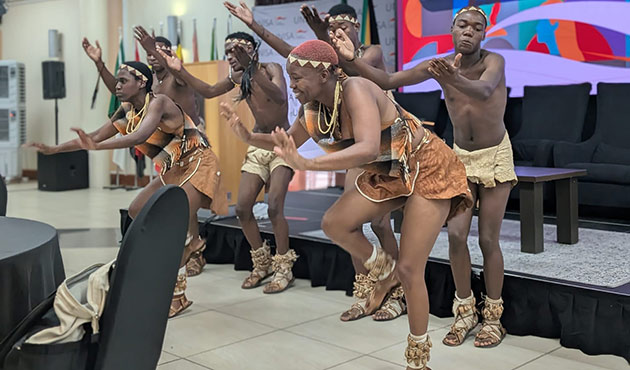
Dibata Tsa Mmino performing at the opening of Unisa’s Internationalisation Festival.
The festival’s student-focused programme also connects with Unisa’s Student Support and Co-Curricular Activities Catalytic Niche Area. This niche area recognises the importance of student development and support beyond formal academic teaching. By creating opportunities for international learning experiences, student mobility and the development of global competencies, the festival provides a platform to consider how engagement beyond the classroom can broaden students’ knowledge, skills and understanding of different cultures and societies. These experiences can complement formal learning by exposing students to different academic environments, perspectives and networks. They also speak to the importance of preparing graduates to participate in an increasingly interconnected world.
The festival's focus on students therefore offers an opportunity for Unisa to advance this catalytic niche area through international engagement. The longer-term value of such initiatives will depend on the extent to which students can access these opportunities and translate their experiences into academic, professional and personal development. The first day established a foundation for the conversations to follow, with a consistent message emerging from the opening address, keynote and panel discussions: internationalisation should be measured by the knowledge it helps universities create, the partnerships they sustain and the contribution their collective work makes to society.
For African universities, this requires more than increasing their international visibility. It calls for intellectual confidence, institutional purpose and a willingness to shape global conversations rather than simply participate in them. It also requires partnerships based on reciprocity, in which African institutions contribute their expertise, knowledge systems and research capabilities as equal collaborators. The festival’s emphasis on knowledge creation and equitable partnerships also speaks to wider development priorities. These include Sustainable Development Goal 4 on quality education, SDG 9 on industry, innovation and infrastructure, and SDG 17 on partnerships for the goals. The discussions also reflect the African Union’s Agenda 2063 and South Africa’s National Development Plan 2030, particularly their emphasis on education, research, innovation, skills development and sustainable development.
For Unisa, the challenge is to ensure that international engagement strengthens its contribution to African scholarship while creating opportunities for students, researchers and communities. This includes giving practical effect to its Student Support and Co-Curricular Activities Catalytic Niche Area by considering how international learning and cultural exchange can enrich the student experience. Ultimately, the question is not simply how far African universities can extend their international reach, but what they can contribute to the world through that engagement. Their place in the global academy will depend not on how closely they resemble institutions elsewhere, but on how confidently they bring their own knowledge, identities and solutions into shared spaces of inquiry.
As the festival continued, that challenge remained central: building an international higher education landscape in which African universities are not merely connected to the world, but help shape the knowledge, ideas and solutions needed to address shared global challenges.
*By Lesego Chiloane, Journalist, Department of Institutional Advancement
Publish date: 2026-11-20 00:00:00.0

 Unisa Internationalisation Festival challenges universities to reclaim Africa's place in global knowledge production
 At 74, Unisa graduate Dr Pinkie Modisane proves it is never too late to chase a dream
 My disability taught me how to walk through life
 Unisa SBL encourages Birch Acres learners to dream big and pursue their ambitions
 Are we really winning? Unisa dialogue confronts identity, migration and the unfinished decolonial project