

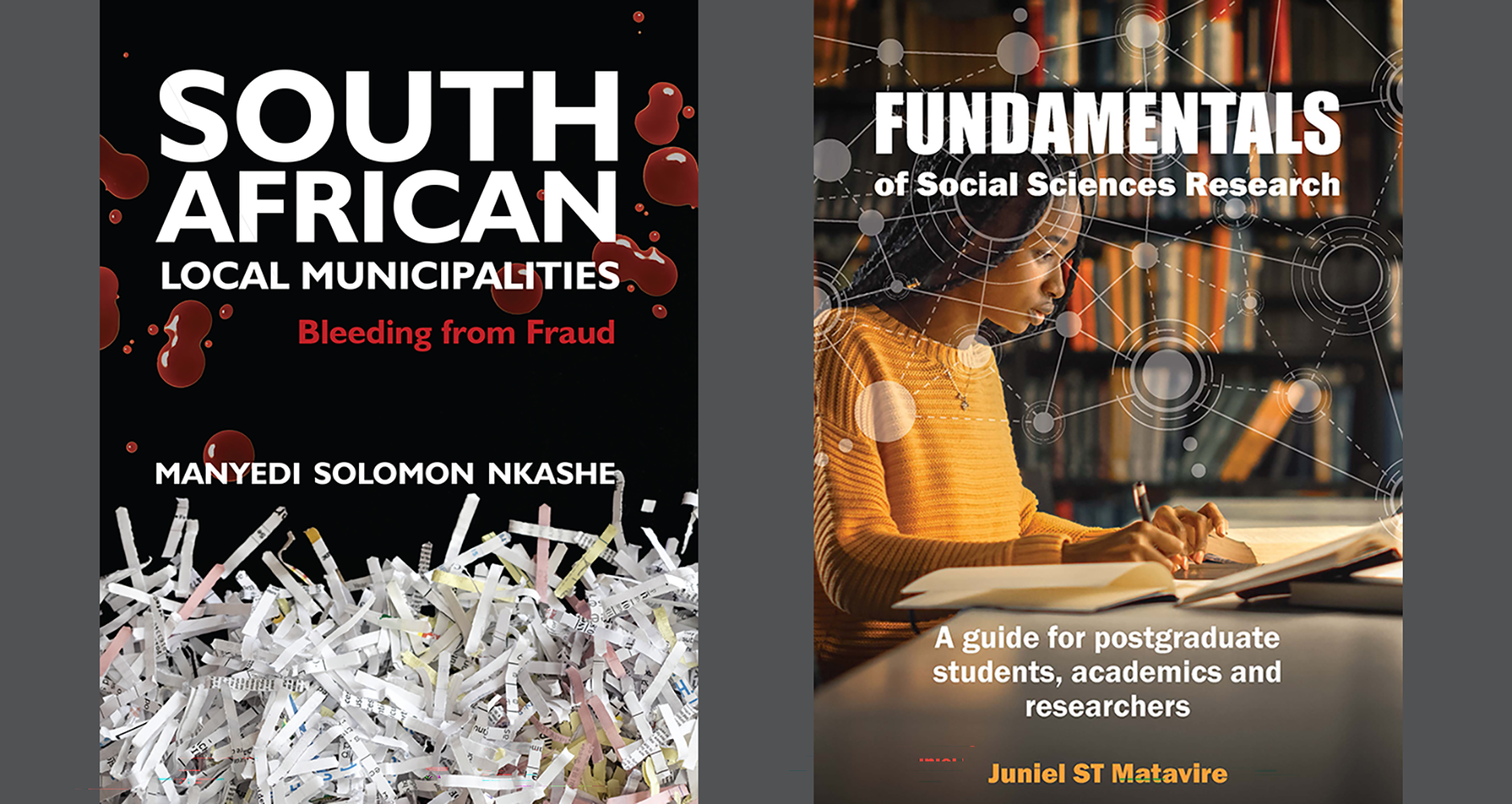
Under discussion were South African local municipalities bleeding from fraud by Dr Manyedi Solomon Nkashe and Fundamentals of social sciences research: A guide for postgraduate students, academics and researchers by Dr Juniel ST Matavire.
From corruption undermining South Africa's municipalities to research methodologies that do not always reflect African realities, two authors have challenged how institutions respond to some of the country's most persistent problems.
Dr Manyedi Solomon Nkashe, author of South African local municipalities bleeding from fraud, and Dr Juniel ST Matavire, author of Fundamentals of social sciences research: A guide for postgraduate students, academics and researchers, unpacked their work during a recent live-streamed book conversation hosted by Unisa Press in collaboration with Unisa Library and Information Services.
While their books tackle markedly different subjects, both authors raised a common question: whether established systems and approaches are adequately responding to the realities confronting South Africa and the continent.
For Nkashe, that means examining weaknesses in government oversight, cooperative governance and the fight against municipal corruption. For Matavire, it means questioning research practices that often privilege Western understandings of knowledge without sufficiently accounting for African histories, cultures and knowledge systems.
Together, the discussions reflected the university's broader pursuit of scholarship that responds to African challenges. Nkashe's work speaks particularly to Sustainable Development Goal (SDG) 16: Peace, Justice and Strong Institutions, while Matavire's focus on accessible and contextually relevant postgraduate research advances SDG 4: Quality Education. Both also intersect with Unisa's commitment to African-centred knowledge production and sustainable development.
Nkashe holds a PhD in Criminal Justice from Unisa and specialises in criminal justice, forensic investigations, good governance and forensic science-related technologies.
His book examines fraud and corruption in South Africa's municipalities and proposes a systematic model through which public-sector employees can be trained to detect, deter and combat corruption as part of the broader professionalisation of the public service.
One of the central problems identified in his research, Nkashe said, is a breakdown in cooperation between the country's national, provincial and local spheres of government.
"I observed that government departments do not understand the meaning and purpose of cooperative governance," he said.
According to Nkashe, weak cooperative governance contributes to inadequate oversight of municipal processes and procedures, creating vulnerabilities that can enable fraud and corruption while further undermining service delivery.
Drawing on his experience in government, he also questioned whether the Department of Cooperative Governance and Traditional Affairs (CoGTA) was adequately fulfilling its responsibility to support and oversee municipalities.
"CoGTA is supposed to fill posts in local government and provide incumbents with assistance and guidance. But this doesn’t happen, and it is a gap that has been overlooked for more than 20 years now," he said.
His argument goes beyond identifying corruption after it has occurred. Nkashe advocates preventative measures, including ethics training for municipal officials as part of the professionalisation of local government.
Timing, he argued, is critical.
Municipal elections are often followed by significant changes in personnel. Ethics training should therefore form part of the induction of incoming officials rather than being introduced towards the end of their tenure.
"Government oversight is not functioning as it should," Nkashe said. "CoGTA should exercise the mandates and powers entrusted to it to conduct oversight at municipalities."
His focus on ethical public administration, effective oversight and corruption prevention places the book squarely within the objectives of SDG 16, which calls for effective, accountable and transparent institutions and measures to reduce corruption and bribery.
It also connects with Unisa's work on sustainable development and inclusive innovation, where effective public institutions are essential to ensuring that development translates into functioning services and tangible improvements in people’s lives.
Where Nkashe interrogates the institutions governing communities, Matavire turns his attention to another institution: the university and the way knowledge itself is produced.
A lecturer in Applied English Language Studies at the Tshwane University of Technology, Matavire focuses his research on research practices, interdisciplinary knowledge production and methodologies across higher education and public administration.
His book draws on years of teaching research methodology and supervising master's and doctoral students and seeks to make research more accessible, particularly to postgraduate students navigating complex theoretical and methodological concepts.
But at the heart of his argument is a deeper concern about whose understanding of knowledge dominates African scholarship.
"Our conceptions of what constitutes knowledge tend to be based on a Western notion of what constitutes knowledge and how knowledge is constructed," Matavire said.
"And I have a problem with that. We abandon our own constructions of what constitutes knowledge when, in fact, we need a meta-methodology and an epistemological practice that recognises the complexities and the circumstances, the histories, the cultures and the knowledge systems of our own circumstances."
His argument is not for abandoning established Western research traditions. Instead, Matavire proposes adapting and expanding research methodologies so that they recognise the contexts in which African researchers and their subjects exist.
The approach speaks directly to SDG 4’s emphasis on inclusive and equitable quality education, but also to Unisa’s drive to strengthen scholarship that is rooted in African experiences, knowledge systems and intellectual traditions.
Matavire said the starting point for the book was his experience with postgraduate students who often struggle with concepts presented in ways disconnected from the intellectual and social contexts they bring into universities.
"The book is informed by the kinds of students and the kinds of experiences I had, and continue to have, in the higher education space and in the postgraduate lecturing and teaching space," he said.
"Students grapple with concepts that are explained in ways that are probably not amenable to the kind of baggage and intellectual capital that they bring to the postgraduate space."
Matavire advocates greater methodological flexibility, including mixed-methods approaches capable of recognising forms of data collection that may sit outside conventional research traditions.
"I am not advocating for a departure from the Western system," he said. "What I am saying is that we need to tailor the Western system so that it is amenable to our realities."
Context, he argued, is crucial to understanding how knowledge is produced and interpreted.
"What may appear to be invalid in a certain context may well be presented as valid if the context is properly described and set up," Matavire said.
Rather than treating research paradigms as rigid and closed, he wants students to understand that phenomena can be approached from different perspectives and that conclusions are influenced by the questions researchers ask, the methods they use and the contexts in which research takes place.
That emphasis on developing African researchers who can interrogate established knowledge while producing rigorous scholarship of their own also supports Unisa’s wider Catalytic Niche Area agenda, particularly where African knowledge systems, postgraduate research capacity and sustainable responses to continental challenges intersect.
Although municipal corruption and postgraduate research methodology may appear to occupy different worlds, the discussion revealed an important connection between the two books.
Both ask what happens when established systems fail to account adequately for the environments in which they operate.
Nkashe argues that South Africa already has structures intended to provide oversight and accountability, but that they must work more effectively if municipalities are to tackle corruption and improve service delivery.
Matavire similarly does not call for established research traditions to be discarded. His argument is that they should be interrogated and adapted to recognise African realities and ways of knowing.
In different ways, both books therefore make a case for institutions that are more responsive to context, whether those institutions are responsible for governing municipalities or producing knowledge.
The conversation was facilitated by Dr Meiya Nthoesane, Director of Unisa Press. Hetta Pieterse, Unisa Press Commissioning Editor and Manager, introduced the authors and provided an overview of their books, while Mokgadi Senyolo, Branch Librarian at Unisa Library and Information Services, delivered the vote of thanks.
For Unisa Press, bringing these conversations into the public domain extends the role of academic publishing beyond producing books. It creates a space in which scholarship can engage directly with the institutional, educational and developmental questions confronting South Africa and the continent.
Click here for more news from Unisa Press.
*By Philip van der Merwe, Editor, Unisa Press
Publish date: 2026-10-05 00:00:00.0

 Unisa Press authors tackle municipal corruption and rethink African research
 Unisa calls on students to reclaim their voice in the age of AI
 Unisa students turn Accounting Sciences knowledge into SAICA award-winning social impact
 Unisa turns to West Coast communities to preserve indigenous knowledge of the sea
 Unisa takes water research from the laboratory into communities