

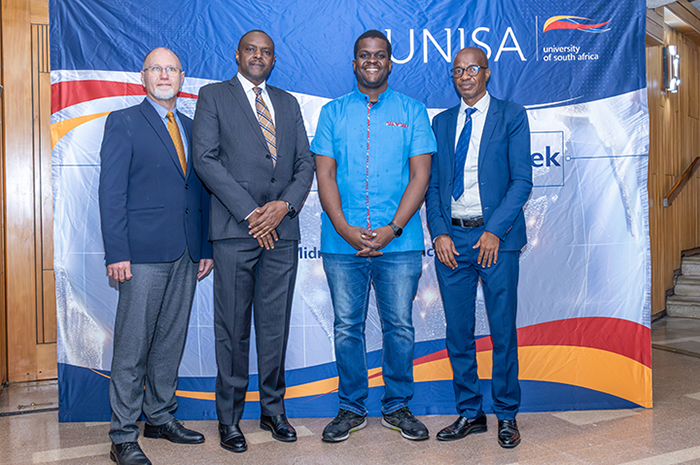
From left: Prof Les Labuschagne, Executive Director of Research, Innovation and Commercialisation, Unisa; Prof William Amos Pallangyo, Management and Leadership Professor, Tanzania Institute of Accountancy; Prof Vukosi Marivate, incumbent of the ABSA Chair of Data Science at the University of Pretoria; and Prof Mpho Ngoepe, Vice-Principal of Research, Postgraduate Studies, Innovation and Commercialisation, Unisa
The opening of Unisa’s Research and Innovation Week, held under the theme "Unisa’s Catalytic Niche Areas: Powering Change", took place on 25 May 2026 at the university’s Muckleneuk Campus.
Reflecting a deeply collaborative spirit, the R&I Week will feature vibrant participation from local and international academics, external partners, student leaders and postdoctoral research fellows (PDRFs) to bridge the gap between academic theory and real-world application.
Led by Unisa’s colleges, this year’s R&I Week will deliberate on strong interdisciplinary engagement across the university’s 10 Catalytic Niche Areas (CNAs), aiming at bridging research and societal needs. However, the R&I Week opening focused solely on digital niche innovations, the Fourth Industrial Revolution and digitalisation as critical components for driving societal transformation.
The R&I Week opening successfully brought together a diverse ecosystem of internal and external stakeholders dedicated to driving academic excellence. Delegates included Unisa’s senior management, heads of department, chairs of department and the university's professional staff.
Delivering a thought-provoking keynote address, Prof Vukosi Marivate, incumbent of the ABSA Chair of Data Science at the University of Pretoria (UP), highlighted the importance of artificial intelligence (AI) in the context of transformative education.
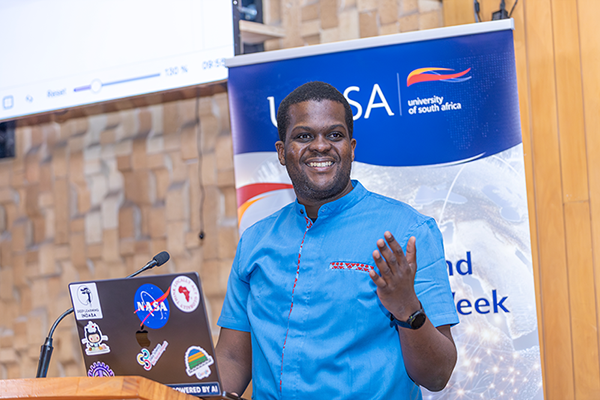
Prof Vukosi Marivate, incumbent of the ABSA Chair of Data Science at the University of Pretoria, delivering the keynote address
Marivate drew on practical examples to illustrate his points, urging delegates to think critically about the role of technology in higher education. He explored how emerging technologies are actively reshaping Africa’s future by turning complex data into insight, and insight into meaningful social change.
In his presentation, Marivate challenged delegates to view AI as more than a technological breakthrough. He argued that AI is also about power, representation and whose knowledge is included in the digital future. Using examples of machine translation errors in African languages, Marivate highlighted how many AI systems continue to perform poorly in contexts where language resources are limited. "Language is more than words," he said. "There is culture, knowledge, geography and lived experience embedded within it." He warned that excluding African languages from AI development risks leaving millions of people behind in an increasingly digital world.
Marivate described the lack of digital resources for African languages as a growing challenge. Comparing it to a high-interest credit card, he suggested that the longer societies delay investing in language technologies, the harder it becomes to catch up. He cautioned that many global AI benchmarks are designed around Western experiences and often fail to reflect African realities. "We cannot assume that a system performing well elsewhere will automatically serve our communities effectively," he said. Instead, he called for human-centred approaches that evaluate AI in light of local languages, cultures and needs.
Central to Marivate's address was the role of community-driven innovation. He highlighted the work of the Masakhane Research Foundation, which promotes natural language processing research in African languages by Africans, for Africans. He also pointed to initiatives such as the Deep Learning Indaba and Data Science Africa, which are building skills and opportunities across the continent. "African AI is not going to build itself," he said. "We have to be actively involved in shaping it."
Much as Marivate is optimistic about AI's potential, he stressed that technology alone cannot solve social challenges. "Technology is a multiplicative force, not an additive one," he said. It amplifies existing strengths and weaknesses rather than creating solutions from nothing. He urged universities to focus on building research capacity, supporting African languages and investing in people.
Officially opening R&I Week, Prof Mpho Ngoepe, Unisa’s Vice-Principal of Research, Postgraduate Studies, Innovation and Commercialisation, welcomed delegates to what he described as a critical moment for higher education. "We are at a critical moment of our scholarship," he said, urging the university community to respond decisively to rapid technological change.
Ngoepe reflected on the timing of the gathering, noting symbolic markers such as Africa Day and the seasonal shift into winter, framing the moment as one of transition and reflection. He used these observations to emphasise renewal and urgency within the research agenda, underlining the need for proactive investment in research, collaboration and innovation capacity. At the same time, Ngoepe cautioned that innovation must remain grounded in society. "The future of digital stewardship must be co-designed with communities, not driven only by algorithms," he said, emphasising inclusion, ethics and equity in technological development.
Closing his address, Ngoepe formally declared R&I Week 2026 open, calling for collaboration, reflection and transformative scholarship. "Let us continue advancing scholarship, innovation and research excellence as we collectively power change," he said.
Facilitating the question-and-answer session, Dr Genevieve James, Deputy Director of Engaged Scholarship under Unisa’s Teaching and Learning, Community Engagement and Student Support Portfolio, raised critical questions on AI, language and access.
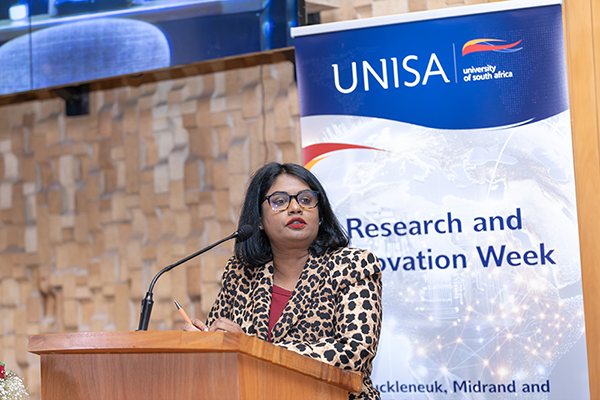
Dr Genevieve James, Deputy Director of Engaged Scholarship, Unisa
James steered a lively and reflective dialogue on AI, language and inclusion. She opened the engagement by challenging delegates to reflect on the deeper purpose of the session, asking: "Was this eye-opening, stimulating? Was this a call for urgent action?" Her framing set the tone for a discussion that moved beyond technology into questions of justice, access and representation.
James questioned the implications of exclusion, asking: "If AI cannot speak my mother tongue, then who is it really speaking for?" She warned that when systems fail to understand local languages such as isiZulu, Sesotho and Xitsonga, they risk excluding the very communities they claim to serve. "If our languages are absent, our stories become invisible," she noted, linking language loss to broader risks of marginalisation in the digital age.
During the proceedings, delegates congratulated Marivate on receiving the Order of Mapungubwe in Silver, which was recently bestowed by President Cyril Ramaphosa. This is South Africa's highest civilian national honour, and was awarded for Marivate’s groundbreaking contributions to AI and data science, and for ensuring that African languages are included in digital technologies.
This year’s R&I Week opening was a resounding success, and a clear message emerged: AI is reshaping society, but also exposing whose languages and knowledge systems are included or excluded.
* By Lesego Chiloane, Journalist, Department of Institutional Advancement
** Photography by Khathamzi Mduduzi, Unisa Multimedia Centre
Publish date: 2026-05-26 00:00:00.0

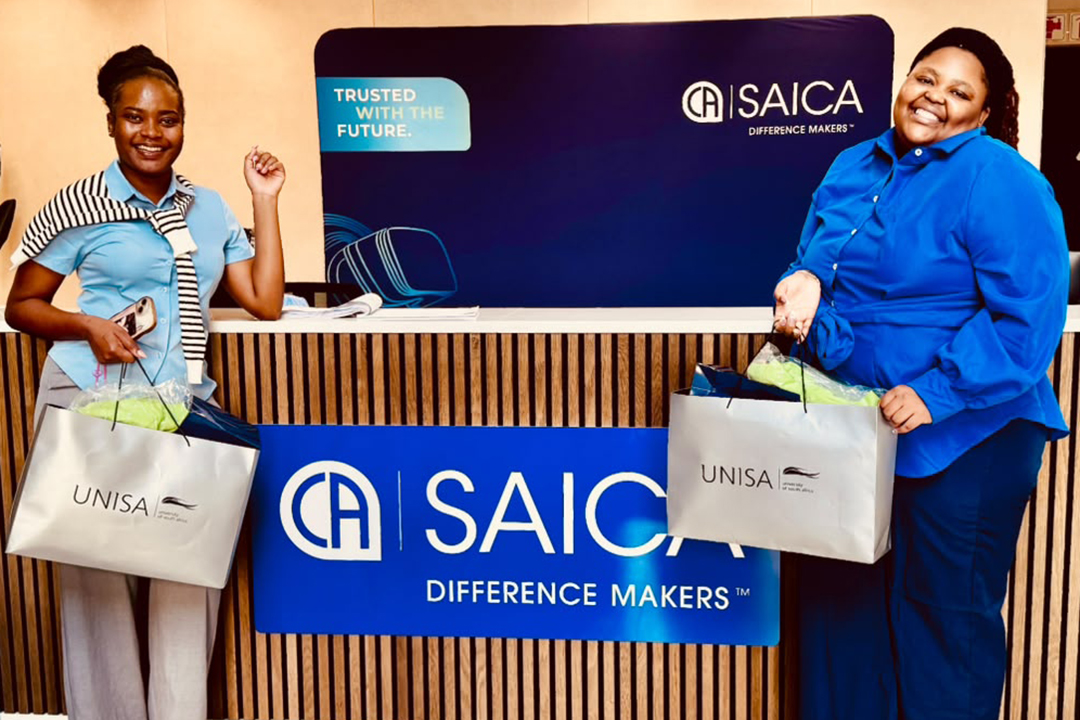 Unisa students turn Accounting Sciences knowledge into SAICA award-winning social impact
 Unisa turns to West Coast communities to preserve indigenous knowledge of the sea
 Unisa takes water research from the laboratory into communities
 Unisa women researchers join KwaZulu-Natal farmers in fight for food security
 Calls for decolonisation and 'unlearning to learn' take centre stage at Unisa-GCIS heritage dialogue