

Postgraduate students, postdoctoral fellows and emerging researchers are helping to shape the future of research at the University of South Africa (Unisa), using the institution's Catalytic Niche Areas (CNAs) to explore complex challenges through collaboration, innovation and community engagement.
Their contribution came into sharp focus during two roundtable discussions held on 31 July as part of the Catalytic Niche Area Symposium. The sessions provided a platform for early-career researchers from different disciplines to reflect on how the CNAs are influencing their research, broadening their networks and creating opportunities to produce research with impact beyond the university.
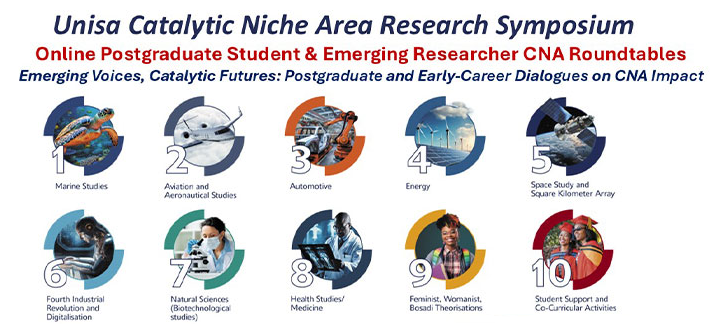
The roundtables were deliberately included in the symposium programme to give emerging scholars greater visibility and to highlight their substantive contribution to CNA research and knowledge production.
Opening the first roundtable, Prof Jessica Murray from the College of Graduate Studies (CGS) highlighted the important role emerging researchers play in advancing the work of the CNAs.
The session, chaired by Dr Perside Ndandu, encouraged participants to reflect on how their involvement in the CNAs had expanded their understanding of research impact, challenged existing assumptions and opened new opportunities for collaboration.

Dr Perside Ndandu, Postdoctoral Research Fellow, College of Graduate Studies
A recurring theme was the need for researchers to look beyond traditional academic boundaries. Participants emphasised the importance of engaging communities, questioning established assumptions and ensuring that research findings can inform policy, professional practice and everyday life.
Dr Mahmood Akbari noted that complex societal problems cannot be addressed from a single perspective. The CNAs, he suggested, create a space where different forms of knowledge and expertise can come together to develop more meaningful and sustainable responses.
For emerging researchers, this approach also creates opportunities to learn from scholars in other disciplines while developing research that is more responsive to the realities of the communities it seeks to serve.
The second roundtable, led by Dr Newman Tekwa, focused on the importance of interdisciplinary collaboration and the need to break down research silos.

Dr Newman Tekwa, Postdoctoral Research Fellow, College of Graduate Studies
Discussions demonstrated the breadth of research taking place within the CNAs, with scholars exploring issues ranging from rural aviation and climate change to astronomy, gender-based violence and computational sciences.
While these fields may appear unrelated, participants highlighted how collaboration across disciplines can introduce new perspectives, methods and solutions. They also stressed that meaningful research partnerships should extend beyond academia.
Government departments, traditional leaders, schools, non-governmental organisations, industry partners and local communities were identified as important stakeholders in ensuring that research responds to real-world challenges.
This outward-looking approach is particularly important for emerging researchers, who are not only developing their academic careers but also finding new ways to connect their research to the needs of society.
Across both roundtables, one message stood out: research should have reach and relevance beyond the university.
The CNA communities of practice provide a platform for researchers to translate knowledge into activities and interventions that engage directly with communities. Examples discussed during the sessions included community workshops, STEM outreach programmes, sky-viewing events, recycling initiatives and collaborative problem-solving projects.
These activities demonstrate how research can move from academic papers and conference presentations into spaces where it can have a tangible impact on people’s lives.
For Unisa students and staff, the growing involvement of emerging researchers in the CNAs also points to the value of creating research environments where collaboration is encouraged and young scholars are given opportunities to contribute meaningfully.
The discussions reinforced the broader purpose of the CNAs: to bring together different disciplines and forms of expertise to produce knowledge that is socially responsive, accessible and capable of contributing to transformative change.
As the next generation of scholars continues to participate in these communities, the CNAs are becoming more than research platforms. They are spaces where emerging researchers can test ideas, build partnerships and develop solutions to some of society’s most pressing challenges.
* By Hanli Wolhuter, Communication and Marketing Specialist, College of Graduate Studies
Publish date: 2026-08-12 00:00:00.0

 From academic setbacks to master's distinction: Unisa graduate's journey of resilience
 Ethiopian doctoral graduates highlight Unisa's growing impact across Africa
 Unisa SBL calls for shift from building houses to creating sustainable communities
 From law graduate to student leader: Tshegofatso Mmope's commitment to justice and empowerment
 Unisa Western Cape honours retirees and celebrates their enduring legacy