
The University of South Africa (Unisa) is strengthening its efforts to promote disability inclusion and accessible education through a series of engagements ahead of the International Day of Persons with Disabilities (IDPD), commemorated annually on 3 December.
As part of its Beyond silence, beyond disability campaign, Unisa Radio hosted a discussion examining the support available to students with disabilities, the barriers they continue to encounter and the importance of creating an inclusive teaching and learning environment. The discussion featured Deenadayalan Moodley, Materials Production and Access Technology Coordinator at the Advocacy and Resource Centre for Students with Disabilities (ARCSWiD), and Unisa student Lesego Rapudi, who shared insights into the university's disability support services and the lived experiences of students navigating higher education.
The engagement forms part of preparations for a three-day disability awareness programme in Polokwane, Limpopo, from 1 to 3 December 2026. The programme is being organised collaboratively by ARCSWiD, the College of Education's Inclusive Education UCDP Project, the College of Human Sciences and Unisa's North-Eastern Region. Held under the theme Beyond silence: Advancing sign language accessibility and inclusion for all, the programme seeks to raise awareness, amplify the voices of students with disabilities, challenge misconceptions and encourage practical improvements in teaching, learning, communication and student support.
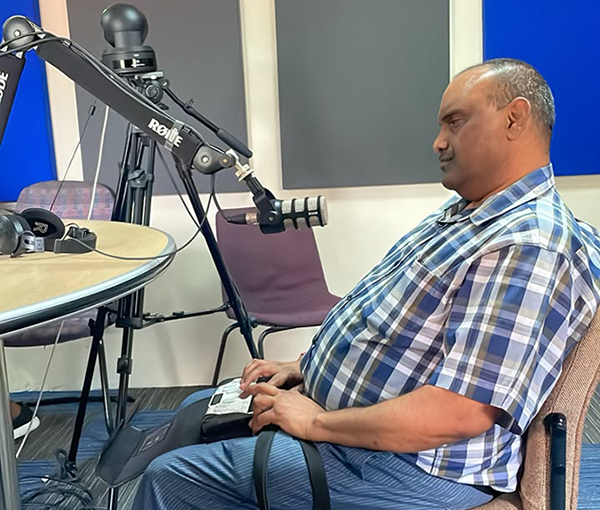
Deenadayalan Moodley, Materials Production and Access Technology Coordinator at Unisa's Advocacy and Resource Centre for Students with Disabilities (ARCSWiD), during an interview with Unisa Radio's Funanani Rambanduli on accessible learning materials, assistive technology and disability inclusion.
Its central message is that meaningful inclusion requires more than the availability of services. Students must be able to access those services and participate fully throughout their academic journeys. Addressing how Unisa accommodates students with different disabilities, Moodley explained that the university considers individual requirements when providing learning materials in alternative formats. Once a student's support needs have been established, the student completes an accommodation form and submits the relevant supporting documentation. This information helps the university determine the appropriate format for making learning materials accessible.
Depending on individual requirements, alternative formats may include Braille, large print, accessible electronic documents, audio resources and DAISY materials. The objective is to ensure that the format in which academic content is presented does not become a barrier to learning or prevent students from demonstrating their knowledge and abilities. Moodley also highlighted the importance of working with academics and lecturers to improve the accessibility of teaching and learning materials. Through engagement and guidance, academics are encouraged to incorporate accessibility considerations when developing their content, rather than waiting for students to encounter barriers before making adjustments.
This approach reflects the principles of Universal Design for Learning (UDL), which promotes flexible ways of presenting information, engaging students and assessing their understanding. By considering accessibility during the development of educational resources, universities can create learning environments that accommodate a wider range of student needs from the outset. The discussion also examined the support available to Deaf and hard-of-hearing students, particularly the importance of accessible communication in higher education. Moodley highlighted the provision of South African Sign Language (SASL) interpretation during selected tutorial sessions and university events. He also emphasised the importance of real-time captioning, closed captions and transcripts, especially for video-based learning materials.
These measures help ensure that students who cannot access audio content are not excluded from academic information, discussions and university activities. Accessible communication is equally important when students interact with university departments, seek academic assistance or participate in institutional programmes. Moodley further explained that Unisa provides access to assistive technology, including computers equipped with text-to-speech and screen magnification software. Such technologies can improve students' independence and access to learning materials, provided they are supported by accessible digital platforms, compatible documents and appropriate technical assistance.
The discussion highlighted that assistive technology is most effective when it responds to individual needs and is integrated into a broader system of student support. Sharing her personal experience, Rapudi emphasised the importance of individual assessments in identifying the support students with disabilities require to succeed academically. She explained that an assessment of her needs resulted in recommendations that included dictation software and additional time during examinations.
These accommodations have helped her navigate aspects of her studies and highlighted the difference that appropriate support can make to the student experience. Her experience also demonstrated that reasonable accommodation is not about giving students an unfair advantage. It is about removing barriers and ensuring that they have an equitable opportunity to demonstrate their knowledge and abilities. Rapudi reflected on the challenges she encountered when transitioning from contact-based learning to Unisa's open distance and e-learning environment.
Adjusting to online learning presented particular difficulties, including challenges with typing and completing academic tasks. However, the support and assistive technology provided by the university helped her manage some of these difficulties. Her experience underscores the importance of ensuring that students are not only informed about available support services but can also access the assistance they need when they need it. For distance education institutions, this requires early identification of support needs, timely assessments, clear referral processes and consistent follow-up, particularly because students may not have regular face-to-face contact with university staff.
Beyond the availability of support services and technology, the discussion explored the responsibility of lecturers, administrative staff and fellow students in creating an inclusive university environment. Moodley stressed the importance of understanding both visible and invisible disabilities, noting that conditions that are not immediately apparent are often misunderstood and can expose students to stigma and discrimination. He illustrated this by referring to students with learning disabilities who may experience difficulties with spelling and subsequently face ridicule from people who do not understand their circumstances.
Such difficulties should not automatically be interpreted as a reflection of a student's intelligence, knowledge or academic potential. He also emphasised the need to equip academics with the knowledge and skills to accommodate students with disabilities when developing learning materials and curriculum content. Although some academic programmes undergo formal reviews only after several years, incorporating accessibility into curriculum development can benefit current and future students.
The discussion reinforced the point that an inclusive university is shaped not only by its policies and support services but also by the attitudes and everyday conduct of its employees and students. Building awareness must therefore go hand in hand with respectful engagement, ongoing training and institutional accountability. The campaign's emphasis on sign language accessibility featured prominently in the discussion, with Moodley calling for greater awareness and acceptance of South African Sign Language. He explained that communication barriers can contribute to loneliness and social isolation, particularly when Deaf individuals are excluded from everyday conversations and interactions.
With South African Sign Language recognised as South Africa's 12th official language, he encouraged members of the university community and the wider public to learn and embrace sign language. Greater awareness and use of SASL would help improve communication between Deaf and hearing people, making educational institutions, workplaces and public spaces more accessible. The message is particularly relevant to higher education, where communication is central to teaching, learning, student support and participation in academic life.
Promoting sign language should therefore extend beyond commemorative events and become part of the university's everyday commitment to accessibility. The Unisa Radio discussion reinforced the importance of moving beyond disability awareness towards practical and lasting institutional action. While policies, assistive technologies and support services are essential, their effectiveness ultimately depends on whether students can access them and whether the university community understands its shared responsibility for inclusion.
This requires continued collaboration between student support departments, academic colleges, administrative units and student leadership, with the lived experiences of students with disabilities informing the development and evaluation of institutional services. The initiative also supports the United Nations Sustainable Development Goals, particularly SDG 4 on inclusive and equitable quality education and SDG 10 on reducing inequalities. At the continental level, it advances the African Union's Agenda 2063 vision of an inclusive society in which all citizens can participate meaningfully in development. It also speaks to South Africa's National Development Plan, which emphasises equality, social inclusion and the removal of barriers that prevent persons with disabilities from participating fully in society.
As Unisa prepares for the International Day of Persons with Disabilities on 3 December, the campaign calls on the university community to translate awareness into action through accessible systems, responsive support and meaningful participation. Ultimately, the message of Beyond silence: Advancing sign language accessibility and inclusion for all is that accessibility is not a privilege, reasonable accommodation is not a favour, and inclusion is a collective responsibility.
* By Romeo Gavhi, Kefiloe Tshabalala, Gugu Mngadi, Mampe Phora, Bareng Madubanya and Bheki Nxumalo
Publish date: 2026-11-09 00:00:00.0

 Unisa champions disability inclusion and sign language accessibility ahead of International Day of Persons with Disabilities
 Unisa PhD student Gosego Sedikelo wins prestigious 2026 Eni Award for sustainable battery recycling research
 Unisa and TVET Colleges join forces to drive rural economic development through education and technology
 Unisa deploys 100 Election Observers to strengthen democracy and electoral accountability
 Unisa champions disability rights, inclusion and accessibility through month-long awareness campaign