

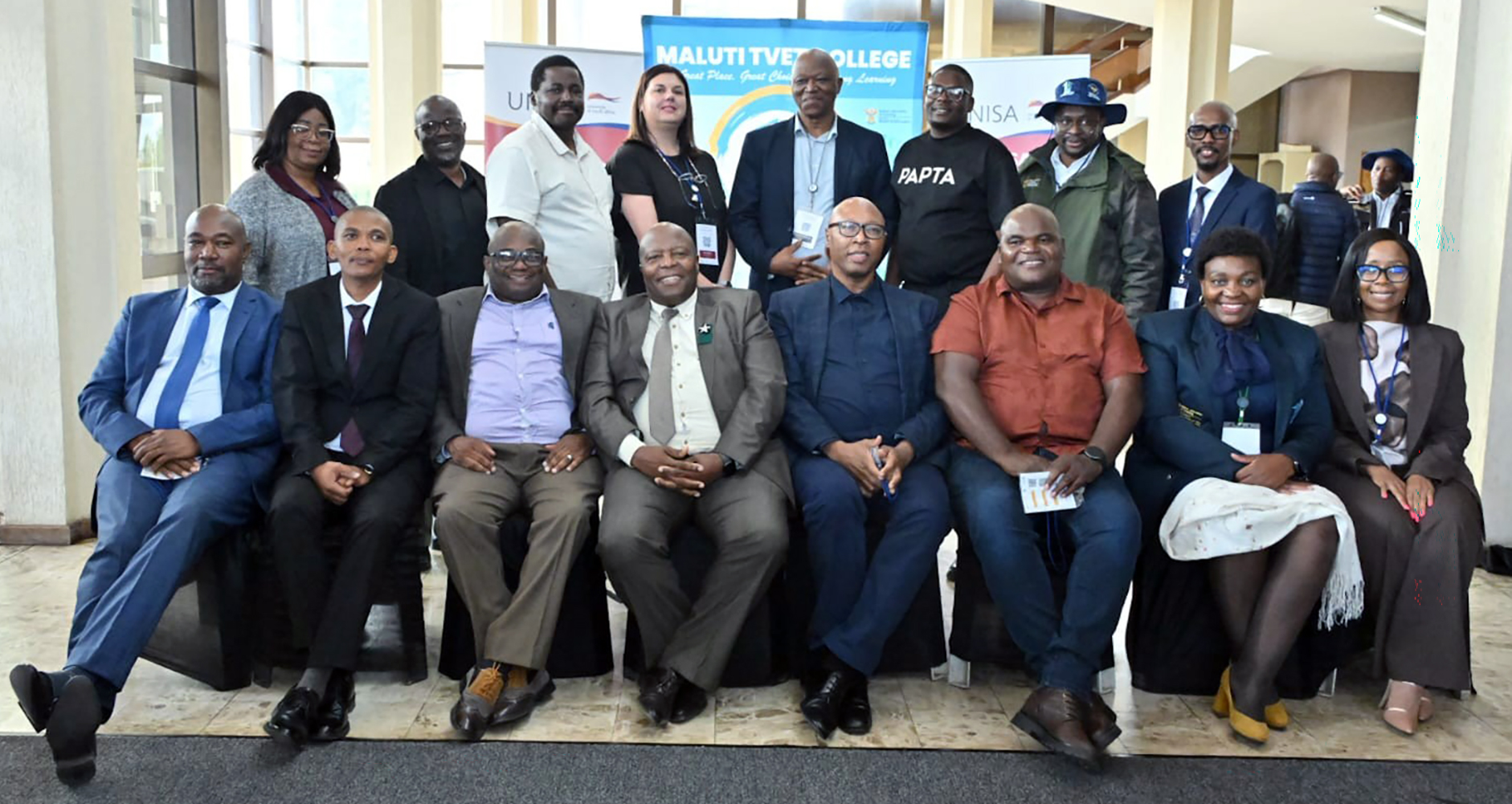
Representatives and stakeholders from Unisa, Maluti TVET College and the post-school education and training sector gather during the Second Annual Seminar held in Phuthaditjhaba, Free State, on 6 and 7 October 2026. The engagement focused on strengthening institutional collaboration, skills development and digital innovation to support rural economic transformation.
Education and technology can transform rural economies, but unlocking that potential requires stronger partnerships among universities, technical and vocational education and training (TVET) colleges, industry, and communities.
This was the central message of the Second Annual Seminar jointly hosted by the University of South Africa (Unisa), Maluti TVET College and Goldfields TVET College. Held at the Thabo Mofutsanyana District Municipality Chamber in the Old Parliament Building, Phuthaditjhaba, Free State, the seminar brought together academics, education practitioners and stakeholders from the post-school education and training (PSET) sector to examine how education, skills development and emerging technologies can contribute to rural economic transformation.
Under the theme “Harnessing education, training and technology for rural economic development: A pathway to transformation”, participants explored practical approaches to strengthen teaching and learning, improve graduate employability, and ensure education responds to the changing needs of communities and industry. The discussions placed particular emphasis on the challenges facing rural communities, where limited access to technology, specialised training and employment opportunities can restrict economic participation.
The opening day focused on the importance of institutional collaboration in advancing education and economic development. Hopang Mokotjo, Human Resource Coordinator at Unisa's Midlands Region, directed the programme, while Motlalepula Elias Tsotetsi, Principal of Maluti TVET College, welcomed delegates and participating institutions. Outlining the purpose of the seminar, Angie Bopape, Acting Director of Unisa's Midlands Region, highlighted the importance of partnerships in strengthening education, expanding access to skills development and supporting community transformation.
The programme brought together perspectives from university leadership, TVET colleges and education specialists, with presentations examining how institutions can collaborate more effectively to respond to national development priorities. Liana. Joubert, Acting Chief Financial Officer of Unisa, presented on “United for impact: Forging partnerships for sustainable local, national, continental and global development”.
Her presentation placed institutional cooperation at the centre of efforts to address development challenges and strengthen the contribution of education to society. Dr Nicky. Tjano, Acting Director of Teaching and Learning at Unisa, explored the role of digital innovation in reshaping higher education, preparing communities for technological change and supporting sustainable livelihoods. The discussions highlighted the need for educational institutions to remain responsive to emerging technologies while ensuring that students and communities are not excluded from the opportunities they create.
A key focus of the seminar was the role TVET colleges can play in strengthening rural economies through relevant qualifications, practical training and industry partnerships. Prof Motalenyane. Modise, from the Central University of Technology and Dr Raymond. Patel, Chairperson of the Council at Maluti TVET College, shared perspectives on how TVET institutions can respond to changing economic and technological demands. Their contributions explored the importance of equitable access to training, graduate employability, digital transformation and developing skills that meet the needs of local industries.
The discussions also examined how colleges can strengthen their relationships with employers to ensure that training programmes provide students with relevant knowledge and practical experience. For rural communities, these partnerships are particularly important because they can help connect education and training with local economic opportunities. Rather than preparing students only for employment outside their communities, responsive TVET programmes can also support entrepreneurship and skills development that contribute to local growth.
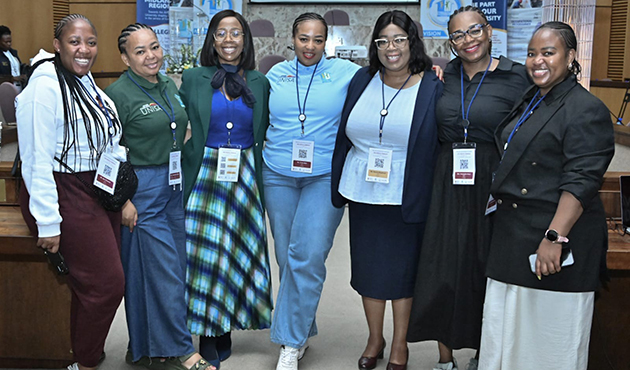
Delegates and members of the organising team from Unisa and partner institutions at the Second Annual Seminar in Phuthaditjhaba. The two-day engagement provided a platform for knowledge-sharing, professional networking and discussions on strengthening education and training opportunities in rural communities.
The afternoon programme continued with presentations on curriculum innovation, stakeholder collaboration and digital transformation. Dr Pitso. Kheza from Lephalale TVET College contributed to discussions on improving programme relevance and strengthening knowledge transfer in rural communities. The first day’s proceedings concluded with remarks by Prof Oupa. Mashile, Acting Deputy Registrar at Unisa, followed by a demonstration of artificial intelligence (AI) tools facilitated by Unisa's Academic Development Open Virtual Hub Unit.
The demonstration provided an opportunity for participants to engage with emerging digital technologies and consider their potential applications in education and training. The second day shifted attention towards practical strategies for strengthening teaching, learning and industry responsiveness. The programme was directed by Priscilla Mvimbe, a lecturer at Goldfields TVET College.
Opening the research presentations, Prof Sello Mokoena, Coordinator of the Unisa UNEVOC Centre, examined how strengthening the competencies of TVET lecturers can improve collaboration between colleges, industry and communities. The discussion highlighted the importance of continuous professional development in ensuring that lecturers remain equipped to prepare students for changing workplace requirements.
Other presentations explored the contribution of renewable energy skills and technology adoption to rural economic development. Participants also examined the experiences of hospitality graduates entering entrepreneurship, highlighting the importance of preparing students not only for formal employment but also for self-employment and business development. Work-integrated learning featured prominently, with discussions focusing on how stronger relationships between colleges and employers can provide students with practical experience and improve their transition into the workplace.
These engagements reinforced the need for training programmes that respond to real economic opportunities and the skills required by industry. The seminar also examined how curriculum innovation and technology can help address inequalities in access to education and employment. One of the areas explored was the importance of encouraging women’s participation in science, technology, engineering and mathematics (STEM).
Presentations considered how curriculum development and institutional support can create opportunities for more women to pursue studies and careers in these fields. The establishment of digital skills hubs within rural TVET colleges was another important topic. Such facilities could help expand access to digital training and provide students and surrounding communities with opportunities to develop skills relevant to an increasingly technology-driven economy.
Participants also considered the role of renewable energy training in preparing young people for emerging industries and supporting sustainable economic activity. Together, these discussions demonstrated the importance of ensuring that technological advances are accompanied by accessible education and skills development. While innovation and industry partnerships were major themes, the seminar also recognised that students require appropriate academic and personal support to succeed. Nteeng Moatlhodi, Senior Student Counsellor at Unisa, presented on developing a framework to strengthen student support services, drawing on a case study of South African TVET colleges.
Her contribution highlighted the importance of support systems that respond to students' academic and personal circumstances. Other presentations addressed lecturer upskilling and reskilling, academic support for undergraduate students with low vision, and the alignment of occupational qualifications with industry requirements. These discussions emphasised that meaningful educational transformation must consider both the quality of teaching and the barriers that may prevent students from participating fully in learning.
Strengthening academic support and making educational opportunities more inclusive are essential to improving student success and ensuring that graduates are equipped to contribute to society. The seminar concluded with a vote of thanks delivered by Francis Mahlangu, Principal of Goldfields TVET College, who acknowledged the contributions of the participating institutions, presenters, delegates and organisers. The seminar's focus on education, technology and rural economic development reflects Unisa's commitment to research, teaching and community engagement that respond to societal needs. The discussions support several United Nations Sustainable Development Goals, particularly SDG 4, which promotes inclusive and equitable quality education, and SDG 8, which focuses on decent work and economic growth.
The emphasis on digital innovation, renewable energy skills and stronger industry partnerships also contributes to the objectives of SDG 9, which promotes industry, innovation and infrastructure. By examining opportunities for women in STEM and improved access to education for students with disabilities, the seminar further addressed issues relevant to SDG 5 on gender equality and SDG 10 on reducing inequalities. These priorities complement South Africa's National Development Plan 2030, which recognises education, skills development and employment creation as essential to reducing poverty and inequality.
They also resonate with the African Union's Agenda 2063, particularly its vision of a prosperous Africa supported by education, innovation, industrial development and an appropriately skilled workforce. For Unisa, the collaboration demonstrates the value of working across institutional boundaries to connect academic knowledge with practical skills development and community needs. The Second Annual Seminar provided a platform for universities, TVET colleges and other stakeholders to exchange research, share experiences and identify areas for further collaboration.
It also highlighted the importance of aligning education and training with economic opportunities, particularly in rural areas where access to specialised skills and employment remains a challenge. Through their partnership, Unisa, Maluti TVET College and Goldfields TVET College are contributing to discussions on how the post-school education and training sector can become more responsive, inclusive and relevant to the communities it serves. The engagement reinforced the need to strengthen digital capabilities, improve curriculum relevance, expand industry partnerships and provide students with the support required to succeed.
Although the seminar provided an opportunity to share research and proposals, translating these discussions into lasting change will require continued cooperation and practical implementation.
* By Mampoledise Emily Malo, Administrative Assistant Support (ATS), Unisa Midlands Region
Publish date: 2026/11/06

 Unisa PhD student Gosego Sedikelo wins prestigious 2026 Eni Award for sustainable battery recycling research
 Unisa and TVET Colleges join forces to drive rural economic development through education and technology
 Unisa deploys 100 Election Observers to strengthen democracy and electoral accountability
 Unisa champions disability rights, inclusion and accessibility through month-long awareness campaign
 Unisa KwaZulu-Natal Region promotes staff well-being through health and wellness day