

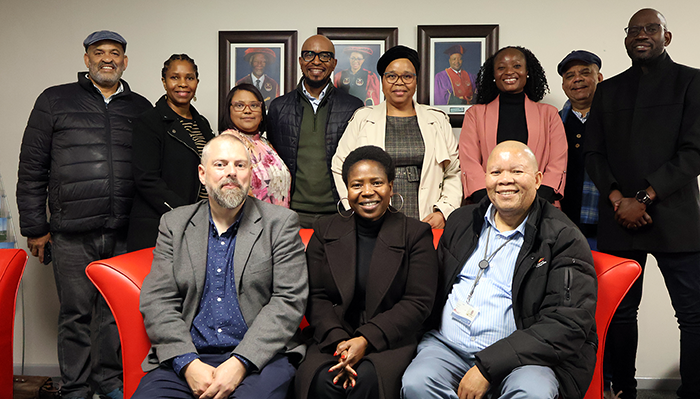
Delegates from the College of Agriculture and Environmental Sciences and the Western Cape Region
The Unisa Western Cape Region recently hosted a high-level delegation from the College of Agriculture and Environmental Sciences (CAES) as part of ongoing efforts to strengthen collaboration in implementing the university's catalytic niche areas and broader institutional priorities.
The delegation, led by CAES Acting Executive Dean, Prof Ntanganedzeni Mapholi, and supported by CAES Acting Deputy Executive Dean, Prof Ashley Gunter, and several chairs of department, engaged with the regional leadership team led by the Regional Director, Motale Nkgoang. The engagement provided an opportunity to explore collaborative approaches to teaching, learning, research, student support, community engagement and partnership development in support of the university's strategic objectives.
Welcoming the delegation, Nkgoang highlighted the importance of closer collaboration between colleges and regional structures to advance the university's academic project and strengthen its impact within communities.
"The regions," he said, "are uniquely positioned to support the implementation of institutional priorities through local partnerships, infrastructure, student support and community engagement. This engagement marks an important first step in identifying practical ways of translating strategic intentions into initiatives that have a tangible impact on students and communities."
A key focus of the engagement was implementing the university's catalytic niche areas. While discussions initially centred on opportunities linked to marine studies, Mapholi emphasised the interconnected nature of the catalytic niche areas and the importance of adopting an integrated approach to implementation.
The discussions highlighted the linkages between marine studies, agriculture, energy, aviation, research, innovation, community engagement and student support, among others, illustrating the interconnected nature of the university's catalytic niche areas. Regional and CAES colleagues reflected on how these areas can reinforce one another and contribute collectively to the university's strategic objectives.
Reflecting on the significance of the engagement, Prof Mapholi noted: "The university's catalytic niche areas present important opportunities for innovation, partnership development and societal impact. Their success depends on our ability to work collaboratively across institutional structures and disciplines, while recognising the important role that regions play in connecting the university with students, communities and external stakeholders."
The engagement was characterised by open and constructive dialogue between the CAES delegation and the regional team. Rather than focusing solely on existing activities, discussions explored future possibilities, shared challenges and practical opportunities for collaboration. The interactive nature of the engagement created space for both teams to identify areas of mutual interest and collectively consider how the university's strategic priorities could be translated into meaningful initiatives within the region.
Infrastructure development emerged as a key discussion point. Discussions explored opportunities for laboratory facilities, computer laboratories, office accommodation for extraordinary professors and postdoctoral fellows, and collaborative research and innovation spaces.
Importantly, there was a shared understanding that future infrastructure developments within the region should be designed as multi-purpose institutional assets. Rather than serving a single discipline or college, such facilities should support teaching, learning, research and community engagement across colleges and in catalytic niche areas. This approach reflects the view that regions are an integral part of the university and that regional infrastructure should contribute to the broader institutional mission.
The subsequent campus walkabout provided the CAES delegation with an opportunity to view existing facilities and identify potential spaces that could support future initiatives. Discussions during the walkabout reinforced the importance of creating flexible environments that can accommodate a range of academic and support activities while strengthening regional capacity.
Student success and academic support featured prominently throughout the engagement. The college highlighted concerns regarding student preparedness in gateway subjects such as Mathematics and explored opportunities for regional involvement in bridging and support initiatives. The discussions reinforced the important role that regions can play in extending academic support closer to students and communities.
The engagement also explored opportunities for engaged scholarship and community-based projects. Particular attention was given to strengthening partnerships with schools, communities, government departments and industry stakeholders to support agricultural education, skills development and community empowerment. Work-integrated learning opportunities, practical training requirements and support for incarcerated students were also identified as areas requiring further collaboration and exploration.
The CAES management team further highlighted the importance of communication and stakeholder engagement in supporting the college's strategic objectives. Discussions explored ways in which the region and the college could work together to strengthen institutional visibility, showcase successful projects and identify strategic partners capable of supporting future initiatives.
A key outcome of the engagement was agreement that Gunter would develop a project plan incorporating the opportunities identified during the discussions. Regular engagements between CAES and the Western Cape Region will be established to monitor progress, refine priorities and support implementation. This collaborative approach highlighted the potential for this engagement between CAES and the Western Cape to serve as a model for future partnerships between colleges and regions.
The engagement marks an important milestone in strengthening collaboration between CAES and the Western Cape Region. More importantly, it represents a significant step towards operationalising the university's strategic vision through collaborative planning, shared infrastructure, strengthened partnerships and integrated support systems that benefit students, communities and society.
* Submitted by John Abrahams, Head: Facilitation of Learning, Western Cape Region
Publish date: 2026-06-12 00:00:00.0
 Unisa's Eastern Cape open day attracts strong student interest
 Unisa strengthens collaboration to advance catalytic niche areas
 Call to foster interdisciplinary collaboration
 Doctoral graduate unpacks labour relations crisis in Ghana's public sector
 Public procurement reform takes centre stage at Unisa colloquium