
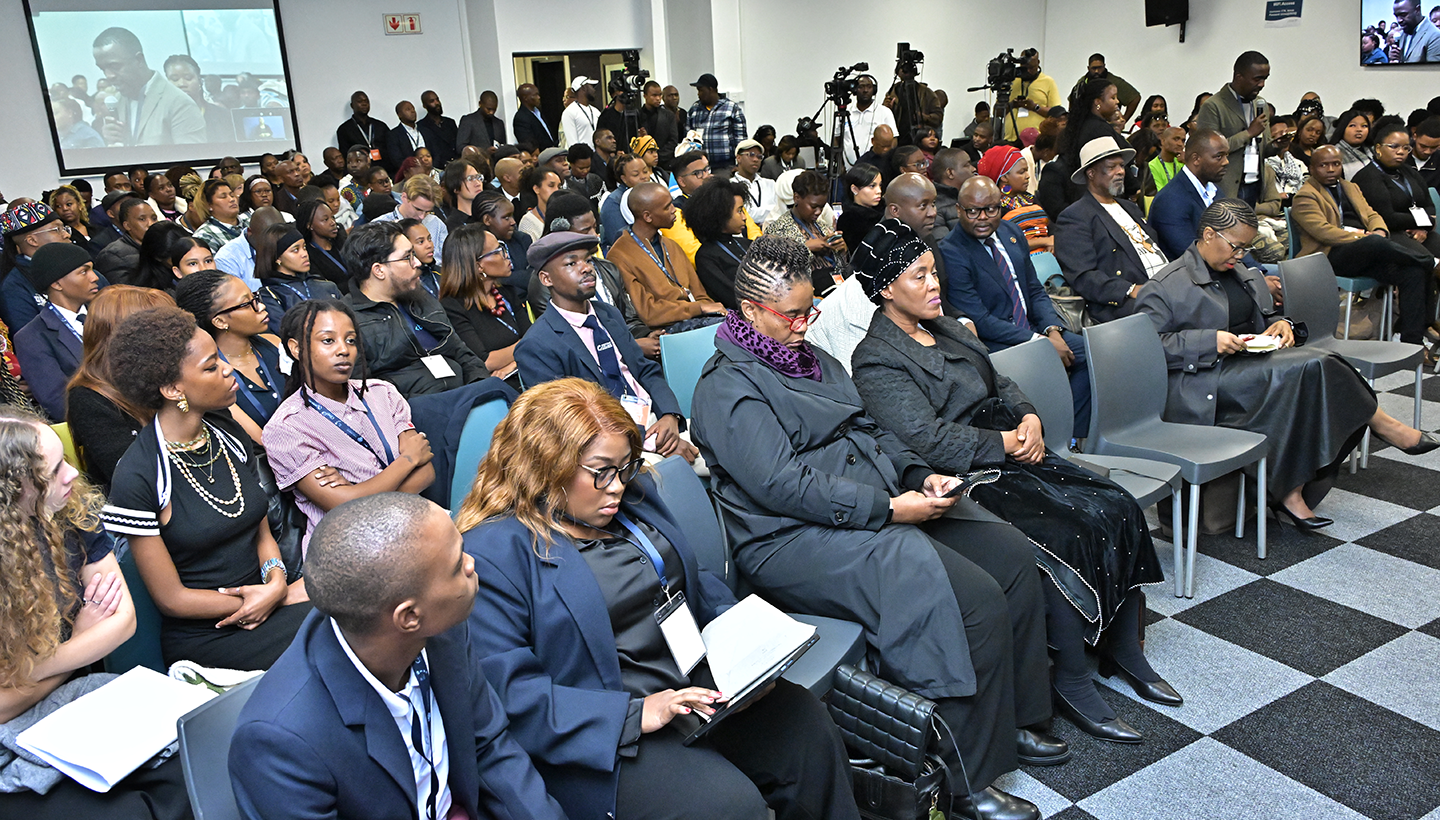
Young people took centre stage at the event
Concluding a week-long series of Africa Day reflections and dialogues on Africa’s future, Unisa and the Thabo Mbeki Foundation (TMF) hosted a Post-Lecture Student Town Hall, turning the spotlight on student voices, civic responsibility and the role of universities, women and young people in carrying Pan-African commitment into practice.
Held on 25 May 2026 at the Unisa Parow Campus, the session provided a structured platform for responding to the week’s arguments. Notably, it convened in the 50th anniversary year of the 16 June uprisings, and young people took centre stage to make their voices heard on South Africa’s development issues.
In his opening and welcoming remarks, Thabo Mbeki, Unisa Chancellor and Former President of South Africa, outlined the purpose of the engagement and its primary objectives. Mbeki highlighted that the platform enables youth and students to lead the continent towards a better future and to address its challenges. "Higher education," he said, "serves a primary role in developing students as thinkers of the country and their people."
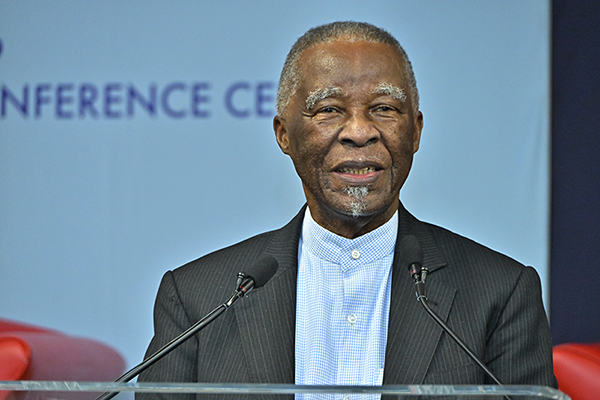
Thabo Mbeki, Unisa Chancellor and Former President of South Africa
Mbeki commended Prof Puleng LenkaBula, Unisa Principal and Vice-Chancellor, for her outstanding leadership, spotlighting her role in ensuring that the university produces future leaders.
Reflecting on his keynote address at the Africa Day Lecture, Dr Kayode Fayemi, Former Governor of Ekiti State in Nigeria, emphasised the importance of the engagement and shared key insights from his lecture, highlighting the challenges faced in Africa. He stressed that, being ideological towards providing solutions, the youth must develop ways to change and steward the roadmap towards the African Union’s Agenda 2063. Fayemi reinforced Mbeki’s "I am an African" speech to encourage youth to engage interactively and take shared responsibility.
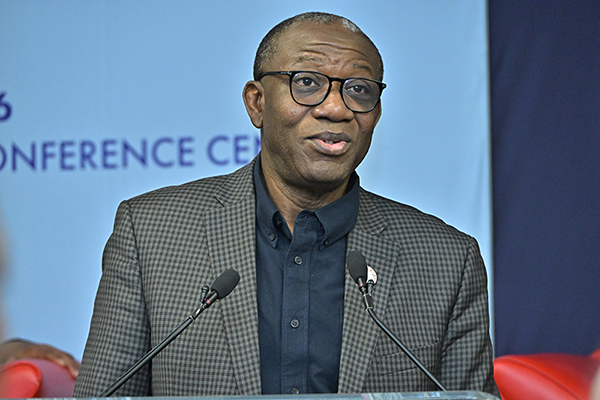
Dr Kayode Fayemi, Former Governor of Ekiti State, Nigeria
Central to the proceedings was a question-and-answer session, in which students raised inputs from Mbeki and Fayemi on compelling issues, including guiding young women to make meaningful contributions to South Africa’s development, curbing the alarming rise of Afrophobia and divisions on the continent, strengthening political leadership to improve management of the state’s financial resources, the inclusion of women in key leadership positions, universities’ contributions towards building African sovereignty and solidarity, decolonising academic curriculums to serve African interests, and replacing the Roman/Latin legal systems with African traditional laws and governance systems.
Responding, Mbeki urged the students to study the nation's political and economic history to better understand its current state and develop relevant strategies to usher in the desired change. "The democratic South Africa inherited a declining economy, which was further halted by the global crisis in 2008," Mbeki stated. Despite various challenges, he said that he oversaw economic growth during his tenure as president of the nation, offering students hope to overcome the challenges facing them and make a lasting impact.
Continuing, Mbeki lamented the lack of progressive movements in South Africa to successfully tackle long-standing and emerging issues plaguing the country, identifying gaps for young people to step up and fill.
Commenting on the role of higher education institutions, Mbeki encouraged technical and vocational education and training (TVET) colleges and universities to access the African Union’s (AU's) evaluation report on the first decade of Agenda 2063 and assess their decisions and functions with it to ensure alignment in championing African interests.
To provide guidance on relevant actionable steps, Fayemi outlined three fundamental documents from the AU, namely the Constitutive Act of the African Union, Agenda 2063, and the Agreement Establishing the African Continental Free Trade Area, declaring that they detail the Africa we want, in politics, the economy, the gender question and children’s rights, among others.
Speaking on implementing Pan-Africanist policies, Fayemi noted: "The citizens are closest to our local governments, and it is what happens at that level that mostly affects the people." With that understanding, he implored national policymakers to pay close attention to issues at the grassroots level to formulate relevant policies for society. On the continental level, he applauded the policies of the AU, which he said are "focused on African trade, a common African currency, and establishing an African central bank".
Overall, Mbeki and Fayemi successfully addressed the students' questions and affirmed the youth’s determination to bring African solutions to African problems.
The week-long Africa Day celebrations reaffirmed Unisa and TMF’s commitment to Pan-Africanism, engaged scholarship, advancing the African agenda and shaping the continent’s future.
Read also:
Africa Day Lecture champions African unity
Unisa hosts high-profile business breakfast in buildup to Africa Day Lecture
* By Victor Malatji and Nontsikelelo Ndebele, Journalist Interns, Department of Institutional Advancement
** Photography by Shooheima Champion, Multimedia Centre
Publish date: 2026-05-26 00:00:00.0

 Unisa students take top honours at 2026 HEQAF Student Paper Presentation Competition
 Young KZN photographers explore the ocean through Unisa lens
 Prof Brendon Barnes champions climate justice through psychology
 Prof Vhahangwele Masindi sets sights on a water-secure future
 Unisa's Top 100 CTA achievers recognised as accounting firms seek emerging talent