

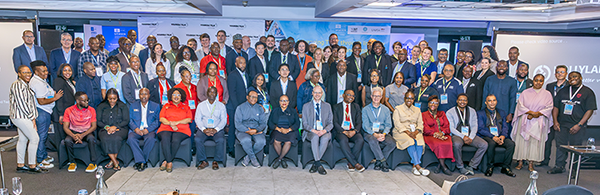
Attendees on day two of the conference
Hosted by UNEVOC-UNESCO and Unisa, in collaboration with Durban University of Technology and JET Education Services, the ongoing three-day BILT conference, taking place from 19 to 21 May 2026, is being held in Umhlanga.
As day two of the conference convened, discussions centred on the evolving role of skills development in preparing learners for a changing world of work, with reflection on how training systems can better respond to innovation and labour-market needs.
Following the official opening of the conference, a panel discussion under the sub-theme "From policy to practice: Governance models for industry-responsive TVET" brought together stakeholders across different regions.
The interactive session unpacked responsive TVET systems, which are internationally designed through governance frameworks that align education systems, labour-market priorities, industrial strategy and stakeholder accountability. The second aspect focused on sustainable industry engagement. In the latter, the movement beyond informal collaborations towards structured institutionalised partnerships was outlined as an important element.

From left: Chigozie Okonkwo, Birgit Thomann and Maribel Illig
Deliberating on "Transforming TVET systems in Africa: Policy, partnerships and the continental TVET strategy", Chigozie Okonkwo, Education and Skills Advisor at the African Union Commission, recognised the theme as a reflection of conditions that determine whether TVET becomes a sustainable system.
Acknowledging Africa’s need for strong TVET systems, as emphasised by the African Union, Okonkwo stated that for the achievement of inclusive growth, decent jobs and better opportunities for young people, TVET must be given special attention as it is central to Africa’s development and Agenda 2063. "Skills development is a driver for productivity, competitiveness and sustainable growth and personal development," he affirmed.
Highlighting the importance of policy coherence, he emphasised the struggle to create jobs through a TVET policy that is not linked to the economy. Furthermore, he identified the four mutually reinforcing foundations for African Continental TVET, reinforcing that TVET reform must be treated as a full system.
The four foundations comprise the following: policy governance and financing, quality and inclusion, partnership, knowledge and resource sharing, and development, technology and innovation.
In a statement shared with the conference by the Federal Institute for Vocational Education and Training (BIBB), a supporting partner of the event, Birgit Thomann, Head of Department "VET International", underlined how work-based learning plays a key role in equipping individuals with the competencies needed to navigate changing labour markets and empowering them to find their place in society.
"To drive innovation in TVET, particularly regarding digital transformation and the integration of artificial intelligence," she stated, "strong industry partnerships are key."
Maribel Illig, Managing Director and Head of the Vocational Training Centre at the Chamber of Skilled Crafts Ostwestfalen-Lippe zu Bielefeld, highlighted the significance of being job-ready. As such, she indicated that this promotes an active social process within the company. Furthermore, she highlighted networking as a crucial component of bridging the company and education sector, including TVET and academia. "For me, the natural partners are not only limited to companies," she said, "they also include vocational schools."
Concluding, she drew attention to the rapid pace of technological change and noted that new pedagogical approaches are needed.
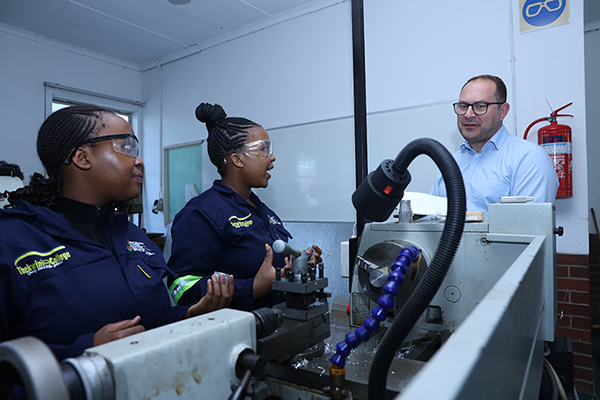
Delegates and attendees visited local colleges
Building on the sub-theme, "Work-based learning in practice: Systems, models and implementation", delegates and attendees were grouped and assigned to local colleges, including Thekwini TVET College, Elangeni TVET College, and Coastal TVET College. These visits served as an opportunity to engage with teachers and students while observing the implementation of work-based learning and industry collaboration in practice.
Read also:
Unisa co-hosts global forum on the future of TVET
* By Moleboheng Mpafa, Communication Intern, Department of Institutional Advancement
** Photography by Mduduzi Khathamzi, Unisa Multimedia Centre
Publish date: 2026-05-21 00:00:00.0

 Unisa SBL calls for shift from building houses to creating sustainable communities
 From law graduate to student leader: Tshegofatso Mmope's commitment to justice and empowerment
 Unisa Western Cape honours retirees and celebrates their enduring legacy
 South Africa's transport recovery faces its toughest test: Delivering reliability for all
 Unisa brings higher education opportunities closer to Central Karoo learners