
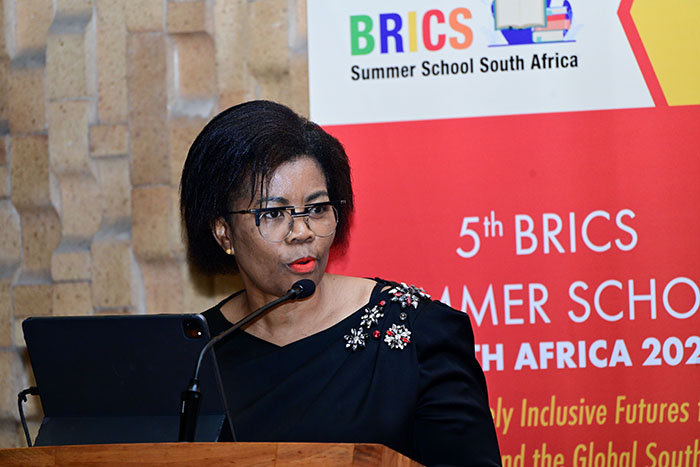
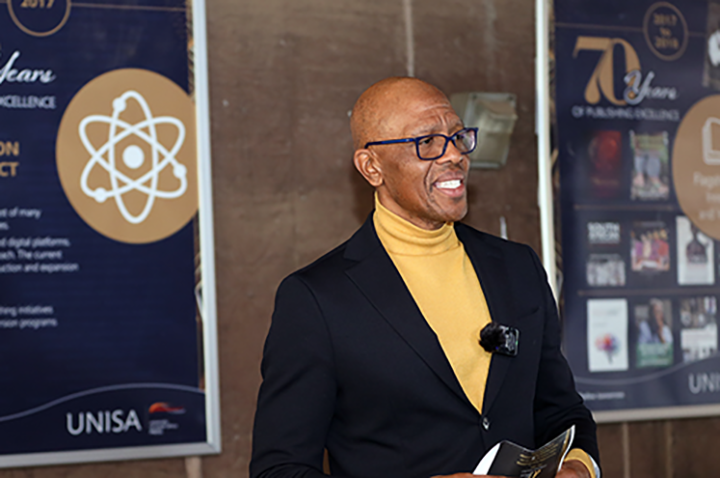
Unisa Principal and Vice-Chancellor Prof Puleng LenkaBula.
Unisa Principal and Vice-Chancellor Prof Puleng LenkaBula has called for young people to take a more active role in shaping global governance, saying they cannot be expected to influence the future while being treated as spectators.
Speaking at the BRICS Summer School, LenkaBula said young people needed meaningful opportunities to participate in decision-making and contribute to debates about the future of their countries and the international system.
She described the Summer School as an important platform for learning, dialogue and intellectual exchange, while commending the South African BRICS Youth Association (SABYA) for creating opportunities for young people to engage with issues affecting their future.
"The South African BRICS Youth Association exemplifies a platform that advances youth interests by helping to shape decision-making systems and ensuring that young people engage actively in the future of their nations," she said.
LenkaBula said BRICS was increasingly serving as a platform for intellectual exchange and cooperation among countries of the Global South. She called for a fairer international order underpinned by a reformed multilateral system.
"At Unisa, we call for a governance model that is progressive, just, equitable and accountable. It is crucial to address who holds power and sets the agendas in our societies," she said.
LenkaBula said universities had a responsibility to do more than educate students. They must also contribute to transforming society through knowledge production, research and critical engagement with systems that exclude large sections of the global population.
"Rather than standing on the sidelines, universities must drive knowledge production and challenge systemic exclusions that affect the global majority," she said.
She said Unisa's identity as an African university was reflected in its commitment to open, distance and digital learning, which enables the institution to extend access to higher education beyond traditional campus boundaries.
LenkaBula also highlighted Unisa's contribution to postgraduate education and research in South Africa, pointing to the university's role in producing doctoral graduates and awarding a significant proportion of the country's master's and doctoral degrees.
She cited former South African presidents Nelson Mandela and Thabo Mbeki as examples of the university's longstanding legacy of leadership and advocacy for international collaboration.
The Vice-Chancellor also highlighted Unisa's international engagement, including its work in Ethiopia through the university's Ethiopia Regional Learning Centre.
She said the centre had contributed to capacity-building initiatives and international academic engagement, with more than 1 100 scholars reportedly graduating since its establishment in 2008.
LenkaBula described this work as an example of knowledge diplomacy, where higher education partnerships are used to strengthen international relations while contributing to development in communities.
Dr Bernie Tlhahara, representing the South African government, reflected on the role of young people and women in the country's liberation struggle and emphasised the importance of education and equal rights in advancing South Africa's transformation.
He encouraged young people to play an active role in building a more equitable society.
Tlhahara said the BRICS Summer School sought to promote freedom, self-determination and critical thinking among participants, including high-school learners and university students.
The initiative, he said, was also intended to create practical opportunities and partnerships among BRICS countries while strengthening education and skills development.
Raymond Matlala, chief executive of the organisation he represented, said the Summer School was focused on building the capacity of young people, women and people with disabilities.
He also referred to survey findings indicating that some participants had limited knowledge of BRICS, with some reportedly even confusing the acronym with construction materials.
Matlala said future initiatives and partnerships would seek to broaden public understanding of BRICS. These include plans for a dedicated Summer School for high-school learners, expected to accommodate hundreds of students.
Ben Joubert, a BRICS sous sherpa at the Department of International Relations and Cooperation, said young people had an important role to play in shaping the future of global governance.
He said the rapidly changing geopolitical environment provided important context for BRICS and its growing engagement with global institutions.
According to Joubert, BRICS was seeking to strengthen existing global institutions rather than replace them. He also highlighted the importance of people-to-people connections and cooperation among member countries in driving lasting change.
The discussions at the Summer School reinforced a central message: young people should not simply inherit the global order created by previous generations. They must have a meaningful role in debating, shaping and ultimately influencing the systems that will determine their future.
By Sipho Jack, Journalist, Department of Institutional Advancement
Publish date: 2026-09-03 00:00:00.0

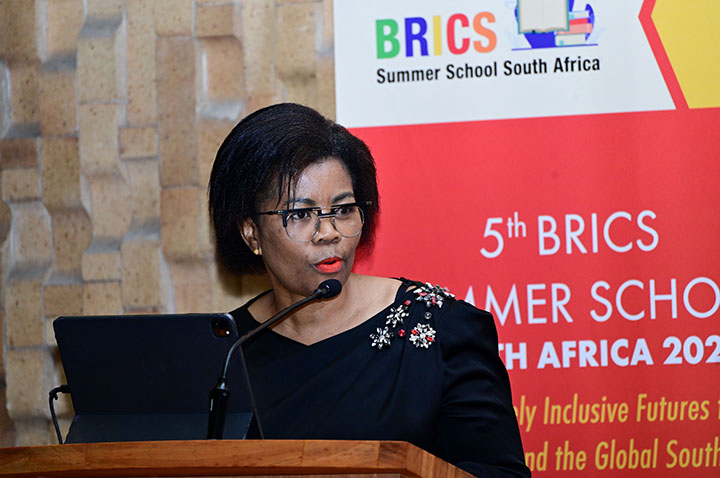 Unisa calls for stronger youth voice in shaping BRICS and global governance
 Prof LenkaBula calls for solidarity and action at Unisa Women's Day commemoration
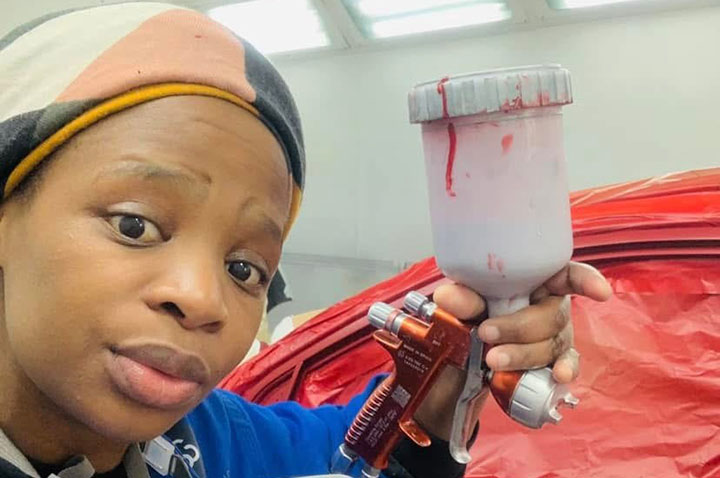 From passion to profession: How TVET shaped Nobuhle Ndandani's automotive spray-painting career
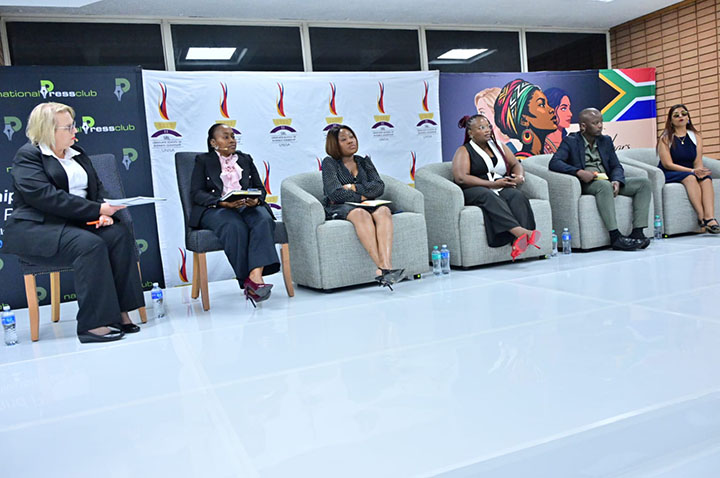 Seventy years after the march, representation is no longer enough
 A visual celebration of 70 years of academic publishing excellence