
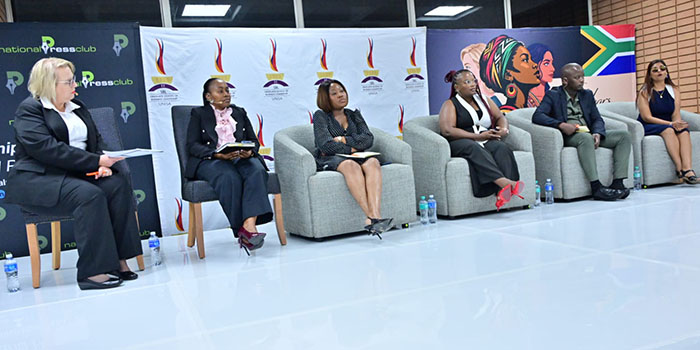
Panel Discussion: Prof Nelly Swart, Director, Executive Education: Unisa SBL, leads a robust panel discussion.
South Africa can point to significant gains in women's representation. Women now occupy more than 40% of seats in the National Assembly. Women also account for nearly half of the country's judges, with 122 of 251 judges being women. More than 60% of graduates from South Africa's colleges and universities are women.
But other indicators tell a different story.
In the second quarter of 2026, unemployment among women stood at 37.5%, compared with 30.3% for men, a gap of 7.2 percentage points. Women's median monthly earnings also remain at roughly 82% of men's.
The figures point to a central contradiction seven decades after 20,000 women marched to the Union Buildings in 1956: women are more visible across South Africa's institutions, but that visibility has not translated evenly into economic power.
The question, therefore, is no longer simply whether women have a place at the table. It is whether they have the influence, resources and authority to shape what happens there.
That question was at the centre of the latest Unisa Graduate School of Business Leadership (SBL) Distinction Dialogue, held in partnership with the Department of Women, Youth and Persons with Disabilities and the National Press Club under the theme 'Empowered Women Empower Nations.'
The dialogue marked 70 years since the historic Women's March. Still, speakers used the anniversary to look beyond commemoration and examine the gap between representation and influence, participation and ownership, and policy and lived experience.
Minister in the Presidency for Women, Youth and Persons with Disabilities, Sindisiwe Chikunga, framed the challenge directly.
"We must move from remembering women to empowering women. From representation to influence, from participation to ownership, and from cooperation to power."
Her remarks shifted the discussion from the number of women occupying positions to what those positions enable them to do.
The questions are practical: Who owns businesses and property? Who has access to capital? Who influences budget decisions? Who benefits from procurement opportunities? And who carries the unpaid care responsibilities that can limit women’s participation in the formal economy?
Chikunga also returned to the demands contained in the Women’s Charter of 1954, arguing that they should not be viewed simply as part of South Africa's history but as an unfinished programme of work.
Those demands included equal pay, property rights, childcare, recognition of unpaid care, protection from discriminatory laws and customs, and freedom from violence.
South Africa has changed considerably since those demands were articulated. The Constitution provides stronger protections against discrimination, while women have entered universities, legislatures, courts, businesses and professions in numbers that the women of 1956 were systematically denied.
Yet many of the economic and social questions raised decades ago remain unresolved.
For Chikunga, the gap between policy and implementation remains one of the country's biggest challenges.
"Implementation remains our weakest link," she said.
A law can exist without changing people’s lives. A policy can create opportunities on paper without ensuring that those opportunities are accessible. Procurement rules can promote women-owned businesses while delayed payments leave those businesses struggling to survive.
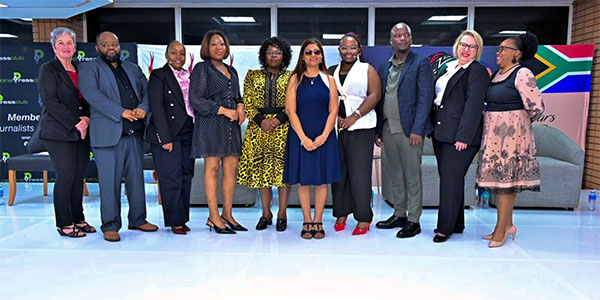
Group picture
The distinction between policy and lived experience was a recurring theme throughout the dialogue.
For women in business, empowerment can mean access to affordable capital and markets. For graduates, it can mean whether a qualification leads to employment or entrepreneurship. For working mothers, it can mean whether workplace policies allow them to remain and progress in their careers without carrying disproportionate care responsibilities.
For many women, safety also remains part of the equation.
An opportunity cannot be considered meaningful if accepting it exposes someone to unacceptable risks or if workplace conditions prevent them from participating fully.
In remarks prepared by Unisa Principal and Vice-Chancellor, Prof Puleng LenkaBula, and delivered on her behalf by Prof Mpfariseni Budeli, Executive Dean of the College of Law, the question of power was also placed at the centre of the historical legacy of the Women's March.
Reflecting on the women who marched in 1956, LenkaBula said:
"They were not asking for a seat at the table; they were demanding ownership of the future."
The distinction is significant. Representation can open a door, but ownership determines who has the power to influence decisions and shape outcomes.
LenkaBula also highlighted the different ways exclusion can affect women, noting that a young woman who is Black, poor, rural, disabled or queer may encounter overlapping barriers rather than a single form of discrimination.
The discussion brought the issue of access to education into sharper focus.
Unisa's open, distance and lifelong learning model was presented as one way of widening opportunities for women who may be working, raising children or living far from traditional university campuses.
But access to education is only one part of the equation.
The more difficult question is what happens after access has been secured. Does education lead to economic mobility? Does a qualification create meaningful opportunities? And can those opportunities translate into greater independence and influence?
A Unisa student who participated in the discussion brought the issue of access into the lived experience of students. Her contribution highlighted the difference between an opportunity being formally available and a person being able to reach it, navigate it and progress once they have entered.
The panel discussion extended these questions into the workplace, including wellness, sexual and reproductive health and rights, flexible working arrangements for mothers and the responsibilities of employers to create environments where women can remain, contribute and advance.
The discussion underscored a broader point: being present in an institution does not automatically mean having power within it.
Chikunga also challenged the media to play a stronger accountability role.
She called on journalists to follow the money, track cases through the justice system and examine what happens to government commitments after announcements are made.
For the media, that means going beyond reporting that a policy exists and asking whether it has been implemented and what difference it has made.
The same responsibility extends to government, business, academia and civil society.
South Africa has no shortage of policies, legislation, targets and public commitments on women's empowerment. The more difficult task is measuring whether those commitments translate into changes in earnings, ownership, procurement, safety, leadership and access to resources.
As Chikunga put it:
"Empowerment is not free. It is either funded, or it remains a slogan."
That challenge provides a useful measure for the next chapter of South Africa's gender-equality journey.
The issue is not only how many women are represented in Parliament, universities, courts or corporate structures. It is also how much economic power they hold, whether qualifications translate into opportunity, whether rights can be exercised without fear and whether women have meaningful influence over the resources and decisions that shape their lives.
In his vote of thanks, Unisa SBL Executive Dean and CEO, Prof Walter Matli, reminded attendees that the work of empowering women cannot be confined to Women’s Month.
"As we reflect on Women’s Month in South Africa, let us remember that celebrating women is not an August event. It is a daily commitment."
Seventy years ago, the women who marched to the Union Buildings could not have known what South Africa would look like in 2026. But they understood that political and social rights required action.
Chikunga returned to that legacy at the end of her address:
"They were not asking permission. They were serving notice."
Seventy years later, the question is not whether South Africa heard that notice.
It is what the country has done with it.
By: Thina Gwiliza, Communications and Marketing Specialist, Unisa SBL
Photographer: Shooheima Champion, Unisa Multimedia
Publish date: 2026-09-02 00:00:00.0

 Astronomy lecture highlights Africa's role in advancing space science at Unisa
 Students take centre stage as Unisa hosts National Multilingual Student Debate
 Es'kia Mphahlele's legacy lives on as Unisa hosts 17th Annual Memorial Lecture
 From waste tyres to shoe polish: Unisa Professor turns waste into opportunity
 Beyond barriers: Dr Nozuko Langa's decade-long journey to a PhD