


Guests and participants at the 17th Es'kia Mphahlele Annual Memorial Lecture
The life, work and enduring influence of literary giant Es'kia Mphahlele took centre stage in Polokwane as the University of South Africa (Unisa) hosted its 17th annual memorial lecture in his honour.
The lecture brought together academics, students, writers and members of the Mphahlele family to reflect on the continuing relevance of his ideas and contribution to African literature and scholarship.
Held under the theme "African writer as a prophet and social critic in contemporary times", the lecture featured acclaimed Zimbabwean author and filmmaker Tsitsi Dangarembga as keynote speaker. Her address, titled "The circular and the linear: A Southern Africanist (re)construction of the world”, examined wealth creation, inequality, colonialism, sustainability and the ways societies organise and distribute resources.
Opening the programme, Unisa Principal and Vice-Chancellor Prof Puleng LenkaBula called for a moment of silence in solidarity with women who have lost their lives to femicide.
She described Mphahlele as "a scholar, teacher and a foundational figure in modern African literature", highlighting the continuing relevance of his contribution to African intellectual life.
LenkaBula said Mphahlele's legacy also offered an important lens through which to understand decolonisation.
"Decolonisation, in its broadest sense, is not only about reclaiming knowledge but also about restoring presence," she said.
She welcomed Dangarembga to the memorial lecture, saying her participation strengthened the longstanding platform for critical reflection on Africa’s present and future.
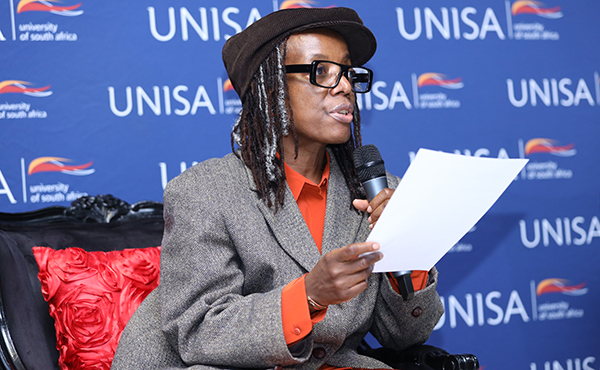
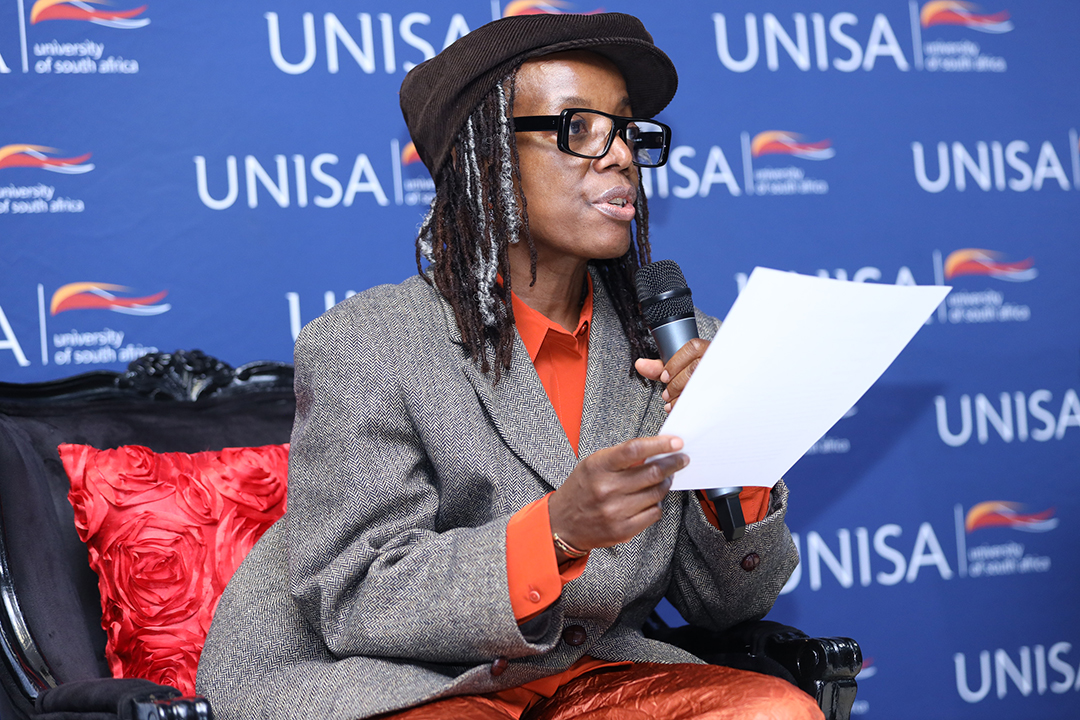
Zimbabwean author and filmmaker Tsitsi Dangarembga delivers the keynote address
In her keynote address, Dangarembga explored the origins and consequences of modern systems of wealth creation.
She explained that the subject formed part of a book she is currently working on, which examines how the concept of wealth creation developed and spread across the world.
"Wealth creation means the process of accumulation, of removal from circulation, of resources," she said.
Dangarembga questioned the sustainability of a system in which resources are accumulated and removed from circulation.
"Sustainability requires circulation rather than flowing off to be cached away," she said.
Her argument extended beyond economics to the natural environment, as she considered the impact of resource extraction on rivers, oceans, air and forests.
She then connected these contemporary questions to the history of European expansion and colonialism, including the role of gold in the development of wealth and political power.
Dangarembga examined the concept of terra nullius, which was used in European colonial thinking to describe land as belonging to nobody, where European powers did not recognise existing systems of authority.
She argued that such ideas contributed to the justification of colonial domination and the dehumanisation of people in colonised territories.
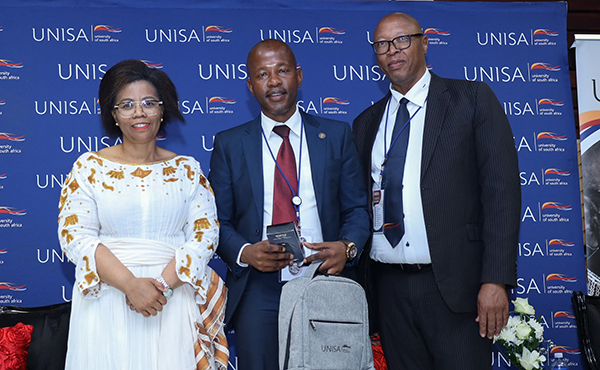
From left: Unisa Principal and Vice-Chancellor, Prof Puleng LenkaBula, Es'kia Mphahlele Reading and Writing Competition winner, Kevin Pohotona and Unisa Acting Deputy Registrar: Student Administration and System Integration, Prof Oupa Mashile.
The question of what happens to colonial structures after political independence was another key theme of her address.
Dangarembga used the term "internal colonisation" to describe circumstances in which colonial structures remain in place even when the people administering them have changed.
"The colonial structure remains intact, while only its agents change," she said.
She said she preferred the term "meta-colonisation" to describe these continuing structures, rather than relying on concepts such as "post-colonialism" or "coloniality".
A further thread running through the keynote was the contrast between linear and circular approaches to organising society.
Dangarembga argued that systems shaped by scarcity can encourage the accumulation of resources, while a circular approach places greater emphasis on reciprocity and keeping resources in circulation within communities.
She drew on the chiShona proverb "kandiro kanoenda kunobva kamwe" to illustrate the principle of reciprocity and the idea that what one gives can return through the wider social system.
Her presentation was followed by a question-and-answer session, allowing members of the audience to engage directly with the issues raised during the keynote.
The programme also celebrated emerging literary talent through the Es'kia Mphahlele Reading and Writing Competition, which recognises students engaging with reading and writing.
Among the winners was Kevin Pohotona, a final-year LLB student at Unisa, who spoke about the influence Mphahlele's work had on him.
"It's an honour to be one of the participants and winner here today. Being a writer myself and having read some of his books, I can proudly say, we are him, we are little Mphahlele's, and his creativity did indeed rub off on us," he said.
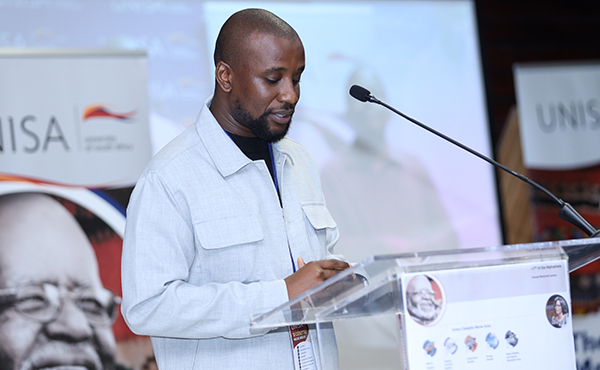
Mphahlele family representative Mr Rorisang Maruatona-Mphahlele
For the Mphahlele family, the annual lecture remains an important tribute to a literary figure whose work continues to shape conversations about African identity, literature, society and intellectual freedom.
The family welcomed Unisa's continued efforts to honour Mphahlele and preserve his contribution to African literature and scholarship.
For 17 years, the memorial lecture has provided a platform for keeping his ideas in conversation with contemporary African society while encouraging new generations of writers, scholars and students to engage with his legacy.
* By Noxolo Miya, Journalist, Department of Institutional Advancement
Photographer: Mdu Khathamzi, Unisa Multimedia
Publish date: 2026-09-22 00:00:00.0

 Es'kia Mphahlele's legacy lives on as Unisa hosts 17th Annual Memorial Lecture
 From waste tyres to shoe polish: Unisa Professor turns waste into opportunity
 Beyond barriers: Dr Nozuko Langa's decade-long journey to a PhD
 Unisa students take top honours at 2026 HEQAF Student Paper Presentation Competition
 Young KZN photographers explore the ocean through Unisa lens