

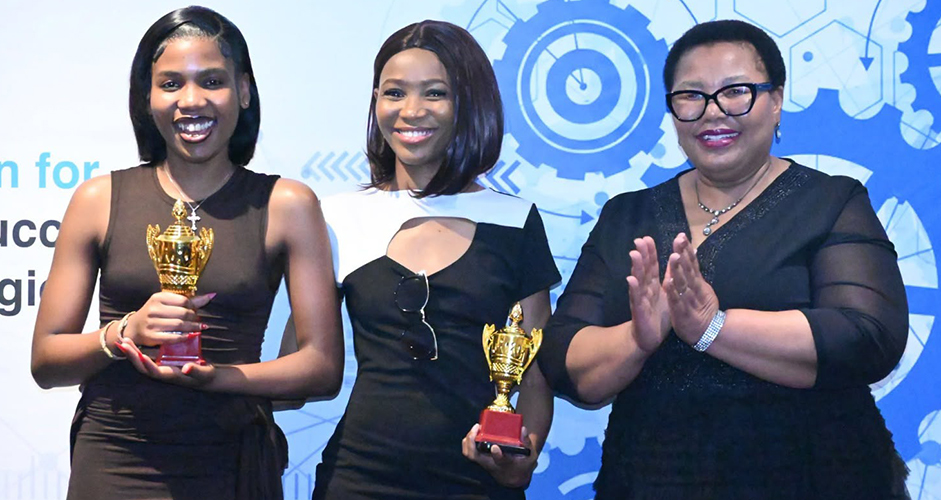
L-R: Nomfundo Muthwa and Lesedi Mahutse, both holding their second-place trophies, which they share as there was no position 3 winner.
Three University of South Africa (Unisa) students took the top honours at the 2026 Higher Education Quality Assurance Forum (HEQAF) Student Paper Presentation Competition, held at the Regent Hotel in East London.
Sanelisiwe Miya won overall, while Nomfundo Muthwa and Lesedi Mahutse shared second place in a competition that allowed students to present research on issues affecting their university experience and academic journey.
Walter Sisulu University (WSU) hosted the forum in collaboration with the Cape Peninsula University of Technology (CPUT) and Unisa. It brought together academics, quality assurance practitioners, administrators and students from across the higher education sector.
The Unisa delegation was led by Prof Lumkile Lalendle, Executive Director of Planning and Quality Assurance, who supported student participation in the competition and ensured that the student voice was represented in discussions on quality assurance.
Miya won the competition for her paper, The Influence of AI Tools in Student Learning and Assessment: A Call for Relooking Academic Integrity.
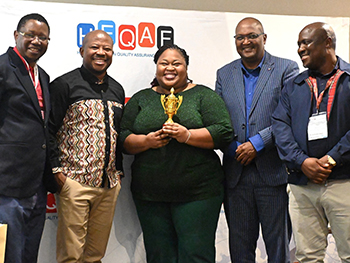
Far left: Prof Lumkile Lalendle, Executive Director of Planning and Quality Assurance at Unisa, with HEQAF officials, congratulating Ms Miya (standing in the middle, holding her position 1 trophy).
Reflecting on her achievement, Miya said: "I am deeply grateful to Unisa and HEQAF for this opportunity to engage with leading voices in higher education and to grow as a researcher; SEQASS has opened new academic possibilities for me, and receiving the Overall Best Speaker award was an incredibly meaningful and humbling experience."
Muthwa, Convenor of the South African Women Lawyers Association Student Chapter at Unisa, shared second place after presenting Rejection as a Catalyst for Growth: Redirecting Academic Choices for Enhanced Learning Experiences.
Her paper examined questions around access to post-school education and how universities respond to students' academic experiences.
Mahutse also shared second place with her paper, Integrating Peer Learning into Quality Assurance Systems: Challenges and Opportunities, which explored ways of incorporating peer learning into institutional quality assurance systems.
The results highlighted the range of issues students are able to bring into quality assurance discussions, from artificial intelligence and academic integrity to access, learning experiences and peer support.
The 2026 forum was held under the theme "Transforming Higher Education for Quality, Equity, and Student Success in the Era of Disruptive Technologies and Artificial Intelligence."
Discussions focused on how higher education institutions are responding to digitalisation and artificial intelligence, as well as the role of quality assurance systems in strengthening teaching, learning, assessment and governance.
The programme included keynote addresses by local and international speakers, paper presentations, panel discussions and roundtables. Issues of equity and social justice were also addressed, including the need to respond to historical inequalities and expand access for previously marginalised groups.
The Student Engagement in Quality Assurance and Student Support (SEQASS) project has provided a platform for students to participate in HEQAF since 2024.
Refiloe Tsephe, the SEQASS Project Leader, has played a key role in creating opportunities for students to move from sharing their experiences to presenting research at scholarly forums.
Prof Itumeleng Setlhodi, SEQASS Project Co-owner, and Tsephe also supported and mentored students as they developed their lived experiences into academic papers.
The success of the three Unisa students reflects the broader purpose of student engagement in quality assurance. Rather than limiting students’ contributions to feedback on institutional services, initiatives such as SEQASS create opportunities for them to produce research, identify quality-related challenges and contribute ideas for improvement.
HEQAF has its origins in the 2020 CPUT-hosted Garmin Quality Conversations and Webinar, which brought together delegates to discuss quality assurance in higher education.
Unisa continued this engagement in 2021 through the Garmin Virtual Quality Workshop. In 2024, a group of universities, including CPUT and Unisa, formally established HEQAF.
CPUT hosted the inaugural forum, which focused on the evolving Quality Assurance Framework, while Unisa hosted the 2025 forum. The 2025 programme explored issues including the student voice in quality assurance, innovative approaches by practitioners, multidisciplinary research and student support services.
The 2026 forum further strengthened collaboration among participating South African universities while providing students with a platform to participate in broader quality assurance conversations.
HEQAF continues to provide a space for academics, researchers, quality assurance professionals, administrators, policymakers and students to exchange knowledge and engage with emerging issues in higher education.
For Unisa's students, the latest competition demonstrated the value of creating opportunities for students not only to participate in institutional conversations, but also to contribute research and evidence to debates about the future of higher education.
* By Siyabonga Seme, Manager: Communication and Marketing, Unisa KwaZulu-Natal Region
Publish date: 2026-09-18 00:00:00.0

 Reclaiming African heritage through geographical names
 From research to real-world impact: Unisa-linked project explores new ways to advance LGBTQIA+ rights
 Unisa hackathon winners develop AI solution to support students at risk of falling behind
 Beyond Black Wednesday: Unisa lecture calls for urgent action to protect media freedom and public broadcasting
 Unisa celebrates 25 new PhD graduates advancing research and innovation