
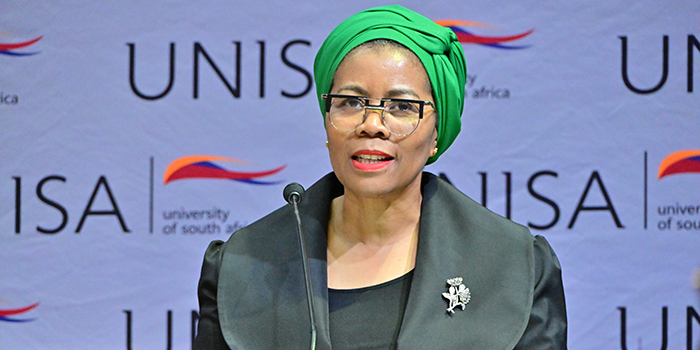
Unisa Principal and Vice Chancellor Prof Puleng LenkaBula
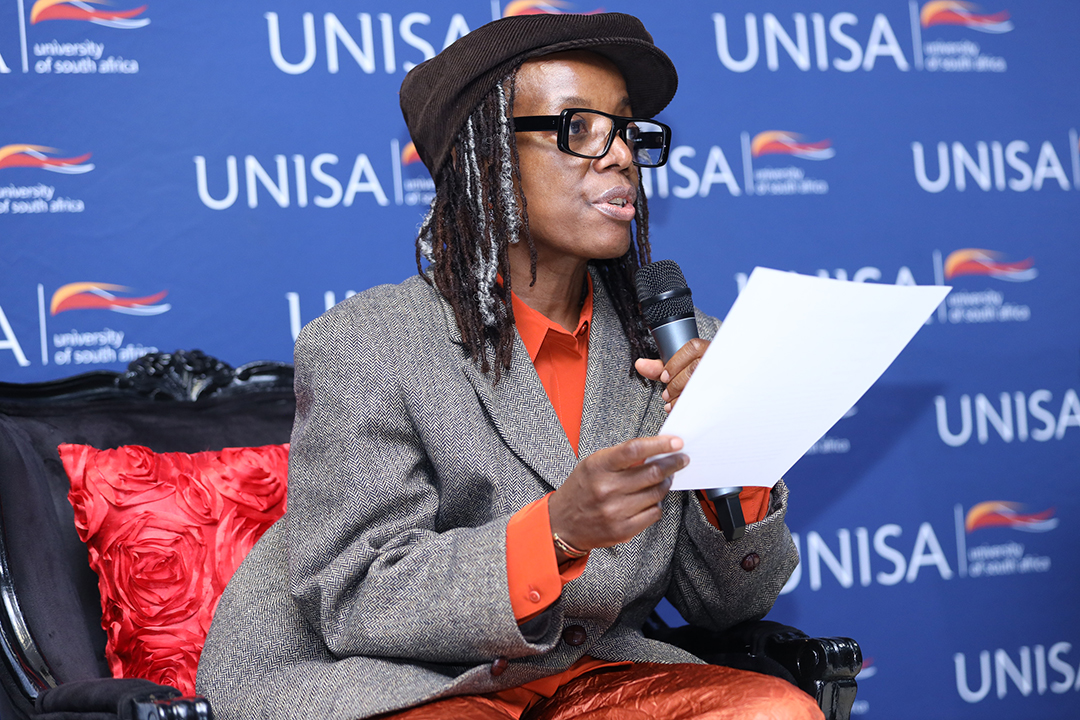
Unisa Principal and Vice Chancellor Prof Puleng LenkaBula has called for renewed solidarity, discipline and sustained hope in confronting injustice and violence against women.
Prof LenkaBula was speaking at a Women's Day commemoration at the ZK Matthews Hall on Unisa's Muckleneuk Campus in Tshwane, which marked 70 years since the historic 1956 Women’s March.
Held under the theme "Passing the Baton: 70 Years of Courage, Collective Action and Heretory," the event reflected on the legacy of women who challenged apartheid oppression while examining the continuing struggle for gender equality in democratic South Africa.
In her address, LenkaBula said resistance to injustice required discipline, solidarity and an unwavering commitment to hope, particularly in confronting systemic inequality and violence that continue to threaten women’s rights.
Drawing on the Belhar Confession and the philosophy of Ubuntu, she said human dignity, wellbeing and social progress were interconnected.
"Ubuntu teaches us that passing the baton of leadership is not merely an act of charity; it is part of our shared humanity. We must work towards a society where power, education and safety are accessible to all," she said.
LenkaBula also challenged academic institutions to place African knowledge systems at the centre of their work and to recognise women as active architects of history rather than passive observers.
She raised concerns about prosperity theology, the marginalisation of women and violence directed at women leaders, calling on society to confront gender injustice rather than remain silent.
Referring to historical figures such as Dr Sophia Williams De Bruyn and Winnie Madikizela-Mandela, LenkaBula urged women to reclaim their narratives and assert their agency.
She also called on universities and churches to reject complacency and play a more active role in supporting marginalised communities.
Keynote speaker Dr Sophia Williams De Bruyn reflected on the courage of the more than 20 000 women who marched to the Union Buildings in Pretoria on 9 August 1956 to protest against apartheid pass laws.
The march, led by women including Lillian Ngoyi, Helen Joseph, Rahima Moosa and Williams De Bruyn, became one of the defining moments in South Africa's liberation history.
Williams De Bruyn recalled the experiences of women who participated in the march, including many whose contributions have not been adequately recorded in the country’s historical narrative.
She also reflected on the hardship and sacrifices endured by women during apartheid.
"Today, I stand proudly at Unisa, which has reached a significant milestone with its first female Vice Chancellor," she said, referring to LenkaBula’s appointment.
LenkaBula became Unisa's first female Principal and Vice Chancellor when she assumed office on 1 January 2021.
Williams De Bruyn said women continued to face significant socio-economic challenges in democratic South Africa, including inequality, unemployment, poverty and gender-based violence.
She cited high levels of unemployment and dependence on social grants among women as evidence of the persistent economic challenges facing them.
According to Statistics South Africa, the official unemployment rate among women stood at 37.5% in the second quarter of 2026.
"Women's Month should not merely be a time for symbolic celebrations," Williams De Bruyn said. "We need actionable support that reaches communities, old age homes, hospitals and prisons, where help is desperately needed."
Reverend Mzwandile Molo, Secretary General of the South African Council of Churches, echoed the call for greater support for marginalised communities.
Molo paid tribute to the women who participated in the 1956 march and to leaders such as Williams De Bruyn, while highlighting the socio-economic challenges confronting women, particularly black women and young people.
He said higher education institutions should engage more directly with communities and contribute to social transformation rather than focus solely on providing academic qualifications.
While South Africa had made significant gains since the advent of democracy in 1994, Molo said more needed to be done to ensure that women fully benefited from the rights and freedoms guaranteed by the Constitution.
The commemoration, facilitated by Prof Meahabo Magano, brought together clergy, political figures and community leaders to reflect on the history of women’s resistance and their continuing role in advancing justice and equality.
The event served as a reminder that the legacy of the 1956 Women's March extends beyond commemoration and places a responsibility on current generations to continue the work of those who came before them.
By Sipho Jack, Journalist, Department of Institutional Advancement
Publish date: 2026-09-02 00:00:00.0

 Astronomy lecture highlights Africa's role in advancing space science at Unisa
 Students take centre stage as Unisa hosts National Multilingual Student Debate
 Es'kia Mphahlele's legacy lives on as Unisa hosts 17th Annual Memorial Lecture
 From waste tyres to shoe polish: Unisa Professor turns waste into opportunity
 Beyond barriers: Dr Nozuko Langa's decade-long journey to a PhD