
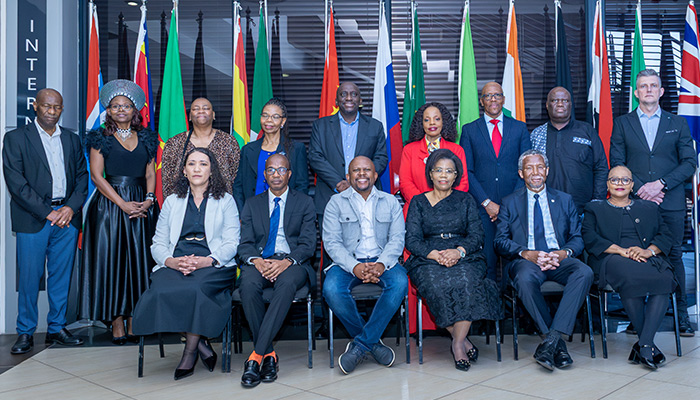
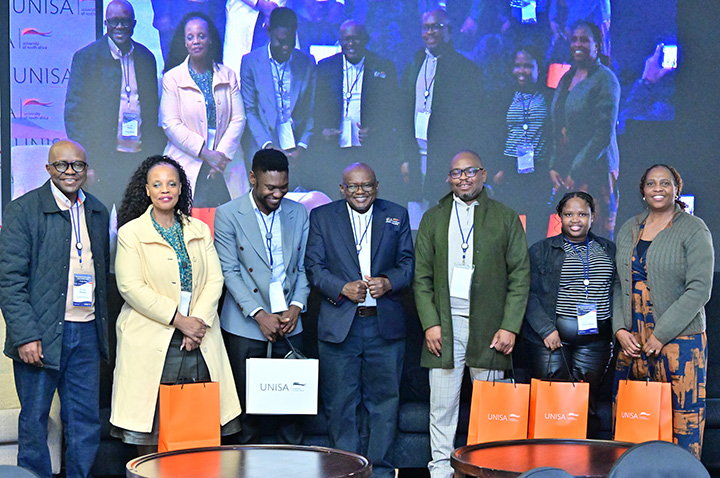
Unisa Principal and Vice-Chancellor, Prof Puleng LenkaBula, with speakers and guests.
The history of a university can be measured in buildings, qualifications and generations of graduates. But it can also be traced through the knowledge it produces, preserves and makes accessible.
For the University of South Africa (Unisa), that history is reflected in two institutions whose combined contribution spans 150 years. Unisa Press is celebrating 70 years of publishing, while Unisa Library and Information Services (LIS) marks 80 years of providing access to knowledge and supporting teaching, learning and research.
The milestones were commemorated at a gathering hosted by LIS and Unisa Press, in collaboration with the Department of Information Sciences, under the theme "Knowledge to Legacy: Timeless Treasures of Collective Impact."
At the heart of the celebration was a reflection on what these institutions have contributed to Unisa, South Africa and the wider knowledge community, as well as what their legacy demands of them in the future.
Unisa Principal and Vice-Chancellor, Prof Puleng LenkaBula, said the anniversaries provided an opportunity to recognise the profound contribution of Unisa Press and LIS to education, research and the advancement of knowledge in South Africa, Africa and the world.
For LenkaBula, the 150 years represented far more than the passage of time. They represented decades of ideas being developed, knowledge being preserved and scholarship being made available to successive generations.
"These landmark centres have contributed immensely to Unisa becoming an African university shaping futures in the service of humanity," she said.
LenkaBula highlighted the role played by the Press and Library in the country's intellectual and emancipatory history. She recalled how Unisa's learning resources were made available to political prisoners on Robben Island, enabling them to continue studying at a time when they were involved in the struggle for the liberation of South Africa.
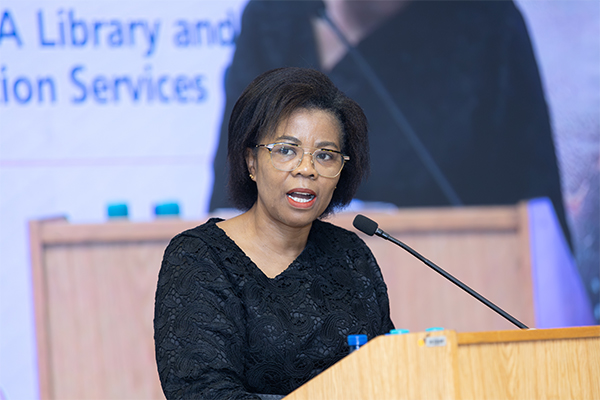
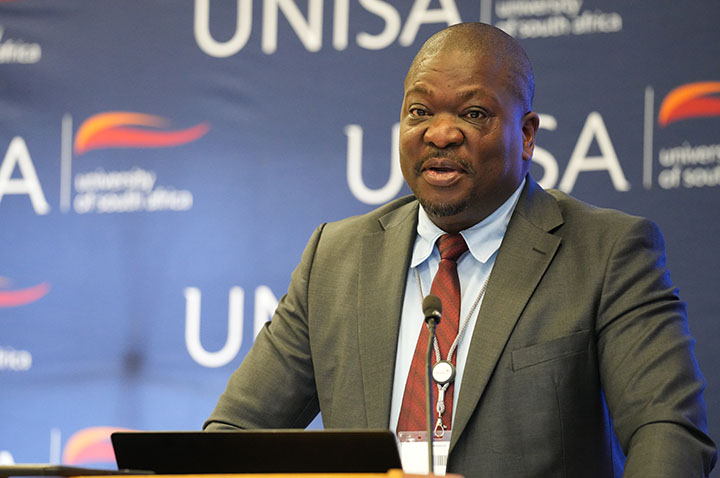
Unisa Principal and Vice-Chancellor Prof Puleng LenkaBula
She also reflected on the role of the library during the transition to democracy, when it became a partner in broadening access to learning, reading and educational resources as libraries were established in townships across Tshwane.
"As we mark 70 years of publishing excellence and 80 years of knowledge, innovation, and access," she said, "these numbers are not the most important aspects of our celebrations, what matters is what those years and their future represent in the context of changes that we are witnessing in our world."
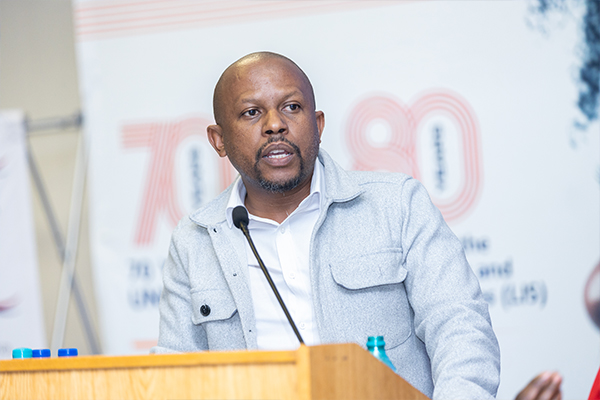
Sello Hatang, Executive Director of Re Hata Mmoho
Her message was therefore not simply one of celebration, but of reflection and responsibility.
LenkaBula challenged the university to consider whether Unisa Press and LIS are sufficiently positioned at the centre of the digital systems that are transforming the production, dissemination and consumption of knowledge.
If they are not, she asked, what must be done to ensure that they are?
The question is particularly important as universities operate within increasingly digital and interconnected knowledge economies. LenkaBula emphasised that Unisa's responsibility extends beyond its internal mandate. The university has a broader role to play in shaping knowledge and ensuring that African scholarship and intellectual contributions are visible and accessible globally.
Through the work of the Press and Library, she said, Unisa is strengthening the visibility of African intellectuals, African scholarship and Africa's contribution to global knowledge.
She also called for publishing to be understood as more than the production of books, journals and other outputs. The real measure of scholarship, she suggested, is its ability to influence thinking, policy and practice across government, the private sector and civil society.
In this way, the impact of education can be seen not only in qualifications awarded, but in the changes and development that knowledge helps to drive locally, across the continent and globally.
Dr Meiya Nthoesane, Director of Unisa Press, reflected on the history of the Press and the contribution of those who led it before the current team.
He said the responsibility of the present generation was to build on the foundation laid by its predecessors while creating a credible institution that could, in turn, become a foundation for future generations.
Unisa Press began its journey in 1956, initially producing research, study materials and guides that were subsequently housed in the library.
Over seven decades, the Press has evolved alongside changing ideas, technologies and approaches to scholarship.
"Over the seven decades, Unisa Press has proudly published 47 accredited journals comprising of issues, volumes, and articles that allow us to engage in what is happening and contribute to shaping the discourse of development of nations at the very least through research," he said.
Nthoesane also highlighted the importance of partnerships in strengthening the Press’s position within the research dissemination environment.
He noted that collaborations with organisations such as Taylor & Francis and Research Aid have enabled Unisa Press to strengthen its role in the university press ecosystem and contribute to shaping how research is produced and disseminated.
Research Aid currently supports 10 of the Press’s open-access journals, contributing to the expansion of research dissemination and accessibility.
"We can say without any share of doubt that in the next 70 years, the foundation that we stand on now is strong enough for the next generation," he affirmed.
Dr Janice De Wee, Acting Executive Director of Library and Information Services, described the Unisa Library as a special institutional treasure that has grown alongside the university.
She said the 80-year milestone was not simply a celebration of longevity, but a testament to vision, resilience and the ability to adapt.
Over eight decades, libraries have undergone profound changes. Books, journals and physical archives have increasingly become part of dynamic digital information environments, transforming how students and researchers find, access and use knowledge.
Yet the fundamental purpose of the library remains unchanged.
Long before the digital transformation of education, Unisa Library continually sought innovative ways to ensure that students, regardless of where they lived, could access the information and resources they needed to succeed.
"Despite these profound changes, our academic life remains unchanged as we connect people with information and create opportunities for education, research, and societal advancement," she said.
Executive Director of Re Hata Mmoho, Sello Hatang, reflected on the paradox of anniversaries: while they celebrate the passing of time, they also remind institutions of the importance of preserving what time might otherwise erase.
He noted that Unisa's anniversary concept document makes an important distinction between celebrating longevity and affirming continued relevance and influence in the global knowledge economy.
While Unisa Library formally marks 80 years since its establishment in 1946 and Unisa Press celebrates 70 years, Hatang pointed to the much deeper intellectual history preserved within the university’s collections. He noted that the oldest library record dates back to 1841, underscoring the importance of archives and the work of those responsible for preserving them.
The celebration also featured a mini-documentary and murals depicting the history and development of Library and Information Services.
The anniversary celebration ultimately demonstrated that Unisa Press and LIS are more than repositories of the university’s past.
Together, they form an essential part of the institution’s knowledge infrastructure, supporting teaching and learning, enabling research, preserving intellectual heritage and expanding access to scholarship.
Their 150 years of collective impact provide an opportunity to honour the generations that built these institutions. But, as LenkaBula’s reflections made clear, the more important challenge is to ensure that this legacy remains relevant to the generations that follow.
As Unisa moves deeper into the digital age and African scholarship continues to find its place in global knowledge systems, the future of the Press and Library will depend not only on how well they preserve what has been created, but on how effectively they help shape what comes next.
* By Moleboheng Mpafa, Communication Intern, Department of Institutional Advancement
Publish date: 2026-08-24 00:00:00.0

 Unisa's Political Sciences Department celebrates 80 years of shaping political thought
 Unisa symposium explores Africa's aviation future through innovation and collaboration
 Second Annual CNA Indaba signals a new phase of implementation at Unisa
 Unisa symposium puts aviation at the centre of Africa’s economic growth
 Unisa leads global records management research output