

The African college of excellence in the social and human sciences
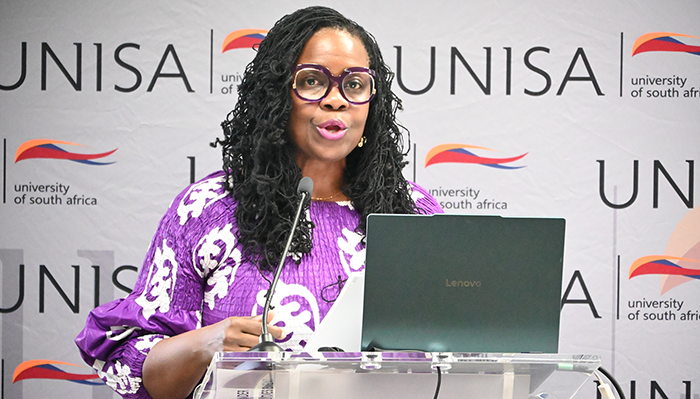
Prof Dianne M. Stewart of Emory University
The Department of Gender and Sexuality Studies (DGSS) made a significant contribution to the University of South Africa's Research and Innovation Week through a dynamic seminar and lecture that brought together internationally renowned scholarship, interdisciplinary research and critical engagement with questions of race, gender, sexuality, religion and decoloniality.
The event, held on 26 May 2026, attracted staff, students and members of the public, both in person and online, reflecting the department's commitment to creating spaces for rigorous intellectual exchange and socially responsive scholarship.
Opening the programme, DGSS lecturer Leandra Joubert welcomed participants and set the tone for the day’s discussions, expressing the department’s hope that the event would be a thought-provoking and insightful seminar and lecture. Her remarks underscored the department’s commitment to fostering conversations that challenge conventional ways of thinking while generating new knowledge and possibilities for social transformation.
In her welcoming address, Prof Deirdre Byrne of the Department of English Studies highlighted the significance of the university-wide initiative, describing Research and Innovation Week as an opportunity for departments to bring their very best to the table. She commended DGSS for showcasing scholars who would engage audiences on cutting-edge matters pertaining to gender and sexuality studies.
A highlight of the programme was a keynote lecture by Prof Dianne Marie Stewart of Emory University in the USA. An internationally recognised scholar of African American Studies, Religion and African Diaspora Studies, Stewart drew on her acclaimed research on marriage, intimacy, race and structural inequality to share with the audience aspects of the history and politics of Black love in America.
Framing marriage as a central cultural institution, Stewart observed that "marriage is a pervasive and compelling institution, a subject American culture cannot relinquish". She reflected on the powerful hold that romantic narratives continue to exert on public imagination, noting that the archetypal image of standing before the wedding altar with one’s perfect soulmate remains irresistible for many. However, she urged audiences nevertheless to confront the unequal realities that shape intimate life, arguing that while marriage remains culturally celebrated, the data pertaining to rates of marriage among Black women register a distinctive social reality. Through a nuanced historical analysis, Stewart demonstrated how the experiences of Black women and Black families reveal broader questions about citizenship, social belonging, structural inequality and the enduring legacies of racial exclusion, with her lecture illustrating how the study of love and marriage can serve as a lens through which to understand broader struggles for justice and human dignity.
Also included on the programme was a lecture by Prof Itumeleng Mothoagae, Chair of the Department of Gender and Sexuality Studies, whose presentation offered a decolonial forensic reading of the Marian sodality, Bana Ba Maria, as a site of intersection of power, coloniality, religion and gender.
Beginning with a profound reflection on scholarly positionality, Mothoagae declared: "I write as a son of a son, and I’m intentional with locating myself as a son of a son". He went on to acknowledge the complexities of speaking from within inherited systems of power, stating, "I write from inside the patriarchy that the violent intersection of Victorian colonial gender construction and patriarchal forms has constituted in this place".
Central to his argument was the insistence that knowledge production must be accountable to the conditions from which it emerges. As he explained, "to name where I speak from is therefore not a preamble to the argument, but the first move of it". Mothoagae argued that colonial power often operates through what he termed "the disembodied, placeless voice through which coloniality has always smuggled its particularity in the disguise of the universal".
Drawing on decolonial theory and critical theology, Mothoagae urged scholars to remain attentive to the relationship between embodiment, power and knowledge, reminding audiences that "to break that concealment is to declare the geopolitical and the body-political epistemic location within the structures of colonial power and knowledge from which the subject speaks".
Together, the two lectures showcased the breadth and depth of scholarship fostered within the Department of Gender and Sexuality Studies. While Stewart illuminated the historical and contemporary realities shaping Black love and family formation, Mothoagae demonstrated the importance of decolonial methodologies in interrogating the structures through which power is produced and maintained.
The event also reflected the department’s commitment to international collaboration, interdisciplinary inquiry and transformative knowledge production. By bringing together global and local perspectives, the programme highlighted the role of Gender and Sexuality Studies in considering some of the most pressing intellectual and social questions of our time.
As Unisa continues to advance its research and innovation agenda, the Department of Gender and Sexuality Studies remains at the forefront of generating scholarship that is both academically rigorous and socially engaged, contributing to the university’s vision of knowledge in service of justice, inclusion and human flourishing.
* By Natalia Molebatsi, Department of Gender and Sexuality Studies
Publish date: 2026-06-09 00:00:00.0

 From waste tyres to shoe polish: Unisa Professor turns waste into opportunity
 Beyond barriers: Dr Nozuko Langa's decade-long journey to a PhD
 Unisa students take top honours at 2026 HEQAF Student Paper Presentation Competition
 Young KZN photographers explore the ocean through Unisa lens
 Prof Brendon Barnes champions climate justice through psychology