

The largest provider of business education in Africa and one of the largest in the world
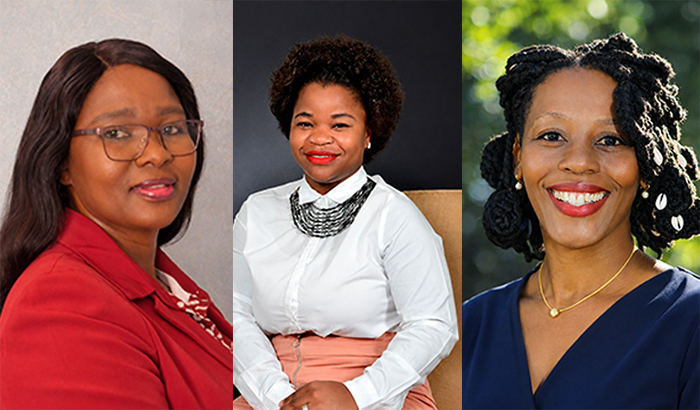
From left: Dr Thulile Ngonyama-Ndou: Head, Office of Graduate Studies and Research; Prof Nthabiseng Moraka, Director, School of Management Sciences; and Dr Sizile Makola, Senior Lecturer, Department of Business Management
Between 20 and 22 May 2026, the University of South Africa (Unisa), through its Department of Business Management, hosted the pioneering SAMS Doctoral and Early Career Methods School on Culturally-Grounded Women’s Leadership in Management Research.
Funded through a competitive grant awarded by the Society for the Advancement of Management Studies (SAMS) in the United Kingdom, the three-day online programme brought together 45 doctoral candidates and early-career researchers from 11 countries across Africa, Europe and Asia. Dr Zamandlovu Sizile Makola, a senior lecturer in the Department of Business Management at Unisa, coordinated the initiative.
The Methods School marked a significant milestone as the first programme of its kind on the African continent dedicated specifically to the epistemological and methodological needs of researchers working within African-centred, decolonial and feminist frameworks. Participants described the programme as a rare academic space where Ubuntu, Bosadi and African feminist theory were treated as foundational research approaches rather than supplementary theoretical concepts.
Thirty-two participants received bursaries to support their participation in the programme.
The school was officially opened by Prof Nthabiseng Moraka, Director of the School of Management Sciences at Unisa, who welcomed delegates on behalf of the College of Economic and Management Sciences (CEMS). In her remarks, Moraka acknowledged Makola’s leadership in securing the SAMS grant and conceptualising the programme.
The initiative also demonstrated strong institutional collaboration within Unisa. Thirteen CEMS academics served as work-in-progress mentors, providing detailed scholarly feedback to participants on their individual research projects. In comparison, 16 Unisa academics and postgraduate students served as rapporteurs during the three-day event.
The programme featured a keynote address by internationally renowned scholar Prof Sabelo J Ndlovu-Gatsheni from the University of Calgary. His address, which explored feminism as a collective obligation, set the intellectual tone for the school.
The programme also featured an esteemed panel of facilitators, including Prof Itumeleng Mothoagae, Leonie Louw, Dr Retha Visagie, Aurra Kawanzaruwa, Prof Ajay Jivan from the South African Board for People Practices (SABPP), Prof BS Ngcamu and Prof Ruth Albertyn. Each facilitator contributed unique perspectives and expertise to the intensive methods training experience.
Reflecting on the impact of the programme, one participant from South Africa remarked:
"Thank you, SAMS Methods team, for the three-day empowerment. It was intensive but very interesting and profound. I enjoyed each moment and have learned a lot. THANK YOU, team and colleagues."
In her closing address, Makola reflected on the initiative's significance and its broader intellectual purpose.
"This School was designed from an African epistemological foundation, not as decoration, but as a genuine commitment to the idea that scholarship done well strengthens the people it studies rather than extracting from them," she said.
She concluded with words that captured the spirit of the event:
"Umuntu ngumuntu ngabantu. I am because you are. This School is because each of you is."
The SAMS Methods School was funded by the Society for the Advancement of Management Studies (SAMS) and hosted by the Department of Business Management in the College of Economic and Management Sciences at Unisa.
* By Dr Zamandlovu Sizile Makola, senior lecturer and SAMS Methods School coordinator, Department of Business Management, CEMS, and Tebogo Mahlaela, Communication and Marketing Specialist, CEMS
Publish date: 2026-06-11 00:00:00.0

 Unisa SBL calls for shift from building houses to creating sustainable communities
 From law graduate to student leader: Tshegofatso Mmope's commitment to justice and empowerment
 Unisa Western Cape honours retirees and celebrates their enduring legacy
 South Africa's transport recovery faces its toughest test: Delivering reliability for all
 Unisa brings higher education opportunities closer to Central Karoo learners