

The largest provider of business education in Africa and one of the largest in the world
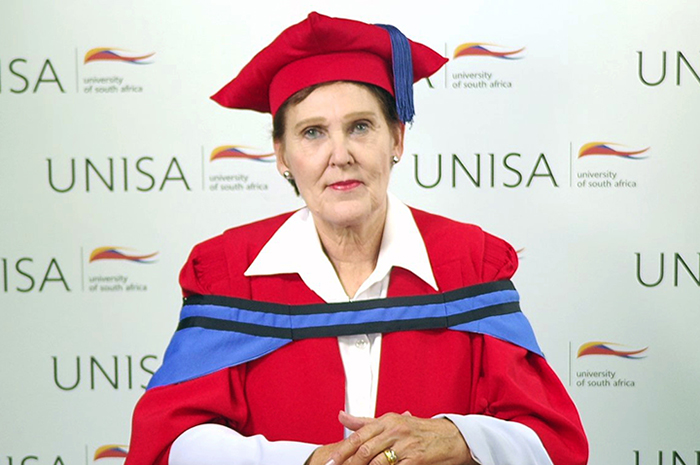
Prof Thea Visser
Prof Thea Visser, from the Department of Business Management in the College of Economic and Management Sciences (CEMS) at Unisa, recently delivered her inaugural lecture, titled "Small Businesses: Time for a New Research Agenda?", calling for a shift in how small businesses are researched to better address current economic, technological and societal challenges.
In her address, Visser highlighted the growing pressures faced by small enterprises, noting that they remain highly vulnerable to economic shocks, supply chain disruptions and the rapid pace of the Fourth Industrial Revolution (4IR). She emphasised that while there is increasing pressure on small businesses to adopt sustainable and environmentally responsible practices, many lack the necessary green skills and innovation capacity to do so effectively.
She further pointed out that small businesses are deeply embedded within their local communities, making them particularly sensitive to informal influences from stakeholders such as community groups and environmental organisations. Despite these pressures, many entrepreneurs delay seeking business support until they are already facing significant challenges. While numerous organisations offer assistance, Visser noted that these programmes often lack consistency, specialisation and the targeted support required to address diverse business needs.
A key concern raised in the lecture was the narrow scope of existing small business research. Visser argued that current studies tend to focus disproportionately on the individual entrepreneur rather than the business as an entity, often describing trends without adequately explaining the underlying causes. She highlighted the overemphasis on constraints and challenges, with limited attention to the interaction among business processes, resilience strategies and long-term sustainability.
To address these gaps, Visser called for a shift towards more interdisciplinary and comparative international research, supported by stronger methodologies and larger-scale datasets. She emphasised the importance of advanced analytical and statistical techniques, as well as greater rigour in quantitative research. Central to her argument was the need for a "techno-social" approach, one that integrates technological advancement with sustainability and social realities.
Visser also underscored the importance of focusing on how small businesses manage disruption and build resilience, particularly within the complexities of the South African environment. This includes examining the relationship between formal and informal enterprises, understanding cultural diversity and exploring how small businesses contribute to broader economic development. She further highlighted the need for expanded and more effective programmes to stimulate youth entrepreneurship.
These research priorities, she noted, align with the developmental objectives of the African Union Agenda 2063, which emphasises inclusive growth and sustainable development across the continent.
Reflecting on her inauguration, Visser described the milestone as both humbling and fulfilling, acknowledging the mentors and colleagues who have supported her academic journey. She emphasised the responsibility of scholars to produce work that is not only methodologically sound but also relevant and responsive to real-world challenges.
"Research must matter," she noted, highlighting the importance of engaging with the lived experiences of entrepreneurs and contributing to policies and practices that strengthen the small business ecosystem.
Visser holds a Doctor of Commerce degree from the University of Pretoria. Her academic career includes supervising numerous postgraduate students to completion, serving on quality assurance panels, and acting as an external examiner for institutions both locally and internationally.
She encouraged aspiring researchers to be intentional in their work, particularly within the South African context, where complex socio-economic dynamics shape entrepreneurial activity.
Emphasising the value of mentorship, collaboration and resilience, Visser noted that academic careers are built over time through sustained effort and a clear intellectual focus.
As small businesses continue to play a critical role in economic development, Visser’s call signals a renewed urgency for research that is innovative, contextually grounded and capable of driving meaningful change.
* By Tebogo Mahlaela, Communication and Marketing Specialist, College of Economic and Management Sciences
Publish date: 2026-05-05 00:00:00.0

 Unisa women leaders challenge the meaning of power, equity and legacy
 Unisa puts staff wellness in focus with 4km Health and Wellness walk
 Unisa research unit urges turning agrifood waste into new economic opportunities
 Liberia turns to Unisa for expertise in building Peace and Reconciliation Memorial Museum
 Unisa calls for stronger youth voice in shaping BRICS and global governance