

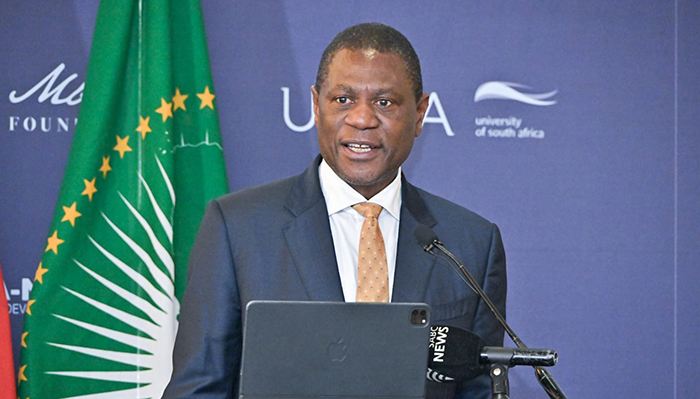
Paul Mashatile, Deputy President of South Africa, outlined the common issues faced by African countries in his keynote address
To mark the beginning of a week-long reflection, dialogue and public engagement on the future of the African continent, taking place from 21 to 25 May 2026 in Cape Town, Unisa, in partnership with the Thabo Mbeki Foundation (TMF) and the African Union Development – New Partnership for Africa’s Development (AUDA-NEPAD), hosted a business breakfast on 21 May, setting the tone for a range of high-level and public-facing engagements which will culminate in the 16th Annual Thabo Mbeki Africa Day Lecture on 23 May.
The engagement, attended by leaders from government, the business sector and development institutions, was followed by a media briefing at which Prof Puleng LenkaBula, Unisa Principal and Vice-Chancellor, and Dr Nardos Bekele-Thomas, Chief Executive Officer of AUDA-NEPAD, provided valuable insights regarding the roles of AUDA-NEPAD and Unisa in advancing the African agenda.
Delivering the keynote address at the business breakfast, Paul Mashatile, Deputy President of South Africa, outlined the common issues faced by African countries, including poverty, underdevelopment, marginalisation, illiteracy, disease and instability. These issues, he said, led to the birth of transformative institutions such as NEPAD to promote accelerated growth and sustainable development, eradicate widespread and severe poverty, and halt Africa's marginalisation in the globalisation process.
Mashatile emphasised that NEPAD’s vision is rooted in Pan-Africanism and is driven by the goal of empowering the continent to control its own destiny. He continued: "As we mark Africa Month and celebrate 20 years of NEPAD, we return to that founding vision; an integrated, prosperous, and peaceful Africa driven by its own citizens and represented by a dynamic force in the global arena".
Mashatile condemned the ongoing anti-migrant and xenophobic violence in South Africa, while acknowledging concerns about illegal foreign nationals involved in crime. "We urge law enforcement to address these issues through legal means and not mob violence," he added. "These acts of violence do not reflect the views of South Africans or government policy."
Continuing, Mashatile noted that NEPAD serves as the main execution arm of the African Union Agenda 2063, and emphasised the importance of African self-determination. He detailed three essential pillars to achieve this goal: regional integration to strengthen unity and economic collaboration, African ownership promoting the idea that Africa’s future should be shaped by its own people, and continental renewal to ensure democracy, industrialisation and social cohesion, which are vital for peace and dignity.
Concluding his address, Mashatile reiterated the importance of African unity, saying: "Africa must connect its regions, its economies, and its people to build a common path for continental renewal".
Offering his remarks, Thabo Mbeki, Unisa Chancellor and Former President of South Africa, noted that the country is expected to make a significant contribution to Africa's development, particularly given its higher level of development compared to many African countries.
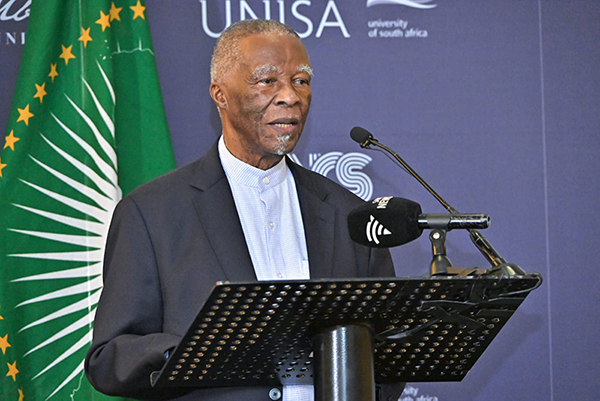
Thabo Mbeki, Unisa Chancellor and former President of South Africa
He further implored institutions such as the TMF and Unisa to play a guiding role in promoting African integration and the continent’s relations with the rest of the world. "We need to bring South Africa back to its position in the continent, where the success of African integration is a major pillar in the policies of our country," he said.
Concluding, Mbeki lamented the high level of unemployment in South Africa and indicated that it is not due to undocumented immigrants in the country, but rather to the unstable growth dynamics since 1994. He also condemned the lack of representation of major South African firms on the continent, arguing that it slows down African development.
Dr Nardos Bekele-Thomas, CEO of AUDA-NEPAD, stated that the New Partnership for Africa’s Development initiative is grounded in self-determination, independence and self-sufficiency as the sources of its creation. She appealed to African governments to fund AUDA-NEPAD to ensure the development of African socio-economic transformation programmes.
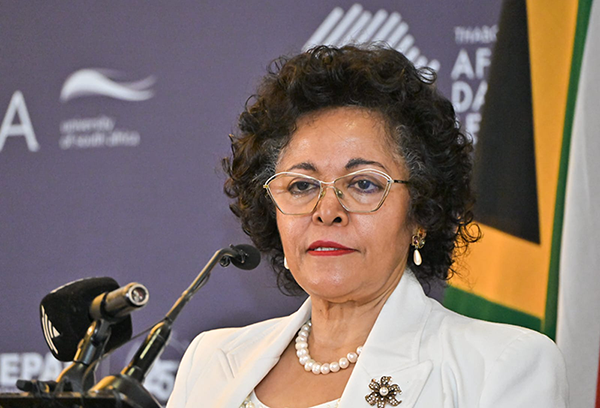
Dr Nardos Bekele-Thomas, CEO of AUDA-NEPAD
Recognising former President Thabo Mbeki’s notion of self-financing development agencies, Bekele-Thomas noted that the discussion centred on implementing and reinforcing African priorities and the collective commitment to supporting African development organisations.
A critical question posed by a reporter to Bekele-Thomas was whether there is a danger that leaders will fail to secure funding for AUDA-NEPAD's developmental programmes, thus leaving Africa's developmental future hanging in the balance. In response, Bekele-Thomas firmly warned against failing to secure domestic funding, noting that a lack of self-funding will force African nations to prioritise external agendas over their own. "The lack of efficiency and effectiveness in responding to African needs," she continued, "depicts the loss of pride and dignity."
Reflecting on continental self-sustainability, she highlighted the benefits of job creation through local manufacturing and raw materials extraction rather than halting the export of raw products. Africa can retain its wealth and drive its own economic transformation.
Reflecting on Unisa's partnership with NEPAD, which began over two decades ago, Prof Puleng LenkaBula, Unisa Principal and Vice-Chancellor, mentioned that it ensured the research and knowledge of African academics and intellectuals are central to NEPAD's policy discussions. "Bearing witness to the current state of the world," she said, "this is a renewal of our commitment towards practising radical hospitability while fighting these threats. Therefore, having discussions surrounding the economy, its distribution, and the role of agency in a developmental and democratic situation will help bandage the wound." She emphasised that institutions of higher education promote and shape the future implementation of such programmes.
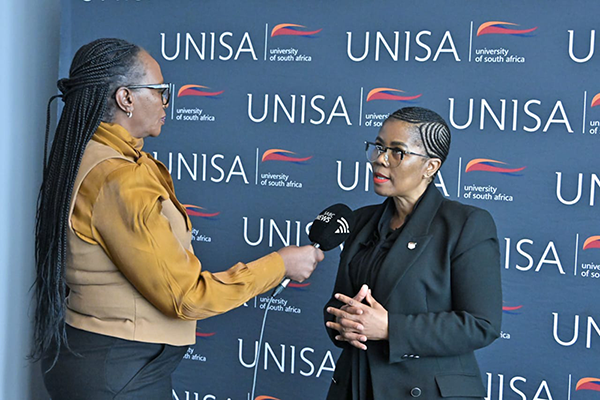
The SABC’s Sophie Mokoena interviewing Prof Puleng LenkaBula, Unisa Principal and Vice-Chancellor at the media briefing
Acknowledging Mbeki’s sentiments on African cohesion and connectedness, LenkaBula stated that Africans are inextricably bound to the fight against colonialism and apartheid. She urged universities to cease being ivory towers and become custodians of Africa's knowledge systems, civilisation, social justice, transformation and economic development.
In conclusion, LenkaBula maintained that NEPAD set the narrative for African ownership, coordination, management and financing of institutions serving the continent, and remarked that Africa often mimics Euro-American models, which stifles local growth.
As the multi-day programme continues, Unisa and Parliament will host a colloquium titled "30 years of the Constitution of the Republic of South Africa" at the National Assembly on Friday, 22 May. The main event, the Thabo Mbeki Africa Day Lecture, follows on Saturday 23 May, and on Monday 25 May, a post-lecture engagement session with young people will be hosted by Unisa at the institution’s Parow Campus.
* By Victor Malatji and Nontsikelelo Ndebele, Journalist Interns, Department of Institutional Advancement
** Photography by Shooheima Champion, Multimedia Centre
Publish date: 2026-05-22 00:00:00.0

 Unisa students take top honours at 2026 HEQAF Student Paper Presentation Competition
 Young KZN photographers explore the ocean through Unisa lens
 Prof Brendon Barnes champions climate justice through psychology
 Prof Vhahangwele Masindi sets sights on a water-secure future
 Unisa's Top 100 CTA achievers recognised as accounting firms seek emerging talent