

The largest provider of business education in Africa and one of the largest in the world
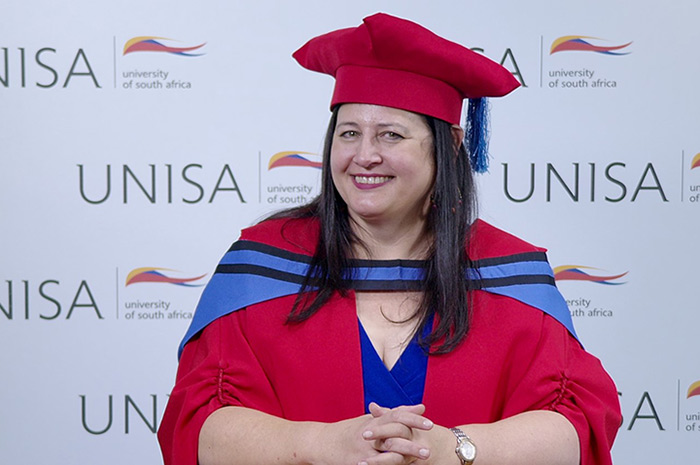
Prof Annemarie Davis
Prof Annemarie Davis from the Department of Business Management in the College of Economic and Management Sciences recently delivered her inaugural lecture titled Making sense of change: personal reflections as a researcher.
With more than a decade of research into management practice, the lecture traced the development of Davis’s research projects since 2010, focusing on the human actions that shape strategy within organisations. Drawing on studies conducted across sectors such as banking, public healthcare, government and private organisations, she highlighted how managers navigate the uncertainty and complexity that accompany organisational change.
"As a strategy-as-practice scholar, I align with the notion that strategy is not something that an organisation has, but something that the humans in the organisation do," Davis explained.
Her research focuses on the experiences of middle managers, who often play a crucial role in interpreting and implementing organisational strategy. According to Davis, many managers experience anxiety, doubt and fear when faced with change, yet they also develop coping strategies and eventually become change agents within their organisations.
One of the key insights emerging from her research is the strategic importance of "pausing". Rather than indicating inactivity, pausing allows managers to reflect and respond more effectively to complex situations.
"Pausing is not a luxury – it is a necessity," Davis said. "In times of crisis, pausing allows managers to rethink, reassess and reframe their strategic responses. It improves awareness and the quality of decision-making."
Another important theme in her research is managerial identity. Davis argued that the role of a manager is not fixed but evolves over time through everyday practice and interactions.
She further explained that being a middle manager is not a static role; it is an ongoing process of becoming, shaped day by day by what they do, who they work with and how they navigate complexity.
Reflecting on the journey that led to her becoming a full professor, Davis described the milestone as both rewarding and humbling. She acknowledged the mentors, colleagues, students and collaborators who supported her academic path.
"I feel grateful and appreciate the roles that so many people have played in the process to reach this milestone," Davis said. "Since joining academia in 2000, I have aspired to reach the rank of full professor. The sense of achievement is richly rewarding and recognises the effort of the journey, successes, setbacks, revisions, rejections and perseverance."
Davis also emphasised academics' responsibility to ensure that research contributes meaningfully to practice.
"True resilience, effective leadership and meaningful impact do not come from constantly pushing forward, but from creating space to reflect, to reframe and to respond with purpose," she said. Davis added, "As leaders, managers and academics, we are called to adapt and ensure that knowledge does not remain locked in theory but is translated into practice that truly makes a difference".
Davis also encouraged aspiring academics to approach their careers with patience and openness. She stated that academic careers grow over time, not overnight. She had this advice for aspiring academics: "Stay open to new ideas, collaborations and ways of thinking, and seek out mentors who generously share their experiences".
* By Tebogo Mahlaela, Communication and Marketing Specialist, College of Economic and Management Sciences
Publish date: 2026-03-25 00:00:00.0

 Unisa hackathon winners develop AI solution to support students at risk of falling behind
 Beyond Black Wednesday: Unisa lecture calls for urgent action to protect media freedom and public broadcasting
 Unisa celebrates 25 new PhD graduates advancing research and innovation
 From Maramanzhi to master's: Unisa graduate champions Tshivenda through scholarship
 Unisa students help shape digital complaints system to improve accountability and service delivery