

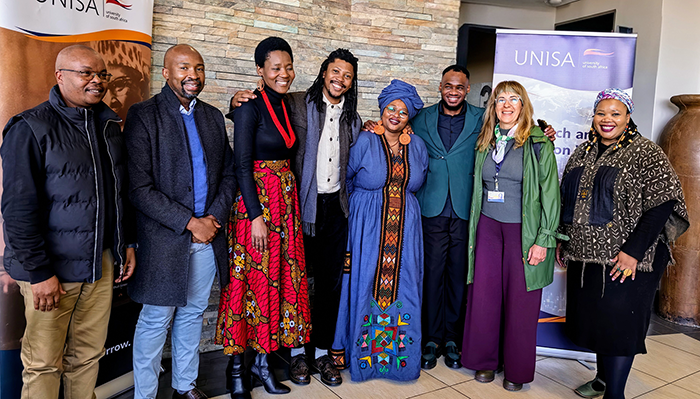
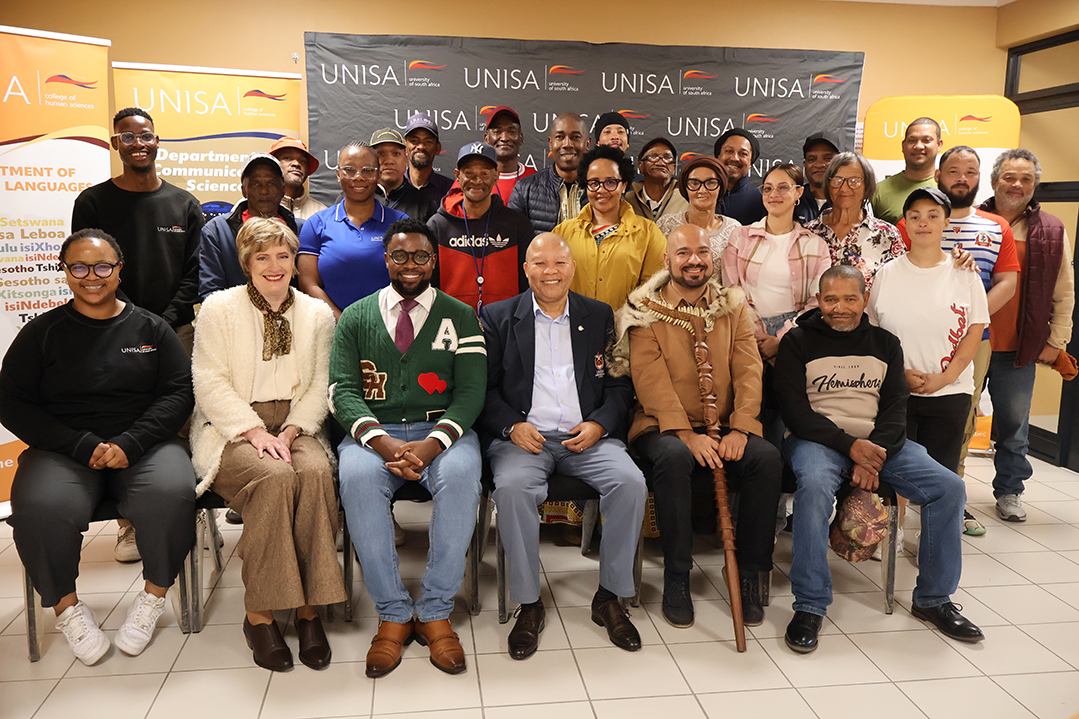
From left: Prof Onyancha Bosire, Head of Graduate Studies and Research, College of Human Sciences; Prof Siyasanga Tyali, Director of the School of Arts; Prof Puleng Segalo, Incumbent of the Chief Albert Luthuli Research Chair; Sanele KáNtsingana, Lecturer in African Languages, University of Cape Town; Mabafokeng Hoeane, Researcher, Chief Albert Luthuli Research Chair; Dr Mlamli Diko, Senior Lecturer in African Languages, Unisa; Hetta Pieterse, Managing Editor at Unisa Press; and Vangile Gantsho, poet, healer, writer, publisher and co-founder of Imphepho Press
On 26 May 2026, Unisa’s Chief Albert Luthuli Research Chair hosted a conference as part of Research and Innovation Week 2026. The symposium, entitled "Reclaiming African languages, identity, knowledge and educational transformation", brought together the academic community, external writers and publishers to explore how African languages can be reclaimed, promoted and strengthened in education, research, publishing, technology and society.
In the spirit of reclaiming African languages, identity and knowledge, Prof Puleng Segalo, incumbent of the Chief Albert Luthuli Research Chair, recited her clan praise in her opening remarks and welcoming address, highlighting her wish to attend a conference someday and speak her mother tongue. The main purpose of the symposium was to reclaim and strengthen indigenous languages, identity, knowledge systems and educational transformation through conference and reflection.
Segalo explained that African languages have historically been marginalised, primarily due to the imposition of European languages by colonial powers as dominant tools for governance, education and social advancement. This imposition extended beyond communication; it constituted a form of epistemic violence that devalued African intellectual systems and worldviews.
Mabafokeng Hoeane, Researcher at the Chief Albert Luthuli Research Chair, argued that African languages were not truly freed after independence because colonial systems were merely continued in new forms.
She further explained that even after independence, many governments continued to use colonial languages, such as English, as the primary languages of education and governance. In contrast, African languages were pushed to the margins.
Hoeane further highlighted that when African languages are excluded from universities and formal institutions, entire knowledge systems are lost or weakened. The main problem she raised is that even though policies exist, indigenous languages are still not fully used in teaching, learning and research. She further stated that this causes inequality because many students must first overcome language barriers before they can show their true academic ability.
She closed her reflection with the message that transformation requires more than policy or translation services. "It requires using indigenous languages as real languages of learning and research, changing curricula across all disciplines, shifting institutional power and resources and treating African languages as central, not secondary," she concluded.
Hetta Pieterse, Managing Editor at Unisa Press, stated that an article published by Mother Tongue Media revealed that 91% of South Africans speak their indigenous languages rather than English.
Pieterse further explained that companies have recognised the benefits of translating their advertising materials into various indigenous languages, as this helps them reach different target markets. According to Pieterse, this demonstrates the importance of valuing and preserving the languages people speak at home, even in academic spaces.
She explained that multilingualism is a reality in South Africa and that knowing more languages creates more opportunities. She mentioned that Mbirimi-Hungwi published an article in 2024 showing that multilingual publishing also benefits smaller publishers and new writers, not just big companies.
Vangile Gantsho, a poet, publisher, co-founder of Imphepho Press, storyteller, healer and academic, took time to discuss identity, womanhood, healing and memory. She reflected on how colonial education disconnects indigenous knowledge, languages and spirituality, creating what she described as a "metaphysical death". Building her argument on the work of scholars such as Dr Wanelisa Xaba and Dr Uhuru Phalafala, she argued that decolonial classrooms should become spaces of healing and reconnection with ancestral knowledge.
Gantsho explained that language carries identity and cultural memory, questioning what is lost when African concepts are translated into English. Through her introspection on spirituality and grief, she explained how colonialism left her without the language to understand experiences such as ukuthwasa, leading her to seek answers online. She stressed the importance of preserving indigenous languages, indigenous epistemology systems and black women's ways of knowing.
The symposium placed strong emphasis on the value of maintaining native tongues. Young people and students are crucial for the survival and vibrancy of indigenous languages. Instead of just using English or other dominant languages, students should be encouraged to speak their native tongues with pride.
Language is connected to knowledge (what we know and how we learned it), culture and identity (who we are). The symposium promoted educational reform, including the use of indigenous languages in academic settings and classrooms. The central message was that the use of African languages in media and education will only grow.
* By Miyendah Mongwe, Intern, Unisa Radio
Publish date: 2026-06-08 00:00:00.0

 Unisa Press authors tackle municipal corruption and rethink African research
 Unisa calls on students to reclaim their voice in the age of AI
 Unisa students turn Accounting Sciences knowledge into SAICA award-winning social impact
 Unisa turns to West Coast communities to preserve indigenous knowledge of the sea
 Unisa takes water research from the laboratory into communities