

Dr Netsanet Gashaye Negatie
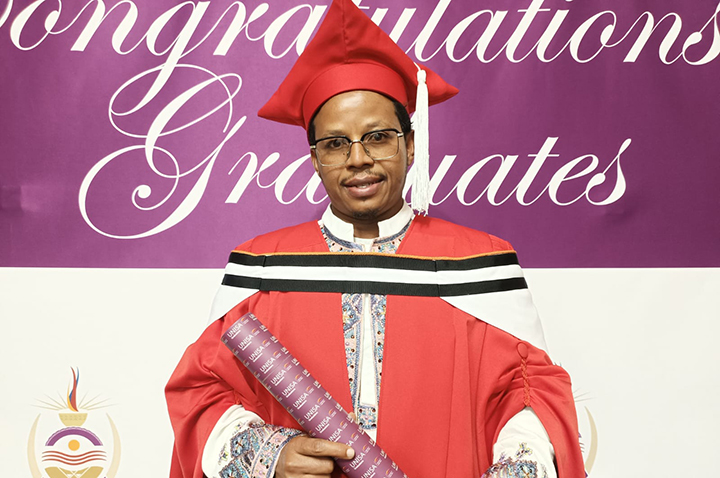
Dr Netsanet Gashaye Negatie from the Unisa Ethiopia Region recently graduated with a Doctor of Business Leadership (DBL) from the Unisa Graduate School of Business Leadership (SBL). His thesis, "Post-harvest value chain analysis of coffee in Ethiopia: Towards a competitive business model", makes a valuable contribution to advancing knowledge and innovation within the coffee industry.
Negatie says a deep passion for agribusiness, international trade and value chain development has shaped his academic and professional journey. Over the years, he has worked extensively in the coffee sector, gaining practical experience across production, processing, marketing and export operations. This exposure, he explains, highlighted the critical importance of strategic leadership and evidence-based decision-making in transforming agricultural industries.
Motivated by a strong desire to contribute more effectively to the development of Ethiopia's coffee sector and broader economic growth, Negatie pursued advanced studies, ultimately completing his Doctor of Business Leadership (DBL) degree.
He notes that the Unisa Graduate School of Business Leadership stood out for its reputation in developing leaders capable of addressing complex business and societal challenges. According to him, the programme’s emphasis on strategic leadership, innovation and practical problem-solving made it particularly appealing. The qualification enabled him to combine academic rigour with real-world business challenges, enabling him to conduct research with meaningful impact in the coffee industry.
Negatie emphasises that coffee remains one of Ethiopia's most important agricultural commodities and a major source of foreign-exchange earnings. However, he points out that despite its global reputation for quality, the sector still faces significant inefficiencies, particularly in the post-harvest value chain. Having worked closely in the industry, he observed these challenges firsthand and recognised the need for a more integrated and competitive business model. This realisation ultimately shaped the focus of his doctoral research.
His study identified several key factors affecting competitiveness within Ethiopia's coffee value chain, including post-harvest losses, fragmented market structures, limited value addition, logistical inefficiencies, and weak coordination among stakeholders. In response, Negatie proposed a competitive business model that stresses vertical integration, improved quality management systems, stronger collaboration among stakeholders, the adoption of appropriate technologies and a more market-oriented approach.
He explains that these findings are particularly significant because they offer a clear framework for enhancing productivity, improving quality consistency, increasing export earnings and creating greater value for all participants in the value chain from farmers to exporters, as well as for the national economy.
Reflecting on his doctoral journey, Negatie acknowledges that balancing research with demanding professional responsibilities was one of his greatest challenges. Conducting extensive fieldwork, collecting reliable data across diverse regions and managing the complexity of the research process required considerable dedication and perseverance.
He shares that he overcame these challenges through careful planning, effective time management and strong support from his supervisors, family and colleagues. Persistence, discipline, and a commitment to continuous learning, he says, were essential in completing the journey.
According to Negatie, the research provides valuable, evidence-based recommendations for policymakers, industry leaders, cooperatives, exporters and investors. By promoting value addition, improving post-harvest practices, strengthening integration among value chain actors and enhancing market efficiency, the proposed model has the potential to enhance both competitiveness and sustainability in the coffee sector.
He adds that these improvements could ultimately lead to higher incomes for producers, increased export revenues, better product quality and greater long-term resilience across the industry.
Negatie also highlights the role of the Unisa Graduate School of Business Leadership in his success, describing it as an intellectually stimulating environment that encouraged critical thinking, innovation and academic excellence. He credits his supervisors' guidance and mentorship as invaluable throughout the research process, noting that the institution helped him strengthen both his academic capabilities and practical leadership skills.
Completing the DBL degree, he says, has broadened his strategic perspective and reinforced the importance of evidence-based leadership. It has enhanced his ability to analyse complex challenges, develop innovative solutions and lead transformational initiatives. He believes the experience has further strengthened his commitment to creating sustainable value and driving positive change within organisations and industries.
Looking ahead, Negatie expresses a strong aspiration to contribute more actively to the transformation of Ethiopia's agricultural and export sectors through research, leadership, policy engagement and industry development initiatives. He intends to build on his doctoral findings by promoting the practical implementation of the proposed business model, supporting value chain modernisation and sharing knowledge through teaching, consulting and collaboration. He also hopes to continue conducting research that addresses strategic challenges in agribusiness and international trade across Africa.
On a personal level, Negatie reflects that this achievement represents years of hard work, perseverance, sacrifice and determination. He acknowledges the support of his family, mentors and colleagues as instrumental throughout his journey.
Professionally, he views the Doctor of Business Leadership degree as a significant milestone, strengthening his ability to contribute meaningfully to business leadership, policy development and industry transformation. More importantly, he sees it not simply as the completion of an academic programme, but as the beginning of a greater responsibility to apply his knowledge and leadership in ways that create a lasting impact for society, the coffee sector and future generations.
* By Talana Lebelo, Alumni Relations Specialist, Unisa SBL
Publish date: 2026-07-27 00:00:00.0
 SBL doctoral graduate is shaping the future of Ethiopia's coffee sector
 A milestone for student wellbeing
 Unisan advances service excellence through his MBA journey
 Unisa brings world's leading mission scholars together to tackle global challenges
 Unisa hosts workshop to empower postgraduate student support and quality assurance