

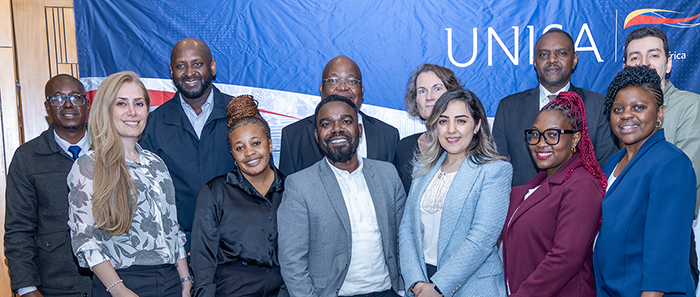
Back, from left: Dr Mthokozisi Ncube, postdoctoral fellow, CGS; Prof Tennyson Mgutshini, Executive Dean, CGS; Prof Patrick Ngulube, Professor in the School of Interdisciplinary Research and Graduate Studies, CGS; Prof Jessica Murray, Acting Director: School of Transdisciplinary Research and Graduate Studies, CGS; Prof William Amos Pallangyo, Rector: Tanzania Institute of Accountancy; and Meisam Aligholami, PhD student
Front, from left: Aylar Shams Khamenei, PhD student; Humbelani Kwinda, MSC student; Dr Itani Madiba, early career scientist; Shiva Shafiei Khosroshahi, PhD student; Dr Sharon Chilunjika, postdoctoral fellow; and Dr Josiline Chigwada, senior postdoctoral fellow
As labour markets continue to evolve, universities are under increasing pressure to ensure that graduates leave with more than disciplinary knowledge. They must be equipped with the skills, adaptability and confidence to navigate a world defined by technological disruption, shifting organisational structures and increasingly competitive employment landscapes.
This was the central message delivered by Prof William Amos Pallangyo, Rector and CEO of the Tanzania Institute of Accountancy (TIA), during his address at the College of Graduate Studies’ session at Unisa’s Research and Innovation Week.
Pallangyo, with over 25 years of experience in teaching, research, consultation and higher education leadership, emphasised that the gap between what universities teach and what companies want cannot be sustained. Although graduate numbers are increasing, vacancies are not keeping up. As a result, many young people seek self-employment opportunities outside of their academic studies. "The mismatch between university training and labour market expectations necessitates a new approach," he asserted, emphasising that institutions must take active steps to prepare students for a future that is considerably more fluid than the past.
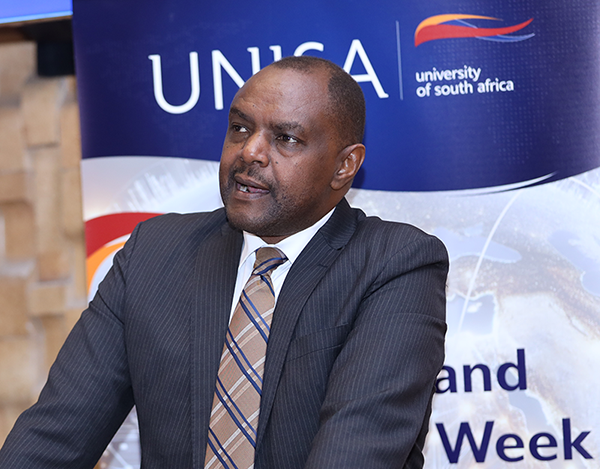
Prof William Amos Pallangyo, Rector of the Tanzania Institute of Accountancy
Established in 1973, TIA has grown into a multi-campus institution serving over 37 000 students across eight locations. In response to the employability challenge, the institute launched its Career Development Programme (CDP) in 2023. This is a structured initiative designed to build the attitudes, skills and knowledge students need to thrive in a rapidly changing world. Research shows that students who participate in career clubs, job simulations and career camps develop significantly stronger career competencies than those who do not, a finding that underpins TIA’s approach.
The CDP offers a comprehensive suite of interventions, including CV-writing workshops, mock interviews, personalised career planning and mentorship. It also recognises that talent development extends beyond traditional academic pathways, supporting students interested in entrepreneurship, sport, music and the creative industries. Cross-cutting training exposes students to industry‑relevant tools such as QuickBooks, national e-procurement systems, digital marketing platforms and human resources (HR) management software widely used across Tanzania’s civil service and private sector.
Industrial engagement is a cornerstone of the programme. Students complete three-month field residencies that provide real-world experience, while academic staff also undertake industry placements to ensure that teaching remains aligned with contemporary practice. Professional alignment is further strengthened through partnerships with certification bodies such as the National Board of Accountants and Auditors and various procurement and logistics councils.
Pallangyo believes these initiatives are helping TIA cultivate a more agile, employable and future-ready graduate cohort, who are equipped not only for today’s labour market but for lifelong career development.
In his welcome address, Prof Tennyson Mgutshini, Executive Dean of the College of Graduate Studies (CGS), emphasised that the college has positioned itself as the engine for optimising Unisa’s catalytic niche areas by building capacity to support societal change. He invited critical engagement and encouraged the audience to ask provocative questions to foster optimal engagement.
CGS showcased a spectrum of emerging research from established researchers to postdoctoral fellows, early-career scientists and postgraduate researchers. Dr Mthokozisi Ncube explored how learning analytics can assist at-risk students and how that can lead to the creative use of resources to support vulnerable students. Dr Josline Chigwada examined how indigenous knowledge can be preserved and mobilised in an era shaped by digital technologies and open science. At the same time, Sharon Chilunjika highlighted the transformative potential of drone technology to improve health access in sub-Saharan Africa, focusing on the unique opportunities and challenges in Lesotho.
Dr Itani Madiba highlighted the significant work of the UNESCO-Unisa ITL/NRF Africa Chair in Nanoscience and Nanotechnology, which was further illustrated through a series of technical presentations from the Chair. He also discussed his research on Mott phase transition oxides for smart window applications aimed at improving energy efficiency and green air conditioning. The Chair’s postgraduate cohort delivered presentations on various innovative projects, including
These projects reflect the Chair's commitment to addressing critical environmental and energy challenges through nanotechnology.
Prof Patrick Ngulube’s reflections and Prof Jessica Murray’s closing remarks highlighted that the presentations illustrated how CGS was "powering change". This change was driven by the contributions of researchers, postdoctoral fellows and postgraduate students to some of Unisa's catalytic niche areas. These areas include Energy, the Fourth Industrial Revolution and Digitalisation, Natural Sciences (with a specific emphasis on Biotechnological studies), Health Studies/Medicine and Student Support and Co-Curricular activities.
* By Hanli Wolhuter, Communication and Marketing Specialist, College of Graduate Studies
Publish date: 2026-06-04 00:00:00.0
 2025 Economist of the Year crowned by BMR/Unisa
 Unisa alumnus transforms academic excellence into entrepreneurial success
 Leveraging advances in 4IR to foster economic growth
 Unisa alumna is shaping the future of business and market development
 Unisa's Disability-Inclusive Student Support Workshops go from strength to strength