
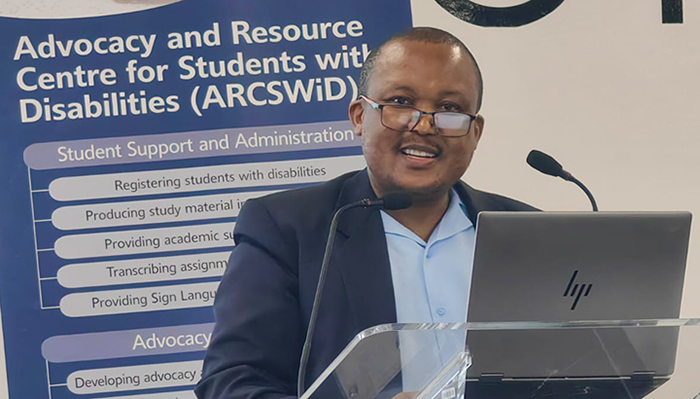
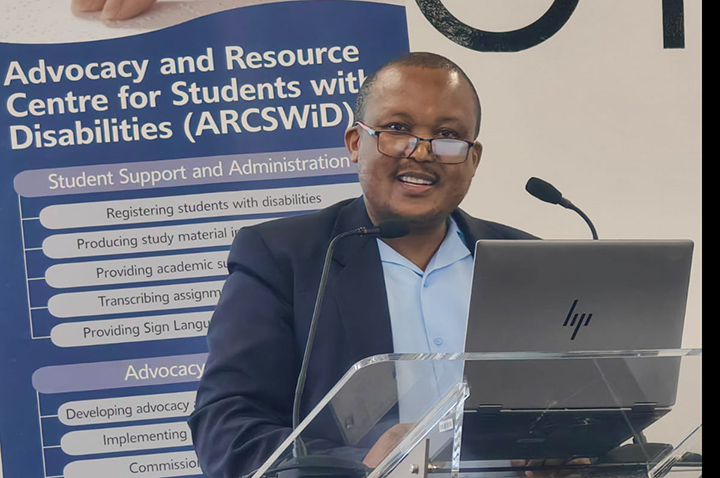
Bheki Nxumalo, Acting Deputy Director of ARCSWiD
A recent series of Regional Capacity Development Workshops, hosted by the Advocacy and Resource Centre for Students with Disabilities (ARCSWiD), in collaboration with the University Capacity Development Programme (UCDP) and Regional Management, continues to advance disability-inclusive student support across the Western Cape and the Midlands regions under the theme "Strengthening Disability-Inclusive Regional Student Support Services".
Following earlier impactful workshops hosted in other regional offices, the programme was extended to the Western Cape Region from 18 to 21 May 2026 and the Midlands Region from 26 to 27 May 2026. These engagements formed part of an ongoing institutional effort to strengthen inclusive practices, enhance staff capacity, and promote equitable access and participation for students with disabilities in an open, distance and eLearning (ODeL) environment.
The workshops brought together regional staff, disability practitioners, student support professionals, academics and students to reflect on practical ways to improve support for students with disabilities across the student walk.
In the Western Cape Region, the workshop provided an important platform for reflection on disability inclusion, reasonable accommodation and the responsibility of higher education institutions to create accessible and enabling learning environments.
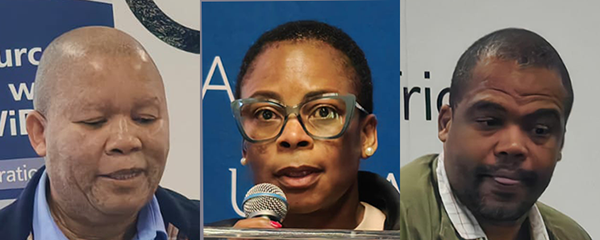
From left: Motale Nkgoang, Dr Nozuko Langa and Dr Tonny Matjila
The Western Regional Director, Motale Nkgoang, emphasised that students with disabilities should not merely be accommodated, but should be empowered to thrive academically and reach their full potential. He noted that true inclusion extends beyond policies and regulations. It is achieved through awareness, commitment and the daily actions of staff members who work to create accessible and enabling environments for all students. He further reminded participants that inclusion is not an act of charity, but a matter of justice, equity and institutional responsibility.
Reaffirming the institution’s commitment to student success, Michelle Frauendorf, Deputy Director of Student Administration Support in the Western Cape, stated that access to higher education must be accompanied by meaningful support, dignity and full participation for students with disabilities. She encouraged staff members to reflect critically on their own practices and to consider whether institutional systems are genuinely accessible and responsive to diverse student needs.
The workshop also took place during preparations for Africa Day celebrations, providing an opportunity to reflect on the values of unity, diversity and inclusion. Nkgoang highlighted the importance of ensuring that persons with disabilities are fully integrated into both the academic and social fabric of the institution, reflecting the broader vision of an inclusive and equitable society.
Following the Western Cape Regional Capacity Development Workshop, Hellen Moraka, Academic Support Officer at ARCSWiD, shared insights on inclusivity, reasonable accommodation and the importance of supporting both students and employees with disabilities in higher education. She explained that inclusivity requires students with disabilities to have equitable access to academic opportunities through reasonable accommodations such as assessment extensions, additional examination time and other forms of academic support. She further emphasised that persons with disabilities should be actively involved in policy development and decision-making processes to ensure that their voices are represented and their needs are addressed.
Gugulethu Mngadi, Acting Advocacy and Liaison Coordinator at ARCSWiD, highlighted practical disability etiquette, orientation and mobility support. She emphasised that staff should ask students how they wish to be assisted, use respectful language, protect students’ dignity and promote barrier-free environments. She further explained that orientation and mobility training enables visually impaired students to move safely, confidently and independently in different campus and regional offices.
Sophy Mabaso, ARCSWiD’s South African Sign Language Interpreter, presented on South African Sign Language, Deaf culture and inclusive communication. She explained that sign language is a visual language with its own grammar and cultural meaning, and encouraged staff to respect Deaf students’ preferred communication methods. Her presentation reinforced the need for accessible communication through SASL, captions, note-taking support and respectful engagement.
The Regional Capacity Development Programme then proceeded to the Midlands Region from 26 to 27 May 2026, where participants reflected on the importance of equitable access to learning technologies, inclusive spaces and accessible communication.
In the Midlands Region, Bongi Lebeloane highlighted the importance of sustaining disability-inclusive support services in the long term. She stated that equal access to technological resources across all regions should not be optional but treated as a mandatory institutional requirement.
She emphasised that all students, including students with disabilities, must have access to the same facilities and resources, such as computer laboratories and digital learning tools. She further noted that, in some instances, students with disabilities are required to use separate rooms or specialised spaces instead of shared computer laboratories. While this may be intended as support, it can unintentionally lead to exclusion and discrimination.
Lebeloane cautioned that separating students with disabilities from their peers may create the perception that they are different or unequal. This can negatively affect their confidence, sense of belonging and academic experience. Inclusive education, she emphasised, should promote integration, participation and belonging rather than separation.
Yandani Chagi, Regional Academic Coordinator in the Midlands Region, raised practical accessibility considerations requiring institutional attention. He noted that regional offices need improved directional signage and wayfinding support. He also highlighted the importance of making posters and notices on regional notice boards more accessible, including, where possible, through sign language-supported communication. Chagi further emphasised the need for additional sign language interpreters to support workshops and online classes.
Chagi also emphasised the need for additional sign language interpreters to support workshops and online classes. His reflections highlighted the importance of accessible communication as a core part of inclusive student support.
Dr Nozuko Langa emphasised that UCDP and ARCSWiD remain committed to strengthening the retention, inclusion and academic success of students with disabilities at Unisa. She highlighted that the regional workshops have created important platforms for engagement between students with disabilities and the staff who support them. She further stressed the principle of "Nothing About Us Without Us", calling for greater student involvement in the planning, facilitation, implementation and evaluation of future workshops to enhance inclusion, representation and impact.
Dr Tonny Matjila, from the College of Graduate Studies, delivered a thought-provoking presentation on "Conceptualising Disability and Models". He challenged participants to move beyond narrow understandings of disability that locate the problem within the individual, and instead encouraged a broader reflection on how institutional, social, environmental and attitudinal barriers often produce exclusion. His presentation reinforced the importance of adopting transformative, student-centred approaches that redesign systems, services and learning environments to enable full participation, dignity and success for students with disabilities.
The Western Cape and Midlands workshops demonstrated that disability inclusion must move beyond awareness and be translated into practical implementation. Participants reflected on several key areas requiring ongoing attention, including accessible communication, sign language support, assistive technologies, reasonable accommodation, inclusive digital platforms, accessible study materials, and continuous staff capacity development.
Reflecting on the significance of the workshops, Bheki Nxumalo, Acting Deputy Director of ARCSWiD, remarked that disability inclusion should not remain at the level of policy statements or awareness campaigns only, but must be reflected in the daily practices, systems and decisions of the university. He emphasised that practical implementation requires coordinated action among regions, academic departments, support services and the student leadership to ensure that students with disabilities experience meaningful access, dignity and participation throughout their academic journey.
The engagements reinforced the importance of collaboration among Unisa stakeholders in strengthening services for students with disabilities. In an ODeL institution such as Unisa, such collaboration is essential to ensuring that disability-inclusive support is available across all regions, rather than being limited to centralised services.
Through these regional workshops, ARCSWiD and its partners continue to strengthen institutional capacity, promote inclusive practices and advance the university’s commitment to access, dignity, participation and student success for students with disabilities.
The continued collaboration among ARCSWiD, CEDU UCDP and regional management reflects a shared commitment to building a university environment where disability is not a barrier to learning, participation or achievement.
* Submitted by Kefiloe Tshabalala, Maria Mohlala and Romeo Gavhi, Interns: ARCSWiD
Publish date: 2026-06-04 00:00:00.0
 2025 Economist of the Year crowned by BMR/Unisa
 Unisa alumnus transforms academic excellence into entrepreneurial success
 Leveraging advances in 4IR to foster economic growth
 Unisa alumna is shaping the future of business and market development
 Unisa's Disability-Inclusive Student Support Workshops go from strength to strength