
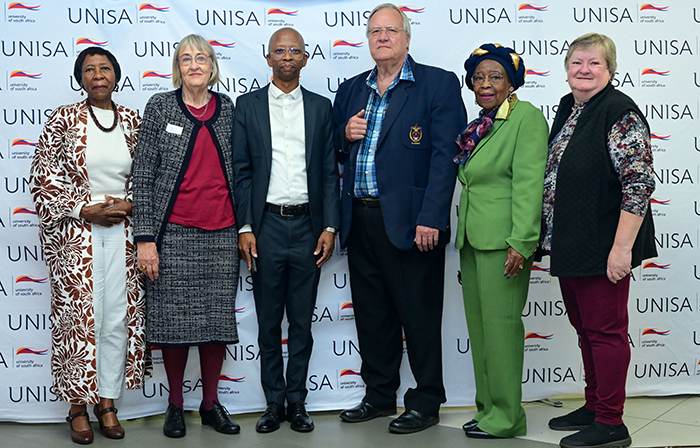
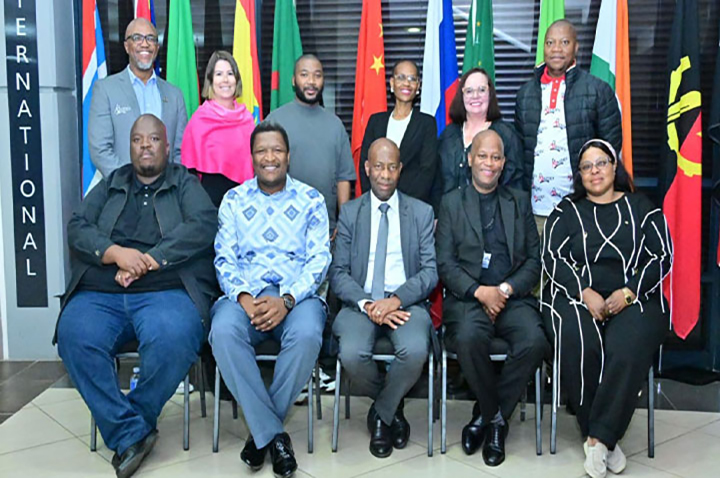
Unisa’s retirees and Executive Director of Department of Institutional Advancement, Prof Boitumelo Senokoane, at the annual International Senior Citizens Day event held in Unisa.
The University of South Africa (Unisa) recently brought together senior citizens and retirees for a celebration of experience, resilience and lifelong connection to the institution.
The second annual International Senior Citizens Day event was more than an occasion to recognise older members of the Unisa community. It created space for reflection, conversation and knowledge-sharing, highlighting the important role that senior citizens continue to play in the university and wider society.
The inaugural celebration took place on 21 August 2025, coinciding with the global observance of International Senior Citizens Day. This year's event was brought forward by a day to accommodate Unisa's busy events calendar while maintaining the spirit of the occasion.
Prof Boitumelo Senokoane, Executive Director of the Department of Institutional Advancement, reminded attendees that leaving formal employment does not mean leaving Unisa behind.
"Retirement does not sever one’s bond with Unisa," he said.
Senokoane described retirees as important ambassadors of the university, carrying its history, credibility and institutional memory into their communities and professional networks.
His message also highlighted the progress Unisa continues to make. He reported a 44.3% increase in research knowledge production between 2023 and 2024, moving the university from sixth to second place nationally and contributing about 12% of South Africa’s total university research output.
He also highlighted Unisa's fourth-place national position according to the Department of Higher Education and Training and its second-place national ranking in fine arts. Internationally, the university ranked eighth in South Africa and 297th globally for societal impact.
For the retirees in attendance, these achievements offered another reason to remain connected to an institution whose story they helped shape.
Consumer consultant Ina Wiken turned the spotlight to something that cannot easily be measured in statistics: the value of lived experience.
She spoke about the "wisdom dividend", referring to the knowledge older people develop through years of experience, including lessons learned from mistakes and setbacks.
Wiken encouraged older people to recognise the value of their experiences and to share their stories with younger generations. In a rapidly changing world shaped by technology, shorter attention spans and constant information, she argued that older generations have an important role to play as sources of perspective, resilience and cultural knowledge.
Her message was particularly relevant to a university community that brings together people from different generations and backgrounds. The exchange of knowledge, she suggested, should not move in only one direction.
Older generations have much to learn from new technologies and changing social realities, but younger generations can also learn from the experiences of those who have navigated significant changes in their own lifetimes.
The celebration also addressed a growing concern for older people: cybercrime.
Jolene Bezuidenhout, a consultant specialising in safety and security, introduced attendees to the concept of cybercrime-as-a-service (CaaS), explaining how criminal networks have become increasingly organised and sophisticated.
She warned that scammers can now access specialised skills and tools through underground online networks, enabling them to launch large-scale attacks.
Phishing remains one of the most common threats, while artificial intelligence is making scams increasingly convincing. Fraudsters can use AI to replicate legitimate-looking messages and communications, making it harder for people to distinguish between genuine requests and attempts to steal their information or money.
Bezuidenhout noted that older people can be particularly vulnerable to these scams, especially when they are less familiar with rapidly changing digital technologies.
The message was clear: digital safety is no longer simply a technology issue. It is a life skill that requires awareness across generations.
Bezuidenhout also introduced the "Life File" initiative presented by AVBOB, which encourages people to organise important personal, legal, financial and medical information in one place.
The initiative provides a structured way for individuals to record important documents and communicate their preferences, including arrangements relating to end-of-life services.
While these are not always easy conversations to have, documenting important information in advance can reduce uncertainty and ease the burden on families during difficult times.
Unisa's International Senior Citizens Day celebration demonstrated that recognising older people is about more than looking back. It is also about recognising their continuing contribution to the present and their role in shaping the future.
For Unisa staff and students, the event offered an important reminder that the university’s community extends beyond current employees and students. Its retirees and senior citizens remain part of its institutional story, carrying memories, knowledge and experiences that cannot simply be archived.
By creating opportunities for generations to meet, share experiences and learn from one another, Unisa is keeping that connection alive.
And perhaps the most important lesson from the celebration was simple: experience does not retire.
* By Sipho Jack, Journalist, Department of Institutional Advancement
Publish date: 2026-08-21 00:00:00.0

 Supporting success: How Unisa's PRG helped Babalwa Ramncwana take the next step in her academic journey
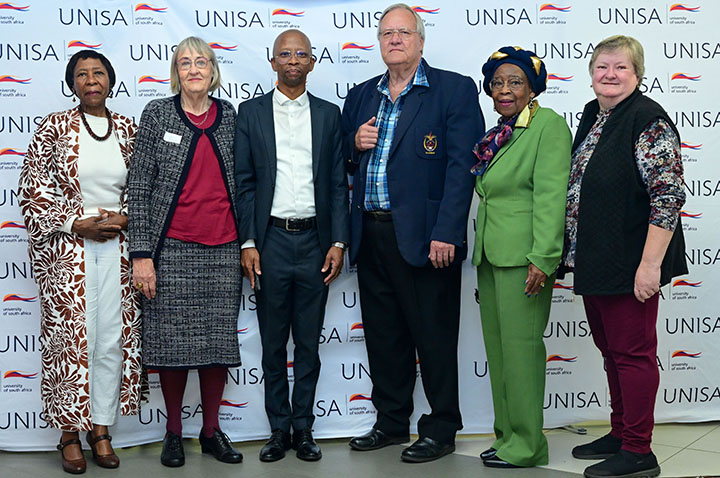 Wisdom that connects generations: Unisa celebrates its senior citizens
 From e-Tutor to Adjunct Academic: Lerato Letsoalo’s journey into academia at Unisa
 NASDEV Conference celebrates women's leadership and calls for ethical, equitable institutions
 Turning data into opportunity for mathematics learners