
When it comes to corruption, universities hide behind academic freedom. They are congregations of the most educated in the country and the public think they are not fit enough to criticise higher education institutions,” said Prof Harry Nengwekhulu, Director of Unisa’s School of Governance. He was speaking at the Unisa-Mail & Guardian Critical Thinking Forum on corruption in higher education that took place on 23 September 2016.
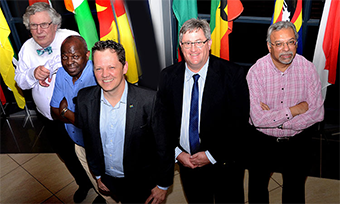
The Unisa-Mail & Guardian Critical Thinking Forum on Corruption in Higher Education took place on 23 September 2016. At the forum were Hugh Amoore (Former Registrar: UCT), Prof Harry Nengwekhulu (Director: School of Governance, Unisa), Marius Oosthuizen (Faculty in Strategic Foresight, GIBS), Jaco van Schoor (Deputy Vice-Chancellor: Finance, UJ), and Mohamed Shaikh (Executive Director: Department of Communication and Marketing, Unisa).
With corruption and unethical conduct seemingly on the rise, this forum aimed to consider the factors behind this kind of behaviour and its impact on the reputation and integrity of institutions of higher learning. Other speakers joining the forum panel were Hugh Amoore, Former Registrar of the University of Cape Town and Jaco van Schoor, Deputy Vice-Chancellor of Finance at the University of Johannesburg. The discussion was facilitated by Marius Oosthuizen, Faculty in Strategic Foresight (Leadership, Strategy & Ethics) at the Gordon Institute of Business Science.
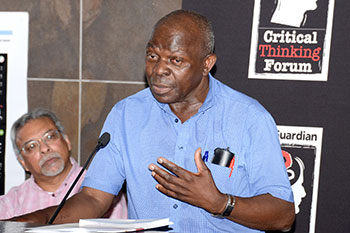
Prof Harry Nengwekhulu (Director: School of Governance, Unisa)
According to Nengwekhulu, lack of public accountability is a stumbling block. “Part of the problem of corruption at universities worldwide, not just in South Africa, is that they have never been subjected to public accountability,” he said. He finds it strange that members of the public know about corruption in schools more than that which happens at universities. “When kids fail matric it becomes a national issue, but it is never a national issue when the pass rates are very low at universities because, after all, we assume universities know what they are doing,” Nengwekhulu argued.
The ethical concerns afflicting higher education are not going anywhere soon and Nengwekhulu believes this is partly due to the myth of academic freedom. “We have created this myth of academic freedom to a point where many do not know the level of corruption that actually exists. The public are able to make comments about the tendering systems at municipalities, government departments, and state enterprises; however, questions are never raised about the financial management of universities.”
Amoore agreed that this and other factors need to be identified and dealt with. Four major risk areas for any university he identified are: research integrity, the scourge of plagiarism, the integrity of the academic record and certification process, and corruption related to the supply chain process. “Higher education institutions are increasingly conscious of the fact that they have to protect and do more to ensure a controlled environment that protects the integrity of research, publications, and of the certification processes, and the academic record,” he said.
On the issue of fake qualifications, Amoore believes that degree mills producing bogus qualifications are only a small part of the problem we face. “Before we get panicky, let us remember that the vast majority of qualifications claimed in this country are genuine. I do not think that qualification fraud is yet endemic, and I sincerely hope it never becomes that.”
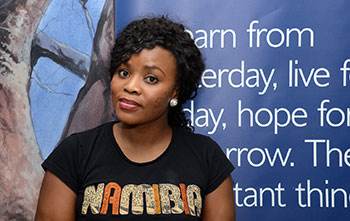
Nonsikelelo Nako (Department of Communication and Marketing, Unisa) who was also an audience member weighed in with her thoughts. “It is unfortunate that universities are controlled by dark forces that use and turn university leaders into ‘I don’t care mafias’ who do not respect the sensitivity of being trusted by the public to lead universities. Nor do they respect their primary stakeholders that come to universities with the hope of becoming something in life through education. Universities are not transparent, neither do they account for their actions—in fact they hide under institutional autonomy. When student leaders try to protest for accountability in institutions, they get threatened and victimised. However, universities preach ethics all the time but they don’t practise it. Is it because leaders of universities benefit corruption, the lack of code of conduct among professors, lack of policy transformation, the absence of political will to fight corruption, and because of the poor quality of school-level education?”
_According to Van Schoor, universities are not very well known for consequence management. “In areas of corruption, we absolutely need to be strict,” he urged. Good financial governance is one of the most important areas where this is required. “We are living in a society where there is massive moral degeneration and many people think that they have a right to the financial, and other spoils, of the country,” he explained.
When it comes to people in higher education who think that funding from the state belongs to them, Van Schoor has only one response: “I always say that the moment that rand goes into the bank account of the university, it becomes public funds. We have to account for it and we have to treat it with beyond scrutiny because it is not our money.”
He believes this is what universities must fundamentally understand. “It is not our money. It is managed on behalf of the taxpayer to fund education for human resource development and for us to develop our country as a whole. None of the money belongs us; we are just custodians of it,” Van Schoor pointed out.
The Unisa-Mail & Guardian Critical Thinking Forum provided fertile ground for discourse on corruption in higher education by opening up the discussion to audience members to weigh in. Some of the questions and comments that came from the floor zoomed in on the following challenges: the relationship between schools and universities when it comes to teaching morals and ethics, hijacked journals, corruption being under-reported at universities because of the fear of reputational risk, the disjuncture that exists between those with real versus fake qualifications, the ramifications of fake qualifications on society, higher education institutions which are under siege by external forces, the possibility of conceptual plans on free education, the peer review system and if it should still be believed in, calls for a more transparent peer review system, and the prevention of all forms of academic dishonesty.
The Unisa-Mail & Guardian Critical Thinking Forum series aims to contribute to thought leadership and critical dialogue which promotes critical thinking and engagement on matters central to the national discourse. The objective is to not only engage in constructive thinking and debate, but also to harness creativity, innovation, and ingenuity in tapping into and sharing new and alternative perspectives on South Africa’s current context.
Publish date: 2016-09-26 00:00:00.0

 Reclaiming African heritage through geographical names
 From research to real-world impact: Unisa-linked project explores new ways to advance LGBTQIA+ rights
 Unisa hackathon winners develop AI solution to support students at risk of falling behind
 Beyond Black Wednesday: Unisa lecture calls for urgent action to protect media freedom and public broadcasting
 Unisa celebrates 25 new PhD graduates advancing research and innovation