

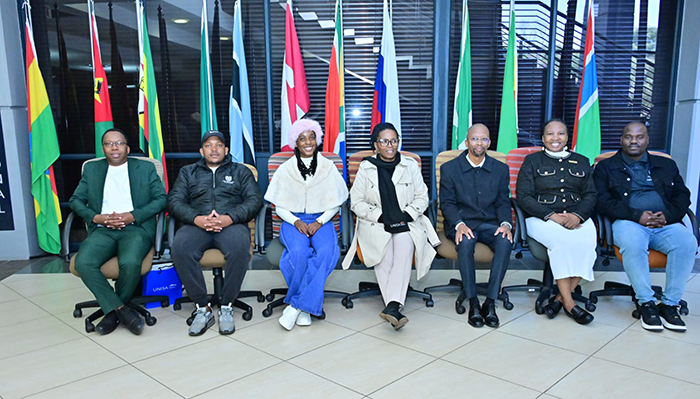
From left, Dr Nicky Tjano, programme director, Mpho Mahlangu, Vaal University of Technology SASUF Student Network Chairperson, Tshegofatso Mmope, Secretary-General of the Unisa SRC, Dr Angie Magabane, Executive Director of Internationalisation and Partnerships, Prof Boitumelo Senokoane, Acting Executive Director of the Department of Institutional Advancement, Dr Mantepu MaseTshaba, Executive Dean of the College of Economic and Management Sciences, and Andile Mthembu, National SASUF Student Network Coordinator
The Directorate of Internationalisation and Partnerships in Unisa's Department of Institutional Advancement (DIA) launched the Unisa SASUF (South Africa Sweden University Forum) Student Network on 13 July 2026.
The SASUF Student Network is a networking platform that aims to bring together South African and Swedish students and other relevant stakeholders in research, education, and innovation to jointly engage on global challenges and their impact on society, especially the youth.
In his welcome address, Prof Boitumelo Senokoane, Acting Executive Director of DIA, warmly welcomed attendees to the launch. He encouraged postgraduate students to establish new relations and strengthen ongoing collaborative efforts in research, education, and internationalisation.
"It is important to highlight Unisa's unwavering commitment to global engagement," he said. "This launch is designed to enable students to collaborate, innovate, and expand their horizons beyond national borders."
Senokoane urged Unisa's postgraduate students to use the platform to exercise their right to freedom of opinion and expression, including the right to hold opinions without interference and to seek, receive, and impart information and ideas through any media, regardless of frontiers. He further emphasised that the network will afford students the right to movement and association. He encouraged postgraduate students to take full advantage of the opportunities that the network provides.
Dr Angie Magabane, Executive Director of Internationalisation and Partnerships, said the occasion marked a significant milestone in the official launch of the Unisa SASUF Student Network. She noted that the network is instrumental in creating opportunities for collaboration between Unisa and partner universities in Sweden. Students will engage in meaningful dialogue, share their experiences, and collaborate on research and educational projects between South Africa and Sweden. The network will also facilitate benchmarking through the exchange of information and joint publication. "When we leave this venue, we will have the coordinators in place who will champion its objective," she said.
In her message of support, Tshegofatso Mmope, Secretary-General of the Unisa Student Representative Council (SRC), extended her appreciation to everyone who made this important initiative possible. She said that the event marks more than the launch of a network: it marks the beginning of a stronger, more connected postgraduate student community.
"Postgraduate students play a vital role in advancing research, innovation, and knowledge creation that addresses both national and global challenges," said Mmope. "We believe that postgraduate students deserve a platform where they can collaborate, share ideas, mentor one another, and access opportunities for academic and professional growth. This network provides exactly that."
She emphasised that the SRC remains committed to advocating for postgraduate student interests, promoting student success, and ensuring that every student has access to opportunities that enrich their academic journey.
Giving an overview of SASUF, Andile Mthembu, National SASUF Student Network Coordinator, said SASUF brings together researchers, teachers, students, university leaders, and key stakeholders to develop joint solutions to the challenges linked to the United Nations Sustainable Development Goals (SDGs) and the African Union's Agenda 2030.
"SASUF continues to act as a platform for fostering global solutions through local impact, promoting local thinking that bridges global insights with tangible sustainable outcomes," said Mthembu. "The forum also promotes sustainable internationalisation through hybrid and virtual collaboration models, enabling broad participation. SASUF expands opportunities for South African and Swedish master's and PhD students to participate in international research and promote early career development through student engagement, a sustainable leadership model, and interdisciplinary hackathons addressing real-world challenges."
Mpho Mahlangu, Vaal University of Technology SASUF Student Network Chairperson, said that the launch was not merely the establishment of a committee but the genesis of a movement to ensure the success of the postgraduate student network. He stated that the success of the student network would not be measured by the number of meetings the committee held, but by the number of students inspired, the collaborations formed, and the lives impacted. He urged Unisa’s postgraduate students to remain curious, embrace opportunities, participate actively, and build friendships across institutions. In conclusion, he congratulated Unisa on this historic milestone. "May your student network become a home for innovation, collaboration, and excellence, and may today’s launch be remembered as the beginning of something truly extraordinary," he said.
Dr Mantepu MaseTshaba, Executive Dean of the College of Economic and Management Sciences, officially introduced the Interim Coordinating Team of the Unisa SASUF Student Network. She said the mandate of the interim team is to establish governance, enable academic value, mobilise students, and grow visibility.
"This interim coordinating team has the responsibility to promote research collaboration and academic opportunities, coordinate seminars, workshops, and conferences, build partnerships with international institutions, and track global trends and opportunities in education," said MaseTshaba. She wished the team well in their new undertakings.
The national leadership of the Interim Coordinating Team will comprise Siya Seme, Communication and Marketing Manager of Unisa’s KwaZulu-Natal Region, and Irma Thema, Academic Administrator at the university’s Graduate School of Business Leadership (SBL).
* By William Thubakgale, Department of Institutional Advancement
** Photography by Shooheima Champion, Multimedia Centre
Publish date: 2026-07-21 00:00:00.0

 Es'kia Mphahlele's legacy lives on as Unisa hosts 17th Annual Memorial Lecture
 From waste tyres to shoe polish: Unisa Professor turns waste into opportunity
 Beyond barriers: Dr Nozuko Langa's decade-long journey to a PhD
 Unisa students take top honours at 2026 HEQAF Student Paper Presentation Competition
 Young KZN photographers explore the ocean through Unisa lens