
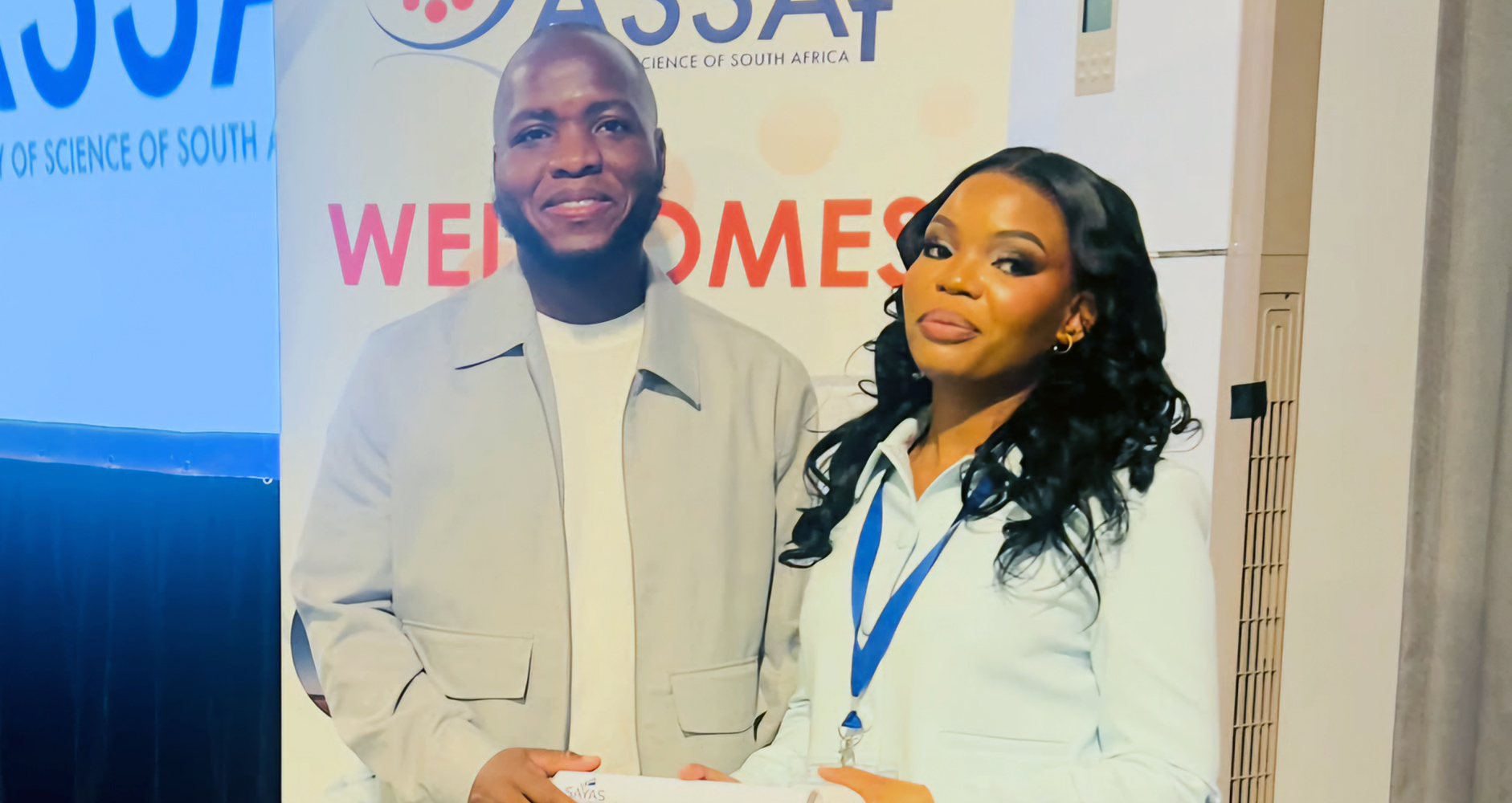
Dr Khodani Matshusa and Dr Mmakgabo Angelina Selepe were formally welcomed into the academy during the Academy of Science of South Africa’s (ASSAf) Annual Awards Ceremony at the Birchwood Conference Centre in Boksburg.
Two researchers from the University of South Africa (Unisa) have received national recognition for their contributions to science and innovation following their induction into the South African Young Academy of Science (SAYAS).
Dr Khodani Matshusa and Dr Mmakgabo Angelina Selepe were formally welcomed into the academy during the Academy of Science of South Africa's (ASSAf) Annual Awards Ceremony at the Birchwood Conference Centre in Boksburg. Their induction recognises their research achievements and contributions to addressing challenges in environmental sustainability and education, two areas with significant implications for South Africa's development. The occasion formed part of ASSAf's 30th anniversary celebrations, marking three decades of promoting scientific excellence, evidence-based policymaking and the contribution of research to society.
SAYAS provides a platform for emerging researchers to contribute to scientific discussions, promote interdisciplinary collaboration and strengthen the role of young scientists in addressing national and global challenges. Opening the ceremony, ASSAf President Prof Thokozani Majozi reflected on the organisation's contribution to advancing science and strengthening South Africa's research community. He acknowledged the dedication of the academy's founders, former leaders and members who have contributed to its development over the years.
"Our sincere gratitude goes to the co-founders, former executive members, and all SAYAS members and current executive for their continued commitment, dedication, and support in building and strengthening this outstanding organisation," Majozi said. He also encouraged continued collaboration among researchers to ensure that scientific knowledge contributes meaningfully to society. "May we continue to work together to advance science, inspire young scientists, and contribute meaningfully to society. Here's to an even stronger SAYAS and a bright future ahead," he added.
The ceremony highlighted the importance of recognising emerging scientific talent and creating opportunities for young researchers to contribute to public policy, innovation and sustainable development. Matshusa, an NRF Y2-rated researcher at Unisa, has established himself in geoheritage research, focusing on mine closure and the sustainable repurposing of abandoned mining sites.
He earned his PhD in Tourism from the University of Johannesburg in 2020 and has since researched how former mining areas can be rehabilitated and transformed into spaces that support environmental conservation, tourism, and community development. Among his notable achievements is the development of South Africa's first comprehensive database of derelict and ownerless mines. The database provides an important resource for identifying abandoned mining sites and informing rehabilitation efforts. His work has contributed to initiatives aimed at rehabilitating more than 30 sites across the country.
Matshusa also authored a UNESCO geoparks report in 2023, contributing to discussions on the conservation and sustainable use of geological heritage. He serves as chairperson of the Geoscience and Society Division of the Geological Society of South Africa (GSSA), where his work contributes to strengthening the relationship between geoscience research and societal development. His research is particularly relevant in a country where abandoned mines can pose environmental, health and safety risks to surrounding communities.
By exploring ways to rehabilitate and repurpose these sites, his work demonstrates how scientific research can support environmental restoration while identifying opportunities for local economic development. These contributions align with Sustainable Development Goal (SDG) 11, which promotes sustainable cities and communities, and SDG 15, which focuses on protecting and restoring terrestrial ecosystems. They also support South Africa's National Development Plan 2030 objectives relating to environmental sustainability, economic development and the responsible management of natural resources. Selepe, a lecturer at Unisa, is recognised for her research in Early Childhood Education and Development, particularly her efforts to improve how young children engage with mathematics, science and technology.
Her work explores culturally responsive teaching methods that combine play-based learning, indigenous knowledge and technology-enhanced educational approaches. By incorporating coding, robotics and early mathematics concepts into learning activities, Selepe seeks to make science, technology, engineering and mathematics (STEM) education more accessible and meaningful to young learners. Her approach recognises that children learn more effectively when educational experiences connect with their cultural backgrounds, everyday environments and existing knowledge.
Through this work, Selepe contributes to broader efforts to strengthen foundational learning and encourage early interest in scientific and technological fields. Her academic achievements include receiving the South African Education Research Association (SAERA) Doctoral Award and securing funding through the National Research Foundation's Thuthuka programme. Her research is particularly relevant to South Africa's efforts to improve educational outcomes and address inequalities in access to quality learning opportunities. By combining indigenous knowledge with emerging technologies, Selepe's work also demonstrates how educational innovation can promote inclusion while preparing learners for an increasingly digital world.
Her contributions support SDG 4, which seeks to ensure inclusive and equitable quality education and promote lifelong learning opportunities. They also relate to Unisa's broader commitment to digital transformation, educational innovation and socially responsive scholarship. The induction of Matshusa and Selepe into SAYAS reflects the diversity of research undertaken at Unisa and the institution's contribution to developing scientific expertise that responds to societal needs. Although their research focuses on different disciplines, both academics demonstrate how knowledge generated through universities can contribute to practical solutions.
Matshusa's work addresses environmental rehabilitation and the sustainable use of geological resources, while Selepe's research focuses on strengthening foundational education through culturally relevant and innovative teaching methods. Together, their achievements highlight the importance of interdisciplinary research in responding to South Africa's developmental priorities. Their recognition also reinforces Unisa's commitment to supporting emerging researchers, advancing academic excellence and producing knowledge that contributes to national, continental and global development.
Through its Catalytic Niche Areas, the university continues to encourage research that connects academic scholarship with pressing challenges, including environmental sustainability, digital transformation and educational development. Beyond recognising individual achievements, SAYAS membership provides opportunities for young scientists to participate in broader research networks, exchange knowledge and contribute to discussions on the role of science in society. For Matshusa and Selepe, the induction represents another milestone in their academic careers and an opportunity to strengthen the impact of their research.
Their achievements also serve as an encouragement to emerging academics and postgraduate students pursuing research that seeks to address real-world challenges. As ASSAf celebrates 30 years of advancing scientific excellence, the recognition of the two Unisa researchers demonstrates the important role that young scientists continue to play in shaping South Africa's research landscape.
Their induction is not only a celebration of individual academic achievement, but also a reflection of Unisa's contribution to developing researchers whose work can improve lives, strengthen communities and advance sustainable development.
* By Sipho Jack, Journalist, Department of Institutional Advancement
Publish date: 2026-11-02 00:00:00.0

 Two Unisa researchers inducted into South African Young Academy of Science
 Unisa calls for ocean science that protects ecosystems and transforms coastal communities
 Unisa Senate closes 2026 on a high note as university celebrates academic and research achievements
 Unisa's Prof Meahabo Magano appointed to Umalusi Qualifications Standards Committee
 Tshwane mayoral candidates outline plans to restore services at Unisa Election Debate