

Africa's development challenge is not simply a shortage of resources, talent or ideas. It is whether institutions can convert those assets into opportunity, dignity and a better life for millions of people.
That question shaped the University of South Africa's (Unisa) eighth Chief Albert Luthuli Research Chair Founders' Lecture, held on Friday 25 September 2026 at the Kgorong Building Function Hall on the Muckleneuk Campus.
Under the theme "Governance and institutional quality: Strategic state-led investment", scholars and public leaders examined the relationship between institutional capacity, economic development and human wellbeing.
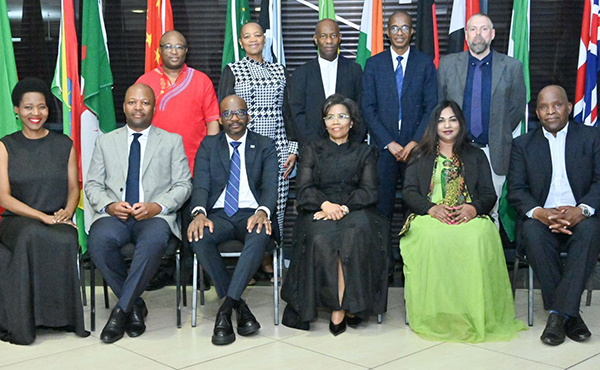
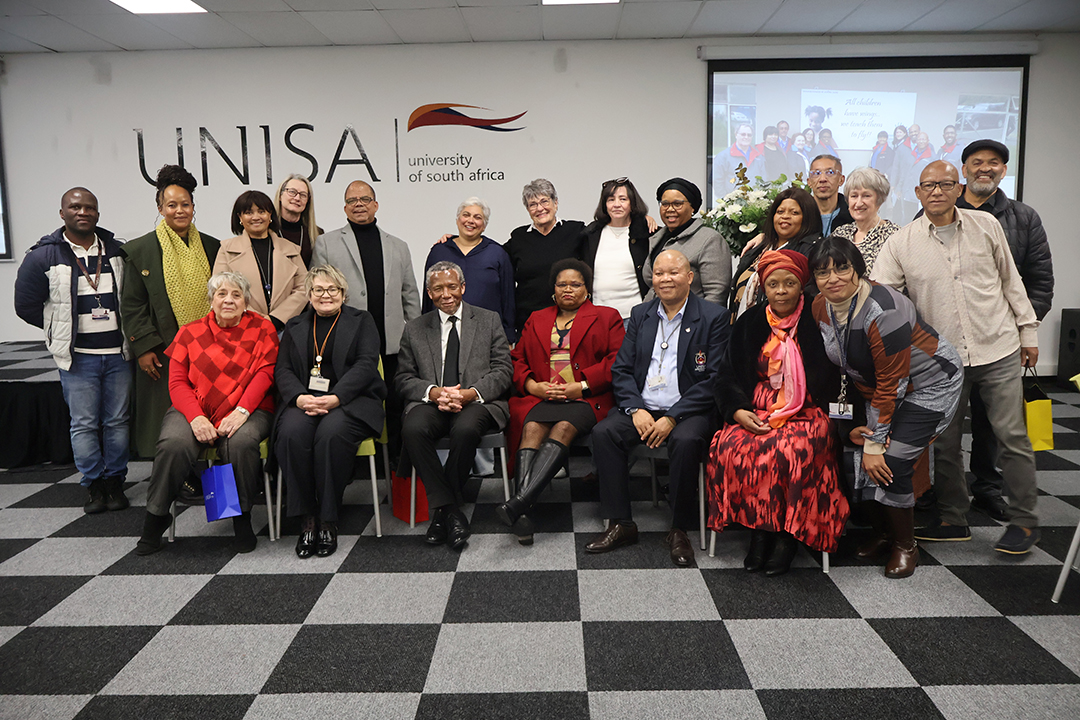
From left to right, front row: Prof Puleng Segalo, Chairperson of the Unisa Chief Albert Luthuli Research Chair; Nkululeko Luthuli, grandson of Chief Albert Luthuli; Honourable Dithapelo Lefoko Keorapetse, keynote speaker; Prof Puleng LenkaBula, Unisa Principal and Vice-Chancellor; Advocate Charlie Naidoo, Chairperson of the Luthuli Museum Council; and Prof David Mosoma, Unisa Council member. Back row, from left: Dr Moses Hlongoane, Executive Dean of the College of Accounting Sciences; Prof Zethu Nkosi, Executive Dean of the College of Human Sciences; Prof Moloko Sepota, Unisa Registrar; Prof Mpho Ngoepe, Vice-Principal: Teaching, Learning, Community Engagement and Student Support; and Prof Ashley Gunter, Deputy Executive Dean, College of Agriculture and Environmental Sciences.
The discussion moved beyond abstract questions about the role of the state and the economy, focusing instead on how governance decisions affect businesses, jobs, public resources and people's everyday lives.
Welcoming delegates, Unisa Principal and Vice-Chancellor Prof Puleng LenkaBula placed the lecture within the university's broader social responsibility.
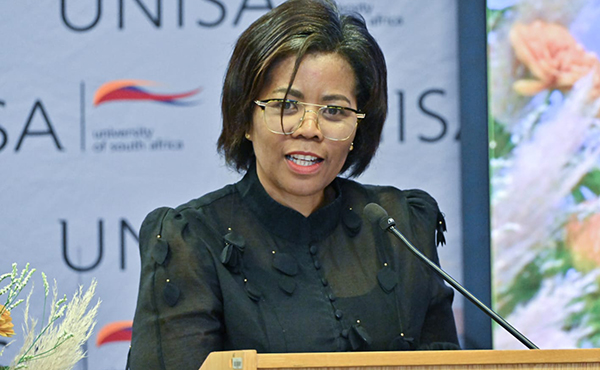
Prof Puleng LenkaBula, Unisa Principal and Vice-Chancellor.
Universities, she said, have a role to play in understanding and responding to the conditions shaping people's lives.
Against the backdrop of unemployment, inequality, gender-based violence and femicide, LenkaBula urged delegates to look beyond statistics and recognise the human consequences behind them.
"These are not stories. These are lives. These are complex questions," she said.
Speaking on behalf of the Luthuli family, Chief Albert Luthuli's grandson, Nkululeko Luthuli, expressed appreciation for Unisa's continued commitment to preserving and advancing the former African National Congress president and Nobel Peace Prize laureate’s legacy through scholarship and public dialogue.
"This lecture has now become firmly embedded in the calendar of this university," he said, acknowledging Unisa’s “commitment, dedication, care, thoughtfulness and substantial investment” in its continued success.
For Prof Puleng Segalo, Chairperson of the Chief Albert Luthuli Research Chair, Luthuli's legacy comes with an obligation to reflect on the society being built, the institutions being sustained and the values guiding public life.
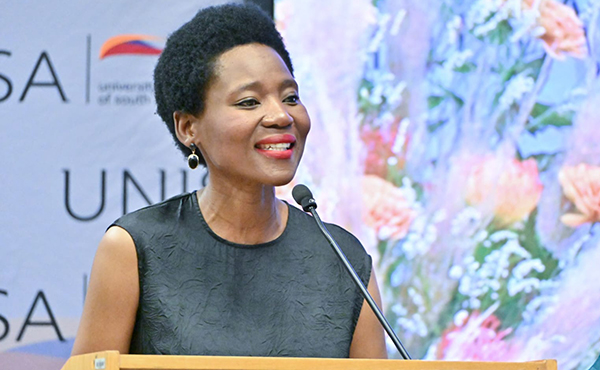
Prof Puleng Segalo, Chairperson of the Unisa Chief Albert Luthuli Research Chair.
"His name asks something of us," she said.
The Research Chair provides a platform to "think in public", bringing academic work into conversation with communities, policymakers, students, entrepreneurs and civil society.
Linked to Unisa's Catalytic Niche Areas, the Chair connects research, dialogue, partnerships and community engagement to the university’s broader research and societal-impact agenda.
For Segalo, this represents "scholarship with a conscience": asking what knowledge does in the world, who benefits from it and what responsibilities follow.
The keynote address was delivered by the Honourable Dithapelo Lefoko Keorapetse, Speaker of Botswana's National Assembly.
Keorapetse argued that development cannot be measured solely through economic growth, natural resources, investment or entrepreneurship.
"Institutions are the engine room of development," he said.
He pointed to budgets, procurement, appointments, regulation and public investment as some of the mechanisms through which institutions shape economic outcomes.
A developmental state, he argued, is not simply one that spends more or intervenes more. It must have the authority, capacity and discipline to work effectively with markets and society while ensuring that public investment produces meaningful outcomes.
He also challenged the idea that entrepreneurship operates independently of its institutional environment.
"Businesses need functioning infrastructure, finance, reliable information, effective procurement and regulations that do not unnecessarily restrict participation."
Economic development therefore depends not only on what countries possess, but on whether their institutions can translate those assets into opportunity.
Prof Patricia Lindelwa Makoni of Unisa's Department of Finance, Risk Management and Banking brought the discussion closer to the experiences of small businesses and vulnerable communities.
She argued that policies that appear effective at a macro level can produce very different outcomes on the ground, making the gap between policy formulation and implementation critical.
Infrastructure, information, procurement, regulatory quality and government effectiveness, she said, can determine whether businesses are able to participate meaningfully in the economy.
Prof Tankiso Moloi, Executive Dean of the College of Business and Economics at the University of Johannesburg, framed institutional quality as a question of human possibility.
"How do we build institutions capable of converting Africa’s resources, talent and imagination into human possibility?"
For Moloi, the answer lies neither in an all-powerful state nor in state withdrawal. It requires capable and accountable institutions that can work with society and markets while retaining the professional capacity and autonomy to make sound decisions.
He also challenged the tendency to place the burden of entrepreneurial failure entirely on entrepreneurs.
"Sometimes the most important support we can provide to an entrepreneur is not another programme, but a better institution," he said.
When institutions work effectively, an entrepreneur with an idea can become an employer, a researcher with an insight can become an innovator and a young person with talent can become a contributor.
Institutional quality is therefore closely connected to dignity because it determines how people experience the state and other institutions in their daily lives.
The discussion also broadened the meaning of infrastructure.
Roads, electricity, telecommunications and digital systems remain essential, but societies also require what could be described as institutional infrastructure: effective regulation, procurement systems, courts, credit mechanisms, professional appointments and accountability.
These systems influence whether businesses can access markets, citizens can participate in economic life, public resources achieve their intended purpose and institutions retain public trust.
Moloi argued that African universities must do more than document the continent’s challenges. They should also contribute to building the capabilities required to address them.
That includes investment in research, innovation, technology, artificial intelligence, public policy, governance and development, while continuously asking whether university research is responding to problems experienced by communities.
The question, ultimately, is generational: What kind of Africa are institutions helping the next generation inherit?
For Unisa, the discussion reflects the role of the Chief Albert Luthuli Research Chair within the university's research-chair ecosystem and its broader commitment to research that responds to national and continental priorities.
The lecture ended with a symbolic reflection on Luthuli's legacy.
In honour of lives lost to violence and in recognition of the continuing struggle against gender-based violence and femicide, a candle was lit during the event.
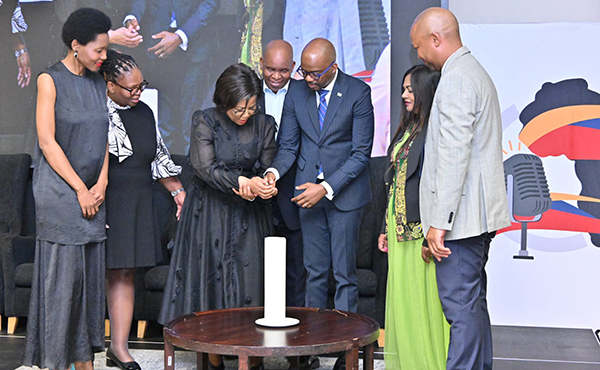
A candlelight moment at the eighth Chief Albert Luthuli Founders' Lecture, honouring the legacy of Chief Albert Luthuli and remembering lives lost in the pursuit of justice, dignity and peace.
Advocate Charlie Naidoo, Chairperson of the Luthuli Museum Council, reflected on the symbolism of the flame.
"If we put the lights off in this entire venue, that candlelight will still flicker," she said, connecting the light to Luthuli's enduring legacy.
The moment offered a fitting conclusion to an evening focused on institutions, governance and human dignity.
Luthuli's legacy remains relevant not simply as a historical memory, but as a continuing challenge to institutions and those who lead them: to ensure that knowledge, public resources and authority are used to expand opportunity, protect dignity and serve the common good.
The enduring question emerging from the eighth Chief Albert Luthuli Founders' Lecture may therefore be less about what institutions are designed to do than what they enable people to become.
*By Lesego Chiloane, Journalist, Department of Institutional Advancement
Photography: Shooheima Champion, Multimedia Centre
Publish date: 2026-09-29 00:00:00.0

 From academic setbacks to master's distinction: Unisa graduate's journey of resilience
 Ethiopian doctoral graduates highlight Unisa's growing impact across Africa
 Unisa SBL calls for shift from building houses to creating sustainable communities
 From law graduate to student leader: Tshegofatso Mmope's commitment to justice and empowerment
 Unisa Western Cape honours retirees and celebrates their enduring legacy