


This is where Ngoepe’s journey with the merged Unisa started. He is pictured at his investiture as chancellor with Prof. Louis Molamu (former Registrar of Unisa). After more than 100 years of existence, the journey of transformation of Unisa finally began and Ngoepe became the first black chancellor of the university.
“Over the many years as Chancellor of Unisa I have learnt so much. In fact, at every graduation ceremony I’ve seen the elderly graduating alongside our youth, I’ve seen people with serious physical challenges receiving their degrees and I’ve also seen students from poor backgrounds graduating alongside those from privileged backgrounds. This is the Unisa I know and the Unisa I hope will continue to exist,” said Judge Bernard Makgabo Ngoepe. At the end of this year Ngoepe will hang up his Unisa robes and drive down Preller Street for the last time as Chancellor of this university. We knew this was the most fitting time to sit down with Ngoepe and hear about his journey, as well as thoughts for a true transformation to be realised across higher education and South Africa.
At the heart of Unisa are students, so seeing thousands of graduates, over the years, proudly walk over to him in their graduation gowns, will always remain etched in his memory. For Ngoepe, nothing has been more humbling during his time at Unisa than being part of graduation ceremonies. “Every single student looks me in the face as I confer their degree and I get to observe everything about them. In a way they look for affirmation, and for me, well it gives me such hope. I love attending graduation ceremonies because each time I leave the hall that night, I leave with hope. I leave knowing that the future is going to be great with so many degrees that we confer on people. It’s an affirmation that we are going somewhere and that we produce people with knowledge and skills which will have a positive impact on the future of our country,” he said with pride.
It’s at graduation ceremonies that Ngoepe is often awestruck by the diversity Unisa represents. “Whenever I confer degrees on individuals I always marvel at how creative God or nature is. I’ve never seen one single face looking like the other. There is just no shortage of creativity. I’ve seen thousands and thousands of faces over the years but God, or nature, has never said, ‘sorry I’ve run out of ideas, we have to repeat this one’,” Ngoepe said, throwing his head back in laugher. He said that this platform has given him the chance to appreciate the diversity Unisa cultivates which is reflective of each student’s skills, dreams and even limitations. “It’s a beautiful thing to be part of,” he said with a smile.
There are many great aspects Ngoepe believes is worth mentioning when it comes to his role as chancellor. A highlight that stands out is Unisa’s successful merger, especially at a time when anxiety of staff was quite high. He recalled how staff expressed fears of losing their jobs, and questions of the lifespan of the institution, as well as upholding the high academic standards it was known for, came to the fore. “It was not an easy period because anything could have gone wrong. Fortunately things went well and here we are at the term where I’m leaving with a very strong institution in place.”
A recent turning point is the ‘fees must fall’ movement, which Ngoepe believes does have some positive benefits. “It has alerted us, as a nation, not just Unisa, to the need to make sure that tertiary education is accessible to many people, including the poor,” he pointed out. However he certainly doesn’t support the violence and destruction that accompanied this cause. “That was, and still is, very sad. It certainly was one of those very dark moments in the history of all higher education intuitions and our country as a whole,” he said. As Ngoepe leaves Unisa, he hopes there will not be any further violence at campuses, while at the same time he applauds the efforts being made for a more accessible tertiary education.
Further, in view of the ‘fees must fall’ movement, Ngoepe is cognisant of the country’s fear of a decline in fees resulting in a decline of academic standards. He believes there is a very serious danger that lack of proper funding at tertiary level will compromise the quality of education in South Africa. “The reality is that quality education does not come cheap. Somebody has to pay for it. Once standards fall, we are going to see a mushrooming of private institutions, with quality education, and into which only the privileged will have access. Private sector will recruit products of those institutions. Where would that leave students from poor backgrounds and the defunct ‘free’ or ‘cheap’ universities? Are we failing to learn from the current school situation,” he questioned?
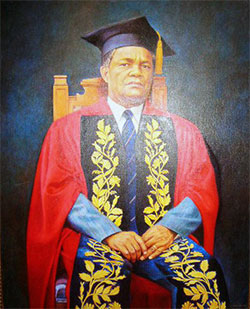
Unisa’s Senate Hall, with its décor in warm golden shades makes it an elegant venue that houses portraits of all Unisa principals and vice-chancellors that have served this esteemed university. The deeper, more regal ZK Matthews Great Hall foyer houses portraits of Unisa’s chancellors. This is where you will find this portrait of Ngoepe, the fist chancellor of the merged university.
Given the current turbulence in higher education, we asked Ngoepe whether Unisa’s drive for institutional culture change is moving at a sufficient pace, or can more be done? “From a certain period of time, particularly since the 80’s, Unisa started to undergo some institutional culture. Remember we came from a period when different racial groups could not graduate at the same ceremony, and posts were occupied by white males. Black academics were described as technical assistants. Today, there are many women academic staff members and the racial composition, even right at the top, has blacks. The former and current Principals and Vice-Chancellors of Unisa are black,” he explained.
As a black individual himself, Ngoepe’s personal experience as he gained success in his career, did come with many challenges. At the peak of his career, Ngoepe was suddenly part of a dramatically transforming country. So how did he overcome prejudice, especially being one of very few black advocates during that time? He explained that it was not easy, given the kind of treatment blacks had to endure. “But the desire to work towards a common and better South Africa for all was, and remains the driving force,” he said.
Speaking of prejudice he recalls an incident he will never forget during his time as an advocate: “I was defending one of the political activists and we were sitting in court on that day. There was a witness speaking in Afrikaans and very softly. I complained to the judge who was hearing the case that the witness was speaking too softly. And the judge simply said, ‘Well the court can hear the witness’ and ordered the witness to proceed.” Ngoepe said that, sadly, this was the kind of prejudice black practitioners had to undergo in the past.
Having grown up in a village where so many children dropped out of school, Ngoepe knows he could easily have been one of them. To a very large extent, this remains the case in South Africa. So, does he perhaps see any imminent solutions on the horizon? “I do. This is tied to the question of resources and improved conditions under which people live. It can be quite a vicious cycle because while you need education to get out of the trap of poverty, you need the means to keep your child at school, for the child to study further at tertiary level. I don’t know if the solutions are imminent but they are obvious—provide quality education and use resources properly. I am not impressed with the quality of education provided at our schools, especially public schools. I know I’m not alone in this view.”
As a celebrated legal mind Ngoepe could, no doubt, have enjoyed a stellar career in private practice. So what then drew him to public service? “It will be recalled that I was one of the team of eight lawyers who helped with drafting of the Interim Constitution for CODESA. Once the new dispensation set in, one was asked to avail oneself to help make that dispensation a reality. This was also why one served in so many different capacities. It was hard to say no. Bear in mind that there were, for historical reasons, very few black lawyers at the time,” he explained.
There is no doubt that the higher education sector needs leaders who are committed to the future of South Africa. As Ngoepe passes on the baton to Unisa’s next chancellor, he has some solid advice to share: “Be interested in the affairs of the university, obviously within limits as the mere titular head. Unisa is big institution and has many activities so it always rewarding to attend as many as possible. In this way you will be part of the university community, understand its objectives, hopes and even fears or concerns. Conferring degrees, being the chancellor’s primary function, is a huge and fulfilling part of this role, which requires you to attend as many graduation ceremonies as possible. When I came in I asked that chancellor’s addresses not be too long at graduations. I hope this remains because our graduates’ minds are on the conferment of their degrees and they want to go home and celebrate.”
When it comes to the success and future of Unisa, Ngoepe’s wish is that it continues to maintain the high academic standard it is renowned for. He also hopes the university will continue to produce genuine and informed intellectuals who have the courage to express their views and convictions, irrespective of circumstances. “This is because our process of building a democratic South Africa is still ongoing, and when things go wrong, as sometimes they do, we look to quality intellectuals to give direction, not only by word of mouth but also through research as well. This university has produced a large number of distinguished leaders and I hope it will continue to do so,” he affirmed.
*Interview and article by Kirosha Naicker
Publish date: 2016-12-07 00:00:00.0
 Unisa alumna is shaping the future of business and market development
 Unisa's Disability-Inclusive Student Support Workshops go from strength to strength
 Developing agile graduates for the changing world of work
 Unisa Innovation Challenge alumnus drives sanitation innovation in Namibia
 Seeing beyond the horizon: Unisa shapes tomorrow as it expands its research outputs significantly