

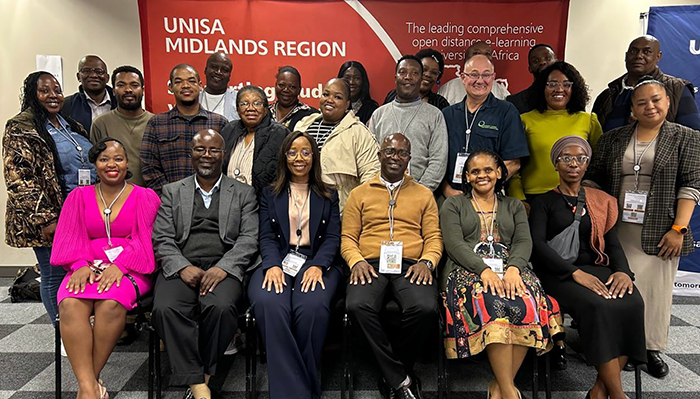
Unisa staff and stakeholder representatives
The Unisa Midlands Region hosted a successful stakeholder engagement session on 21 April 2026 at the Bloemfontein Regional Service Centre. Held under the theme "Strengthening strategic partnerships through dialogue", the event provided the region with an opportunity to explore new possibilities and to foster sustainable, strategic partnerships with stakeholders from both the public and private sectors.
In his opening remarks, Mbodi Khorombi, Acting Deputy Director: Academic and Technology Support (ATS), noted that the country is facing various economic and societal challenges. At the same time, industries continue to experience a shortage of critical skills. "Through this engagement, we pursue interconnected goals, including student placement opportunities, qualifications that are relevant to the labour market, and structured and sustainable partnerships. Strengthening strategic partnerships through dialogue should not just be a slogan, but a call to action," he said.
Khorombi emphasised the rapid pace of digital transformation, the transition to a green economy and shifting manufacturing practices, all of which are changing the skills landscape faster than traditional curricula can respond. He further stated that while partnerships may be easy to establish, they are difficult to sustain, requiring trust and honesty to build long-lasting relationships. He also called on industry stakeholders to create opportunities for work-integrated learning (WIL) and funding support mechanisms for Unisa students.
Sharing an institutional and regional overview, Acting Director of the Midlands Region, Angie Bopape, began by reaffirming Unisa’s vision as the African university shaping futures in the service of humanity. She indicated that the university has been mandated to make quality education accessible, underpinned by the principle of access to success.
Bopape outlined Unisa’s strategic focus areas, including technology-mediated teaching and learning, research outputs, engaged scholarship, student support, enrolment management, co-curricular activities, and initiatives to maximise income resources and strategic partnerships. She emphasised that the institution’s future outlook centres on enhancing scholarly work and strengthening strategic partnerships with stakeholders and industries to respond effectively to societal needs. "We are looking to build and maintain sustainable strategic relationships in the Free State and to become impactful and visible in the province and surrounding communities," she said. She added that the region is aligning its work with global, continental, regional, national and institutional frameworks to ensure relevance.
Bopape highlighted the importance of building towards clearly defined outcomes through the interaction and input of multiple stakeholders. She noted that partnerships across sectors can collectively create contextual relevance, scale initiatives and impact, build sustainable solutions, accelerate innovation and creativity, leverage existing sources and expertise, and strengthen relationships.
Bopape also outlined the 10 catalytic niche areas identified by Unisa’s Vice-Chancellor, Prof Puleng LenkaBula, to advance the university’s academic agenda and enhance academics' roles as engaged scholars responding to societal needs. The areas are
She called on stakeholders to collaborate in sectors aligned with these areas to ensure greater impact and accessibility within communities. "We will align with purpose, discipline and strategic intent, and can no longer work in silos; we need to partner," she concluded.
Candidate legal practitioner Sipho Matshie from the Unisa Law Clinic in the College of Law explained that the college’s model of open distance e-learning has made legal education accessible to students from diverse geographic and socio-economic backgrounds. He noted that the college is committed not only to promoting academic excellence but also to advancing social justice, constitutional values and community development. Its work reflects a deliberate effort to ensure that legal education remains relevant to the realities of the communities it serves. The college’s community engagement projects actively integrate teaching, research and service to promote access to justice and social transformation, particularly for marginalised and previously disadvantaged individuals.
Matshie added that the Unisa Law Clinic provides legal services to indigent and vulnerable communities, advancing access to justice while also serving as a training ground for LLB graduates and candidate legal practitioners by equipping them with practical skills and professional responsibility. In addition, the clinic has developed inclusive community engagement initiatives that extend to remote areas, where students participate and gain valuable legal experience.
He further stated that partnerships can create opportunities to initiate joint outreach programmes, expand access to legal services, and establish structured, practical training for students. Such collaborations can also enhance experiential learning by providing students with meaningful exposure to the legal profession. Emphasising the broader impact of legal education, he noted that it can shape lives and communities. "We need to deepen engagement and build partnerships that are inclusive, responsive and sustainable," he said.
Prof Sogolo Lebelo, Director of the School of Agriculture and Life Sciences, provided an overview of the College of Agriculture and Environmental Sciences, including the qualifications offered, recognition of prior learning (RPL), short learning programmes (SLPs) and the benefits of collaboration. He reiterated Unisa’s mandate in research and innovation, teaching and learning, and community engagement. "There is a need to collaborate as we try to resolve societal challenges. We cannot do it alone; we need to partner with industries, government sectors, institutions and communities," he said.
The region has already signed a memorandum of understanding with Maluti TVET College and the Free State Department of Sport, Arts, Culture and Recreation. Anri Claasen, Assistant Director: Partnerships and Linkages at Maluti TVET College, and Nelisiwe Nodada, Director: Free State Provincial Library Services, delivered presentations reflecting on the successes and benefits of collaborating with Unisa.
Representatives from various industries and organisations were also given the opportunity to outline their work, with many emphasising the urgent need for collaboration across sectors and institutions to create meaningful spaces for knowledge sharing that can be strategically refined and implemented for the benefit of students and communities.
Stakeholders toured the regional service centre to explore its facilities and the range of services offered.
* By Thotogelo Masenya, Communication and Marketing Officer: Midlands Region
Publish date: 2026-05-14 00:00:00.0
 Midlands Region strengthens strategic partnerships through dialogue
 From silos to synergy: strengthening research through catalytic niche areas
 Unisa announces SRC election results, inaugurates Tshwane and Johannesburg leadership
 Transitioning programme to bolster Unisa's academic ranks
 Unisa strengthens its alliance with those who served in the service of humanity