


Nombulelo Sesi Nxesi, former Chief Executive Officer of the Education, Training and Development Practices Sector Education and Training Authority (ETDP SETA)
One of the highlights of the recent Principal and Vice‑Chancellor’s Lekgotla was a thought-provoking panel discussion held on the first day, which probed a central question around the role of universities in society today and in the future.
The discussion brought together senior leaders from the skills development sector, including Nombulelo Sesi Nxesi, former Chief Executive Officer of the Education, Training and Development Practices Sector Education and Training Authority (ETDP SETA), and Dr Khathutshelo Innocent Sirovha, Chief Executive Officer of the Agricultural Sector Education and Training Authority (AgriSETA).
Their reflections echoed many of the themes raised during the opening sessions of the Lekgotla, particularly the growing execution gap between institutional strategies and students' lived realities, and the pressing need for more substantial alignment among higher education, industry and society.
The recurring message throughout the discussion was that universities should not merely respond to change but actively shape it. The panellists emphasised that the future is not something that simply "happens" to institutions. Instead, it is something that must be intentionally imagined, designed and built.
Though universities frequently discuss the future and plan for it, Nxesi cautioned that aspiration without action risks becoming mere rhetoric. The world, she noted, "has changed irreversibly, yet higher education institutions often find themselves lagging behind these transformations". Nxesi said we are no longer operating in stable or predictable environments, and universities must contend with rapid technological disruption that shifts labour markets and poses profound social challenges.
She further described distance and online learning as contested and complex spaces. "Technology, while offering unprecedented opportunities, also raises new ethical, pedagogical and governance questions," she explained. "Artificial intelligence is reshaping how knowledge is produced, accessed and applied, even as many institutions continue to grapple with its implications."
Nxesi also argued that higher education is not about institutional survival, but about relevance. "A university that will define the next era of education will not necessarily be the largest, but it will be intentional, adaptive and aligned," she said. Nxesi continued to say that this requires the careful integration of technology with pedagogy, leadership with accountability and innovation with purpose.
"Technology," said Nxesi, "should not be treated as a peripheral support function. It represents a new architecture of learning. Simply providing digital platforms is insufficient without active facilitation, redesigned teaching approaches and meaningful student engagement. Used responsibly, technology can enhance learning and deepen understanding, but it cannot replace sound pedagogy."
Nxesi continued: "One of the most pressing concerns raised was graduate unemployment. Historically, higher education was seen as a pathway to opportunity, economic mobility and social advancement. Today, however, many graduates struggle to find meaningful work, raising difficult questions about curriculum relevance, skills alignment and institutional accountability."
She challenged universities to reflect critically on their role in producing employable, adaptable and ethically grounded graduates. In addition, she emphasised that education must respond to labour market realities while also cultivating critical thinking, entrepreneurship and the ability to transfer skills across contexts.
She advised: "Partnerships with industry, professional bodies and public institutions were highlighted as essential. Memoranda of understanding and collaborative agreements must move beyond formality to become active mechanisms for work-integrated learning, skills development and economic participation."
Theory without practice, the panellists cautioned, risks leaving graduates ill-prepared for complex professional environments.
Beyond employability, the discussion underscored the university’s broader social responsibility. Education, Nxesi argued, "does not begin at the higher education level. Communities are where value systems are formed, and where many of society’s deepest challenges, including crime, inequality and illiteracy, take root."
She further said universities therefore have a critical role to play in community development through impactful, sustained interventions. "Work-integrated learning and community-engaged scholarship should be systematic rather than peripheral, reinforcing the idea that higher education must serve the public good," said Nxesi.
During her discussion, Nxesi said the future of universities requires a different conception of leadership. "Leadership is not merely positional or confined to executive roles; it is collective and shared," she said. "In an era marked by governance challenges, corruption and institutional pressure, universities need adaptive leaders who are data‑literate, ethically grounded and capable of balancing autonomy with accountability."
Institutional sustainability, she argued, is strategic rather than administrative. It demands foresight, resilience and a shared commitment to the institution’s mission.
At a deeper level, the discussion returned to a perennial question faced by public universities worldwide: Why do universities exist, and how do they create public value?
"In a world where knowledge is widely accessible," Nxesi said, "the value of universities no longer lies in storing information, but in developing critical thinkers, ethical leaders and socially responsive citizens. Research, too, must be solution-oriented, addressing not only local challenges but also continental and global issues, and preparing graduates for forms of work that do not yet exist."
The Vice‑Chancellor’s reference to catalytic niche areas was highlighted as an example of forward-thinking institutional strategy, signalling a commitment to innovation, relevance and future-focused development.
In his presentation, Sirovha delivered a message of affirmation and confidence, noting that producing close to 400 000 students positions Unisa at the vanguard of knowledge in higher education on the continent. "With more than 600 accredited qualifications and measurable institutional improvements, the university community must acknowledge and own its achievements," he said.
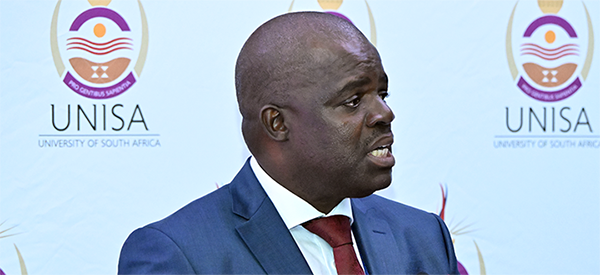
Dr Khathutshelo Innocent Sirovha, Chief Executive Officer of the Agricultural Sector Education and Training Authority (AgriSETA)
He also encouraged communicators to tell the Unisa story more boldly and consistently, observing that excellence often attracts scrutiny. "You need to reaffirm strong government support for the Vice‑Chancellor’s leadership," said Sirovha. His message was clear: Unisa is succeeding, and the institution's leadership must move forward with unity and confidence.
The panel discussion concluded with robust audience engagement, reinforcing the urgency and relevance of the issues raised. Collectively, the reflections underscored a shared understanding that the future of higher education will be shaped by intentional action, societal relevance and a renewed commitment to the public good.
* By Lesego Chiloane, Journalist, Department of Institutional Advancement
** Photography by Shooheima Champion, Multimedia Centre
Publish date: 2026-02-26 00:00:00.0
 Thought leader in research recognised for excellence
 Unisa hosts successful Library Week public lecture
 Unisa PhD candidate appointed to the FASSET Board
 Unisa connects academia and industry at career day
 Unisa pays tribute to iconic civil rights activist