

The largest provider of business education in Africa and one of the largest in the world

Speakers (from left): Dr Lebogang Morodi (Director, School of Criminal Justice, College of Law, Unisa), Deane Nkuna (Group Executive: Information and Communication Technology ARMSCOR), Lieutenant General Wiseman Simo Mbambo (Chief of the South African Air Force), Prof James Chibueze (Professor of Mathematical Sciences, College of Science, Engineering and Technology, Unisa) and Dr Moses Khanyile (Director of the Centre for Military Studies and Defence Artificial Intelligence Research Unit, Faculty of Military Science, Stellenbosch University)
Unisa is hosting its Digital Technology Conference at the Council for Scientific and Industrial Research (CSIR) Convention Centre in Tshwane from 24 to 26 February 2026.
The three-day conference brings together global experts, academics, entrepreneurs, policymakers and students under the theme "Harnessing inclusive and transformative technologies for sustainable development".
Organised by Unisa’s College of Law (CLAW) and College of Economic and Management Sciences (CEMS), in collaboration with the South African National Defence Force (SANDF), CSIR, Telkom and Adapt IT, the conference seeks to explore cutting-edge digital trends and their role in advancing sustainable growth across sectors including the economy, finance, law, health, media and communications.
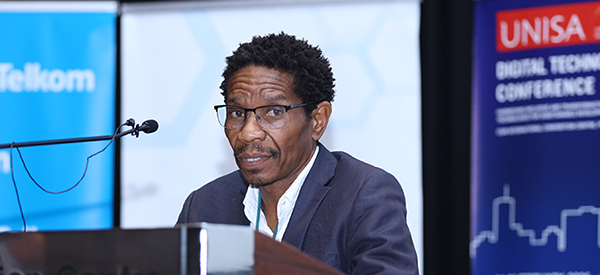
Dr Lebogang Morodi delivering the welcome address
The conference was officially opened by Professor Mpfariseni Budeli Makonde, Executive Dean of the College of Law at the University of South Africa. In her address, she highlighted the importance of digital transformation in shaping Africa’s future and emphasised the need for inclusive, ethical and sustainable technological innovation.
The opening sessions reflected on the rapid evolution of the digital revolution, from its origins in the 1960s to the present-day Fourth Industrial Revolution (4IR), characterised by the convergence of physical, biological and technological systems.
Speakers examined the concept of cyberspace as defined in South Africa’s National Cybersecurity Policy Framework (2015), describing it as both a physical and non-physical terrain composed of computer systems, networks, programs, data and users. Discussions emphasised that digital spaces are shaped not only by technology but also by social realities and lived experiences.

Some of the conference attendees and speakers
Africa’s expanding digital footprint also featured in the dialogue, with recent statistics indicating significant internet growth across the continent, positioning digital transformation as both an opportunity and a governance imperative.
A major point of discussion was the African Digital Compact (2024), adopted by the African Union as the continent’s common position on digital transformation. Anchored in Agenda 2063 and the AU Digital Transformation Strategy, the Compact seeks to harness digital technologies to drive sustainable development, bridge digital divides, safeguard digital rights and foster inclusive innovation across Africa.
Central to the first day’s deliberations was the need to create a strong, enabling environment for digital transformation.
Prof Sebo Tladi, an Associate Professor in the Department of Mercantile Law at the university, underscored the responsibility of governments to shape digital ecosystems. "Governments have a responsibility to create an enabling environment with policies and regulations that promote digital transformation," said Tladi. "Political commitment at the highest level, ensuring stability and predictability of the policy environment, promoting a sustainable environment for the private sector to invest, adopting regulatory best practice and stimulating demand for digital solutions are all part of the enabling environment."
He further emphasised that public policy, legal and regulatory frameworks must be up to date, flexible, incentive-based and market-driven to support digital transformation across sectors and regions, particularly in addressing cross-cutting themes and emerging technologies. The conference features distinguished keynote speakers, including Prof Uchenna J. Orji, Principal Investigator at the African Institute for Cybersecurity and Tele-Informatics Governance and Professor at the American University of Nigeria, and Prof Pumela Msweli, Executive Leadership Consultant.
The conference programme also includes contributions from leading scholars and experts such as Prof James Chibueze (Unisa), Yusuph Kileo (Tanzanian cybersecurity and digital forensics expert), Prof Godwell Nhamo (Unisa), Phila Sibandze (University of Fort Hare), Prof Nomfundo Mthembu (University of KwaZulu-Natal), Prof Patricia Lindelwa Makoni (University of the Witwatersrand) and Dr Moses B. Khanyile (Centre for Military Studies).
Over the course of the programme, delegates will participate in keynote addresses, panel discussions and workshops designed to foster interdisciplinary collaboration, showcase innovative research and facilitate the sharing of knowledge and best practices.
The Digital Technology Conference continues until 26 February 2026, reinforcing Unisa’s commitment to thought leadership, digital governance and inclusive technological advancement in South Africa and across the African continent.
* By Tebogo Mahlaela, Communication and Marketing Specialist, College of Economic and Management Sciences
Publish date: 2026-02-26 00:00:00.0

 Unisa women leaders challenge the meaning of power, equity and legacy
 Unisa puts staff wellness in focus with 4km Health and Wellness walk
 Unisa research unit urges turning agrifood waste into new economic opportunities
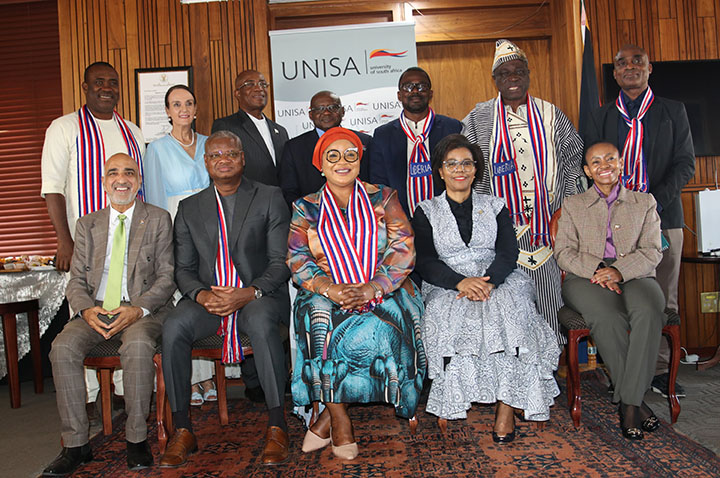 Liberia turns to Unisa for expertise in building Peace and Reconciliation Memorial Museum
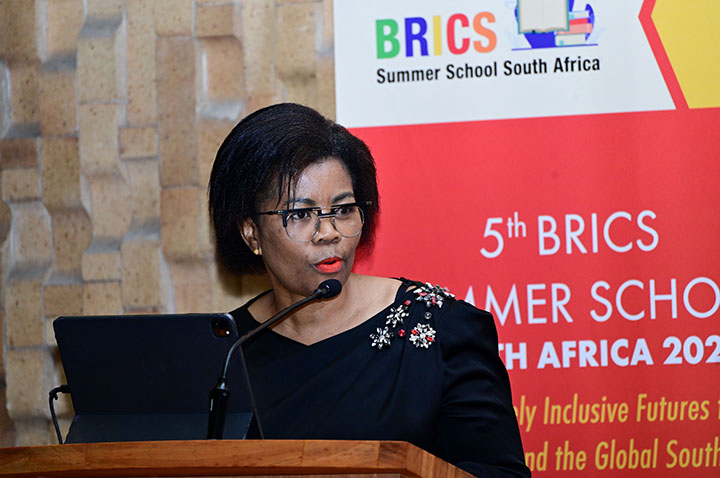 Unisa calls for stronger youth voice in shaping BRICS and global governance