

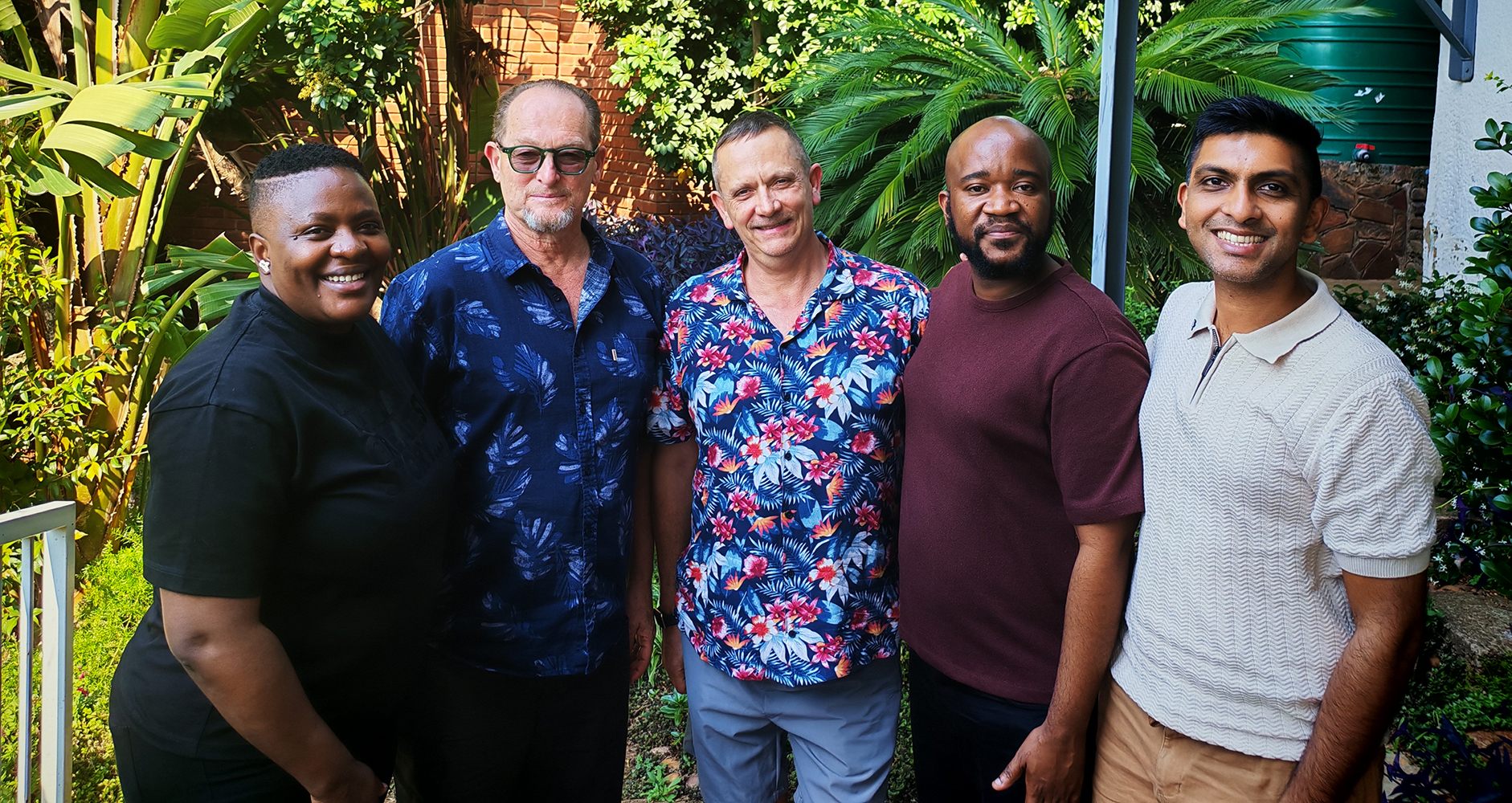
Members of the African LGBTQIA+ Human Rights Project at their strategic research retreat in Pretoria on 16 October 2026. From left: Thembi Dlamini, a clinical psychologist who graduated cum laude with a Master of Arts in Clinical Psychology from Unisa; Prof Juan Nel, an NRF B-rated researcher in Unisa's Department of Psychology; Dr Niel Victor, a clinical psychologist in private practice in Cape Town; Sakhile Msweli, a clinical psychologist at Ngwelezana Hospital in Empangeni; and Suntosh Pillay, a Durban-based clinical psychologist and researcher.
Research has the greatest potential to transform society when its findings move beyond academic publications and become practical solutions that improve people's lives.
This principle was at the centre of a strategic research retreat held by the African LGBTQIA+ Human Rights Project in Muckleneuk, Pretoria. The retreat brought together researchers and practitioners to explore how established research, affirmative practice guidelines and human rights resources could be developed into accessible and sustainable interventions that support LGBTQIA+ people across Africa. Hosted at the residence of Unisa's Prof Juan Nel, the gathering focused on strengthening the project's impact through innovation, collaboration and potential funding opportunities.
Nel is a distinguished professor under Unisa's Office of Graduate Studies and Research and is based in the Department of Psychology in the College of Human Sciences (CHS). The discussions reflected a growing recognition that research addressing discrimination, healthcare inequalities and social exclusion must also consider how its findings can be translated into resources that communities, healthcare professionals, educators and policymakers can use. Operating under the Sexuality and Gender Division of the Psychological Society of South Africa (PsySSA), the African LGBTQIA+ Human Rights Project brings together expertise in psychology, sexuality, gender and human rights.
The project has strong links with Unisa through Nel and other current or former university affiliates, although not all collaborators are affiliated with the institution. Its work includes the development of affirmative practice guidelines designed to help healthcare professionals provide informed, respectful and appropriate services to lesbian, gay, bisexual, transgender, queer, intersex and other sexually and gender-diverse people. These resources seek to strengthen professional competence while promoting dignity, equality and access to healthcare. The project's contribution received international recognition in 2025 when it was honoured with a human rights award from the International Council of Psychologists (ICP).
The recognition provides an opportunity to extend the reach of its work and explore how existing research can inform practical interventions in healthcare, education and human rights advocacy. For Nel, the challenge is to ensure that the knowledge generated through research becomes increasingly accessible and useful to the people and communities it is intended to benefit. This requires approaches that recognise the different social, cultural and institutional environments in which LGBTQIA+ people live.
Prof Marcia Mkansi
A central discussion at the retreat challenged the perception that innovation is confined to advanced technology, engineering or scientific inventions. Prof Marcia Mkansi, a full professor in Unisa's College of Economic and Management Sciences, shared insights into research funding, innovation, intellectual property and the process of translating knowledge into practical solutions. "Innovation simply means doing things differently," she explained. Her message encouraged participants to consider how established research could be adapted into new resources, services or interventions that respond to identifiable problems.
For a project working in psychology and human rights, innovation could include educational materials, digital platforms, interactive learning tools, applications or behaviour-change interventions. Such resources could help healthcare providers strengthen affirmative practices, support educators in addressing discrimination or improve public understanding of LGBTQIA+ experiences. However, Mkansi emphasised that innovation should begin with a clearly defined problem rather than a predetermined technological solution.
Researchers should first examine the challenges experienced by intended users, assess existing responses and identify gaps before deciding which interventions are most appropriate. The discussions included examples such as adapting African-language riddles into interactive educational resources and developing digital tools that explain discrimination and inequality. These examples demonstrated how innovation can draw on social sciences, cultural knowledge and community experiences rather than relying exclusively on sophisticated technology. The retreat also examined an important distinction between conventional research proposals and proposals seeking support for innovation.
While research proposals typically focus on generating new knowledge, innovation proposals must demonstrate how existing knowledge can be translated into a practical response to an identified problem. "Don’t pitch it as research," Mkansi advised when discussing how researchers should position innovation proposals. She encouraged participants to explain the problem they intend to address, identify limitations in existing approaches and demonstrate how a proposed solution would offer something different. A strong innovation proposal should also establish who would benefit, how the intervention could be developed and what would be required to sustain it. For the African LGBTQIA+ Human Rights Project, this could involve identifying specific challenges in healthcare provision, education or community awareness and assessing whether existing research resources could be adapted to address them.
Such an approach would allow the project to build on its established research foundation while exploring opportunities for wider application. Mkansi also highlighted the importance of constructive criticism in strengthening proposals and indicated that she could potentially provide advisory input, subject to her other commitments. The project's work is particularly significant because it seeks to understand sexuality, gender and human rights within African social and cultural contexts. Its approach draws on feminist, womanist and bosadi perspectives, which recognise the importance of African knowledge systems, lived experiences, relationships, care and social transformation. These intellectual traditions provide opportunities to examine how gender, power, inequality and identity are understood and experienced within African communities.
They also encourage researchers to question approaches that may not adequately reflect local realities. This work has clear relevance to Unisa's Catalytic Niche Areas of Health /Pharmaceutical Studies and Feminist, Womanist, Bosadi Theorisations. The health dimension concerns access to informed, inclusive and appropriate healthcare, while the gender-focused dimension supports research that engages critically with inequality, identity and African-centred approaches to knowledge production. By bringing these perspectives together, the project demonstrates how psychological research and human rights scholarship can contribute to more responsive healthcare practices and socially relevant interventions.
The emphasis on African-led knowledge production also supports the African Union's Agenda 2063 vision of an inclusive continent that values human dignity, cultural identity and the contributions of all its people. Another priority was identifying possible partnerships and financial support that could enable the project to develop and implement new interventions. The discussion considered how changes in the international funding environment could affect research collaboration, grant eligibility and institutional arrangements. Participants explored potential opportunities through Unisa's innovation-support structures and the Technology Innovation Agency (TIA). These were identified as possible avenues for further investigation rather than confirmed sources of funding. The retreat also highlighted the importance of multidisciplinary collaboration.
Researchers with expertise in psychology, gender and human rights could work alongside specialists in technology, design, education or product development to create resources that respond to specific community needs. However, successful collaboration would require clarity about responsibilities, institutional contributions, financial arrangements and the intended beneficiaries. Nel emphasised the importance of bringing different forms of expertise together while remaining attentive to whose knowledge informs an intervention and how communities participate in shaping its outcomes. This approach is particularly important when developing resources intended for populations whose experiences and needs may not always be adequately represented in mainstream institutional systems.
As the project considers potential innovations, questions surrounding intellectual property will also require attention. Mkansi encouraged researchers to seek guidance from relevant technology transfer or intellectual property offices when ideas demonstrate potential for further development. Such engagement can help clarify ownership, inventorship, confidentiality, licensing arrangements and institutional responsibilities. It is also important to distinguish between intellectual property that existed before a collaboration and new intellectual property generated through joint work. These considerations become particularly relevant when projects involve multiple institutions, funding partners or technical specialists. Addressing them early can reduce uncertainty and establish a clearer foundation for future development. The discussions reinforced that research teams should consult applicable institutional policies and obtain appropriate guidance rather than assume that intellectual property rights or potential benefits will be allocated automatically.
The project's objectives extend beyond academic research and connect with broader priorities concerning health, equality and social inclusion. Its focus on affirmative healthcare practices is relevant to Sustainable Development Goal (SDG) 3, which promotes health and well-being, particularly through efforts to improve access to appropriate and responsive services. Its work addressing discrimination and exclusion also relates to SDG 10, which seeks to reduce inequalities, and SDG 5, which promotes gender equality. These connections are especially important where social stigma, discrimination or inadequate professional knowledge may create barriers to healthcare and other essential services. In South Africa, the project's emphasis on inclusive services and human development resonates with the National Development Plan 2030's broader objectives of improving healthcare, reducing inequality and building a more inclusive society.
For Unisa, the participation of its academics in such research reflects the importance of engaged scholarship that responds to social challenges and contributes knowledge capable of informing professional practice and public policy. The project's potential contribution to sustainability lies in developing resources and interventions that can remain accessible, relevant and useful beyond individual research activities or short-term funding cycles. The retreat concluded with a clearer focus on the steps that could help the African LGBTQIA+ Human Rights Project extend the practical reach of its work. Possible next steps include identifying priority problems, evaluating potential interventions, examining funding requirements and seeking guidance on intellectual property and institutional arrangements.
The project also intends to explore opportunities to adapt its existing affirmative practice guidelines and research resources for use by healthcare professionals, educators, communities and policymakers. Any future interventions would need to remain responsive to the diverse experiences of LGBTQIA+ people across Africa, with attention to local contexts and the needs of intended users. The project's international recognition provides a foundation from which to strengthen its visibility, but the retreat emphasised that lasting impact will depend on how effectively its research can be translated into practical applications. Ultimately, the gathering reinforced an important principle: research should not end with the publication of findings. By exploring innovation, collaboration and sustainable approaches to knowledge sharing, the African LGBTQIA+ Human Rights Project is seeking ways to ensure that established scholarship contributes more directly to dignity, inclusion, affirmative healthcare and social change.
* By Lesego Chiloane, Journalist, Department of Institutional Advancement
Publish date: 2026/10/23

 Reclaiming African heritage through geographical names
 From research to real-world impact: Unisa-linked project explores new ways to advance LGBTQIA+ rights
 Unisa hackathon winners develop AI solution to support students at risk of falling behind
 Beyond Black Wednesday: Unisa lecture calls for urgent action to protect media freedom and public broadcasting
 Unisa celebrates 25 new PhD graduates advancing research and innovation