

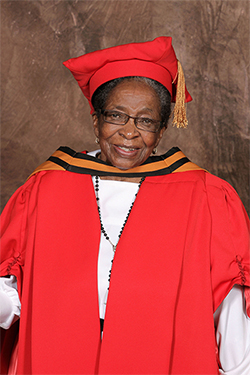
 Unisa is saddened by the death of the prominent trade unionist and activist, Emma Mashinini. Mashinini, who passed away on Monday at the age of 87, received an Honorary Doctorate of Literature and Philosophy from the university on 27 September 2012 for her contribution to fighting for equality.
Emma Thandi Mashinini, or the “Tiny Giant” as she is fondly referred to, is rightly recognised as the doyenne of the trade union movement in South Africa. She was born in Rosettenville, Johannesburg, in 1929 and attended the Bantu Secondary School in Sophiatown. At the age of 14, Mashinini was forced to drop out of school and go to work due to domestic circumstances. In 1956, she took on a full-time job working in the Henochsberg’s clothing factory and there joined the Garment Workers’ Union (GWU) – a union for black workers that was registered and affiliated to the Trade Union Council of South Africa (TUCSA).
At the clothing factory, she started to become aware of the injustices that surrounded her. She was elected shop steward by her co-workers in 1970 and was later appointed floor supervisor by management. In this capacity, she fought to improve the working conditions of the employees. In standing up to a labour system that disadvantaged black women in particular, she achieved one of her greatest victories – the breaking of job reservation at Henochsberg’s. In her position as supervisor, she also secured better working hours, wage increases and the right of workers to have unemployment insurance. Also during her time at Henochsberg’s, she was elected to the national executive committee of the National Union of Clothing Workers (NUCW), the highest body of the GWU.
After the Sharpeville Massacre in 1960, many political organisations were banned and many union leaders were forced to go underground or into exile. Mashinini, though, continued her work, despite the pressures. In 1975, she left Henochsberg’s and took up a position as president of a new union that she had formed, the Commercial, Catering and Allied Workers Union of South Africa (CCAWUSA). Despite a slow start, the union had 1 000 members by 1977 and, within five years, had opened offices in Durban and Cape Town. By this time, CCAWUSA was the second largest union in the country behind the National Union of Mineworkers (NUM). Her biggest task – and her greatest achievement in her position as leader of a union – was her involvement in the formation of the Congress of South African Trade Unions (COSATU).
Mashinini was arrested in November 1981 under Section 6 of the Terrorism Act and spent six months in solitary confinement at Pretoria Central Prison. After her release from prison in May 1982 – against advice to live abroad, but with the unwavering and full support of her loving husband, Tom Mashinini and her daughters Molly, Dudu and Nomsa – she chose to return to and remain in South Africa and to resume her post at CCAWUSA for another four years.
Her unflinching commitment to bettering the lives of her fellow South Africans continued throughout her life. In 1986, she took on the position of head of the Anglican Church’s Department of Justice and Reconciliation, serving under Bishop Desmond Tutu. In this role she dealt closely with the families of detainees who had been incarcerated during the state of emergency. From 1993 to 1995, she served as deputy chairperson of the National Manpower Commission. In the early 1990s, she became president of the Mediation and Conciliation Centre in Johannesburg and, in 1995, was appointed Commissioner for the Restitution of Land Rights. Mashinini was a patron of the Council for the Advancement of the South African Constitution (CASAC) and is also a founder member of both United Cerebral Palsy and of the women’s stokvel “Be United”.
Mashinini’s contribution to labour rights received international recognition from the trade union movement and from other institutions, the British Trade Union (1978) and the Massachusetts House of Representatives (1985) among them. Indeed, 8 March was declared “Emma Mashinini Day” by the Governor of Massachusetts in 1985. Her contribution has also been widely acknowledged in South Africa.
Wife, mother, factory worker, trade unionist, leader and role model. Fearless and unrelenting fighter for equal rights in the workplace. Social justice, human and gender rights activist. Unisa offers its deepest condolences to the family and friends of Emma Thandi Mashinini.
*Compiled by Sharon Farrell
Publish date: 2017-07-12 00:00:00.0
 Unisa alumnus transforms academic excellence into entrepreneurial success
 Leveraging advances in 4IR to foster economic growth
 Unisa alumna is shaping the future of business and market development
 Unisa's Disability-Inclusive Student Support Workshops go from strength to strength
 Developing agile graduates for the changing world of work