

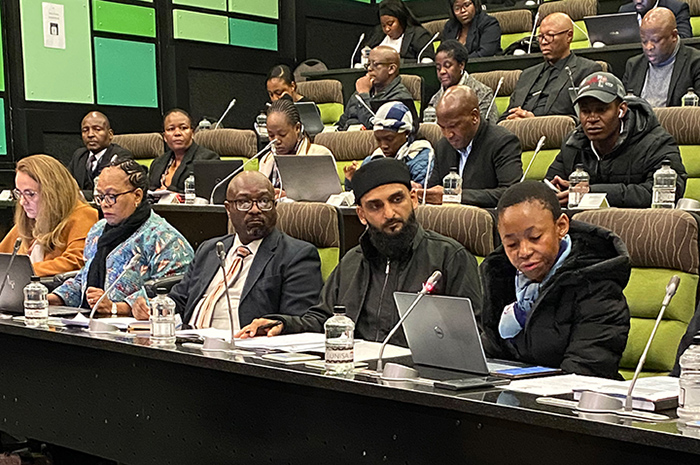
Deputy Minister of Higher Education, Yusuf Cassim (second from right), and acting Unisa Vice-Chancellor, Mathabo Nakene-Mginqi (far right), with representatives from NSFAS and the university’s senior management during deliberations
During a recent oversight visit to Unisa, the Deputy Minister of Higher Education, Yusuf Cassim, called for renewed collaboration between funding bodies and universities to address the financial pressures plaguing the higher education sector. The visit was prompted by concerns raised by some students over the disbursement of National Student Financial Aid Scheme (NSFAS) monies. Cassim emphasised dialogue and joint problem-solving over apportioning blame.
"We are here to listen and tackle the frustrations voiced by students regarding their experiences through existing institutional channels," Cassim said, framing the engagement as a step toward transparent communication and practical solutions.
Unisa’s acting Chief Financial Officer, Liana Joubert, used her presentation to lay out the scale of the financial challenge that the institution is trying to navigate. She indicated that for 2025, Unisa recorded a deficit of R106 million after disbursing more funds to students than it received in revenue.
"This discrepancy will necessitate in-depth scrutiny during audit committees," she said. Looking ahead, she noted that despite receiving R733 million in March 2026, the university disbursed R907 million to ensure students had timely access to learning materials, a decision expected to result in a further R213 million deficit.
Joubert linked much of the pressure to a longstanding policy gap between funding for distance and contact education. Unisa students currently receive an average allowance of R9,000, compared to R48,000 for students at contact universities, with a per-student allowance of R316 that she described as inadequate relative to other social support benchmarks. Rather than assigning fault, she framed this as an opportunity for reform: "We are not blaming NSFAS but are keen to work closely with them to synchronise payments. We can only disburse funds once they are received."
She also praised the university's Student Representative Council for working constructively with management, which allowed students to register for additional modules even when NSFAS support was delayed, an example, she suggested, of what collaboration between stakeholders can achieve. Building on this, she called on the Department of Higher Education and Training to undertake a renewed cost analysis that reflects the growing national and global shift toward distance education, so that funding models better match how students are actually studying.
A representative from NSFAS responded constructively, noting that the funding pressures Unisa faces are not unique to the institution.
"We recognise the challenges but are actively engaging various stakeholders, including student unions and the Treasury, to secure additional funding. Our focus has been to ensure that students receive the support they need," the representative said.
To keep the momentum going, Cassim presented the Acting Vice-Chancellor, Mathabo Nakene-Mginqi, with a compilation of around 100 student complaints gathered through a ministry helpdesk, covering issues such as late personal care allowance payments, unresolved 2025 funds and bursary disbursement delays, requesting a formal response within a reasonable timeframe.
The move was positioned not as a rebuke but as a concrete next step in the collaborative process Cassim and Joubert both called for: turning shared concerns into coordinated action between the ministry, NSFAS and university leadership.
* By Noxolo Miya and Sipho Jack, Journalists, Department of Institutional Advancement
Publish date: 2026-07-10 00:00:00.0
 Deputy Minister calls for collaboration to resolve NSFAS challenges
 Unisa golf challenge drives student success
 Breaking barriers through leadership and academic excellence
 50 years and beyond
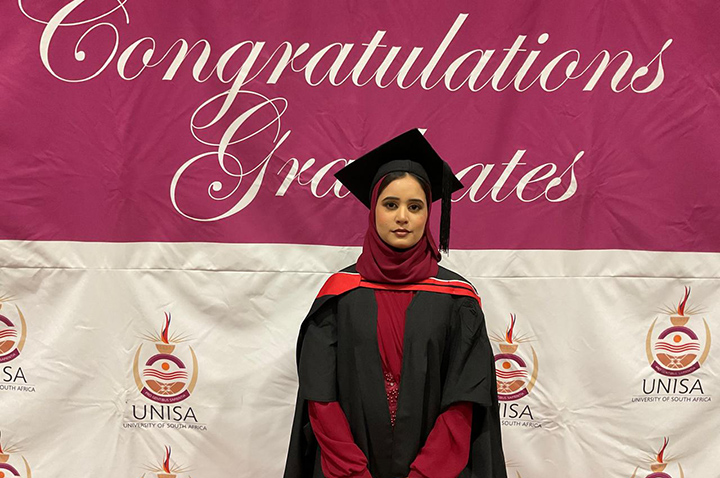 Inspirational Unisa student graduates cum laude with LLB